

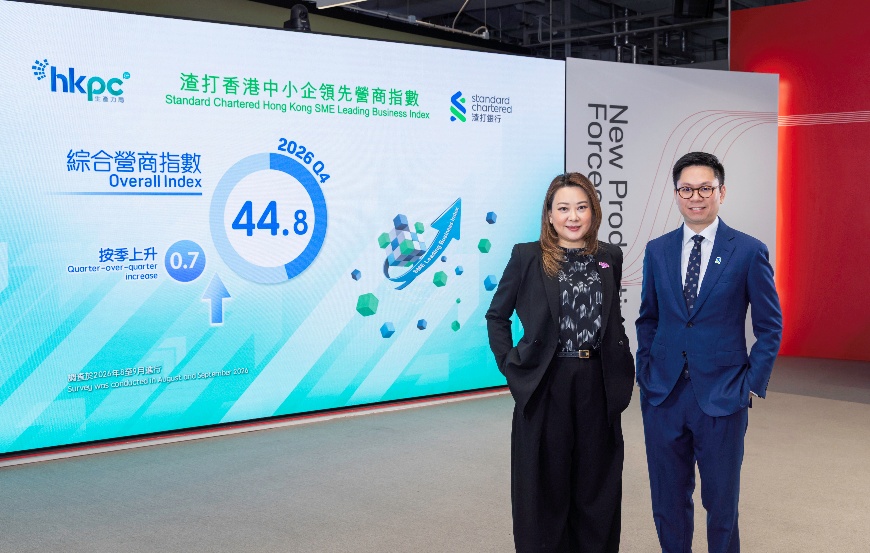
Hong Kong’s small and medium-sized enterprises are more optimistic about business conditions and profitability for the fourth quarter of 2026, although overall sentiment remains cautious, according to a survey released by the Hong Kong Productivity Council (HKPC) on Thursday.
The Standard Chartered Hong Kong SME Leading Business Index shows that the overall score for the fourth quarter rose 0.7 points from the previous quarter to 44.8, reaching its highest level this year but still below the neutral 50 line. Any score below 50 reflects pessimism.
Among its components, the “profit margin” and “business condition” subindexes posted the largest quarter-on-quarter gains, rising 2.1 and 1.8 points respectively to their highest levels of the year.
The gains were particularly pronounced in the accommodation and food services industry, where both subindexes rose 11.7 points. The retail industry also recorded increases, with the profit margin and business condition subindexes rising by 5.3 and 5.8 points respectively.
“A rising number of business and entertainment events, together with the continued recovery in inbound tourism, have boosted confidence across the two industries,” said Tommy Wu, Standard Chartered’s senior economist for Greater China and North Asia.
The brighter outlook in accommodation and food services was also reflected in a separate survey of local prominent companies released last week.
ALSO READ: Survey: HK SMEs more optimistic about external economic outlook
Data from the Census and Statistics Department showed that 34 percent of respondents in this sector expect business conditions to improve in the fourth quarter compared with the previous quarter, the highest proportion among all sectors surveyed.
However, concerns over the external economic outlook persisted among SMEs on the whole, with the aggregate “global economy” subindex across all surveyed sectors in the Standard Chartered SME Index survey falling 1.6 points to 31.5.
Still, the manufacturing industry and the import/export trade and wholesale industry bucked that overall trend, with their industrial subindexes in the “global economy” dimension rising by 3.7 and 3.6 points respectively. The overall industry indexes for the two sectors also reached their highest levels in nearly two years.
“Hong Kong’s external trade activity continues to benefit from the global artificial-intelligence supercycle, driving the import/export trade and wholesale industry index up for two consecutive quarters,” Wu said.
Wu said concerns about excessive AI investment and elevated stock valuations could trigger short-term market volatility, but AI’s underlying trend was still expected to support Hong Kong’s re-export trade and related industries. The growth could moderate next year because of a higher comparison base, he added.
READ MORE: Hong Kong SMEs cautious amid global uncertainty
The survey also pointed to growing interest among SMEs in expanding beyond Hong Kong, with 32 percent saying they were already engaged in cross-border business or planned to expand such operations within the next year.
“More SMEs are viewing cross-border business as an important strategy for reaching new customers and diversifying market risks,” said Karen Fung, the HKPC’s chief marketing officer. The SMEs were also looking beyond traditional trade fairs and physical channels when entering new markets, she said.
More than 90 percent of SMEs already operating cross-border business wanted to leverage digital tools to support their business, Fung said, adding that such tools were playing a growing role in market expansion and business decision-making.
Contact the writer at charlottezhou@chinadailyhk.com
