

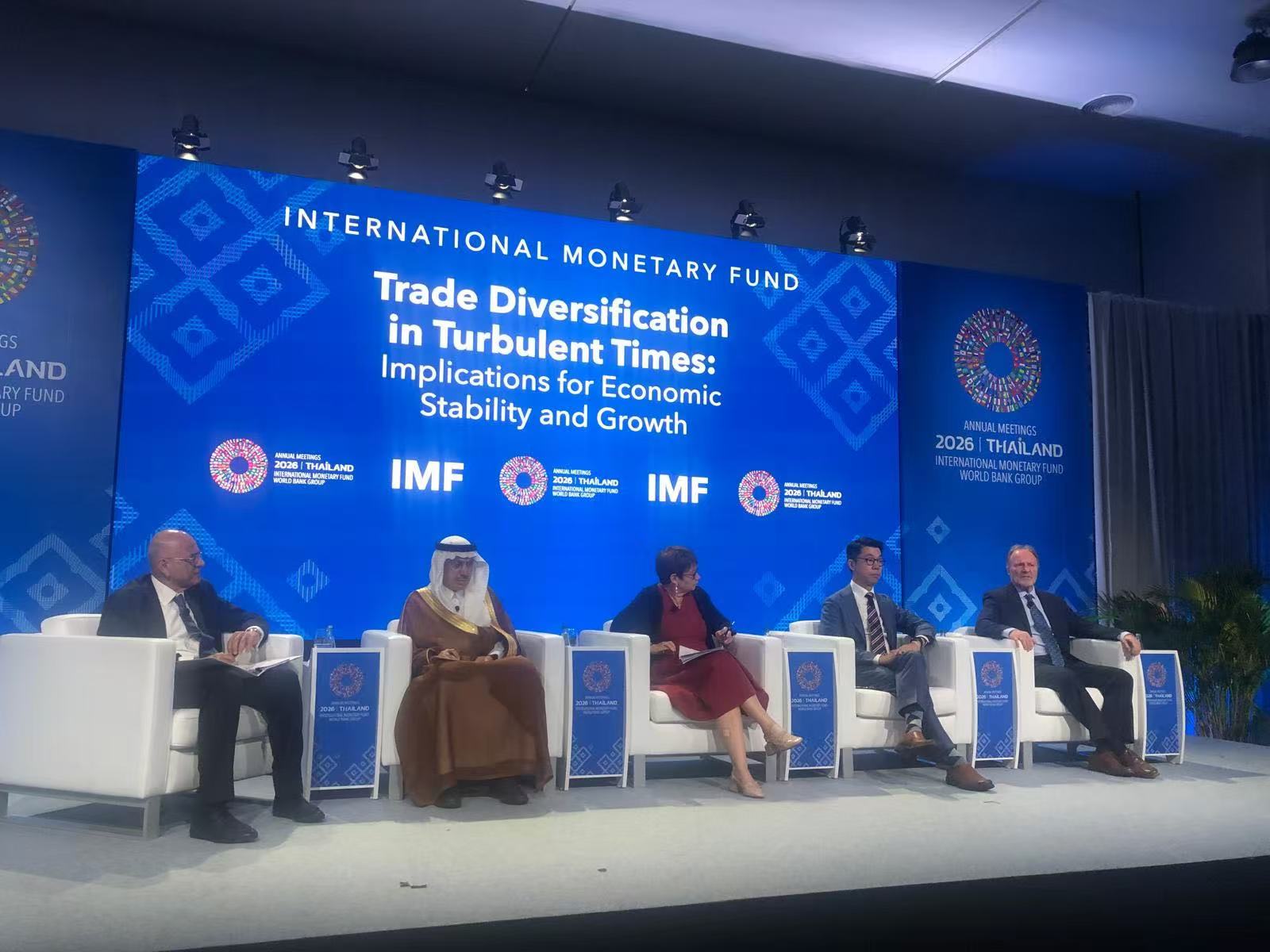
With global merchandise trade growing much stronger than the services trade so far this year, Hong Kong as a reexport trading hub should take advantage of this artificial-intelligence-driven growth to make the economy more diversified, resilient and inclusive by diversifying its export markets and industrial structure.
Panelists expressed this view on Wednesday at a discussion panel on international trade during the 2026 Annual Meetings of the International Monetary Fund and the World Bank Group. The meetings began on Monday and run through Sunday.
World Trade Organization Chief Economist Robert Staiger said the organization has upgraded its growth prediction fairly dramatically for merchandise trade in 2026, and downgraded this year’s prediction for the services trade.
“The global merchandise trade has grown much stronger than the services trade due to the 67 percent growth in investment in AI-enabling goods in the first half of this year, while about 70 percent of every dollar spent on trade was on AI,” Staiger said.
Bur that growth is very concentrated in the top 10 countries in AI-enabling trade accounts for almost 85 percent of the world trade, and this is not a widespread source of growth, the economist added.
The WTO downgraded its services-trade prediction for 2026 largely because the conflict in the Middle East has had a bigger impact on the services trade, particularly trade in tourism and transport, of which the Middle East is a hub, Staiger said.
ALSO READ: Northern Metropolis to boost regional economic integration, says IMF
Hong Kong is a global reexport trading hub that has benefited greatly from the recent AI boom. AI-related products surged 63.7 percent annually in value terms in the second quarter, accounting for about 73 per cent of the city’s merchandise exports.
In an interview with China Daily at the sideline of the panel discussion, Tang Hei-wai, associate vice-president (global) and director of the University of Hong Kong’s Asia Global Institute, said Hong Kong should take advantage of AI-driven growth to consider how to make the city’s services and manufacturing more diversified, resilient and inclusive by diversifying its export markets and industrial structure.
“The value chain of the AI industry stretches from big model development (downstream), to data center (midstream) and to research and development for semiconductor and chips (upstream). The Chinese mainland is investing a lot in (these AI industries) in the last few years, and they have become strategic sectors,” Tang said.
“Hong Kong, which now has its own five-year plan, really needs to think about those strategic sectors. The city has not been prepared to develop those sectors that will benefit from the productivity growth arising from the AI revolution,” he added.
Tang said that many economies that have benefited from this AI boom seem also to exhibit the experience of so-called K-shaped economic development, with a small fraction of the labor market benefiting from the AI-related activities, while the majority of those working in manufacturing and services have not yet experienced the direct spillover effect from the AI sector.
“Hong Kong needs to deepen trust-building with those emerging markets and attract more talents from those economies. With trust-building, there will be tangible agreements that can be signed, which will lead to tangible economic exchanges, whether it is trade or financial flows,” Tang told China Daily.
Hong Kong can consider signing more bilateral free trade agreements with those new emerging markets, he added.
