

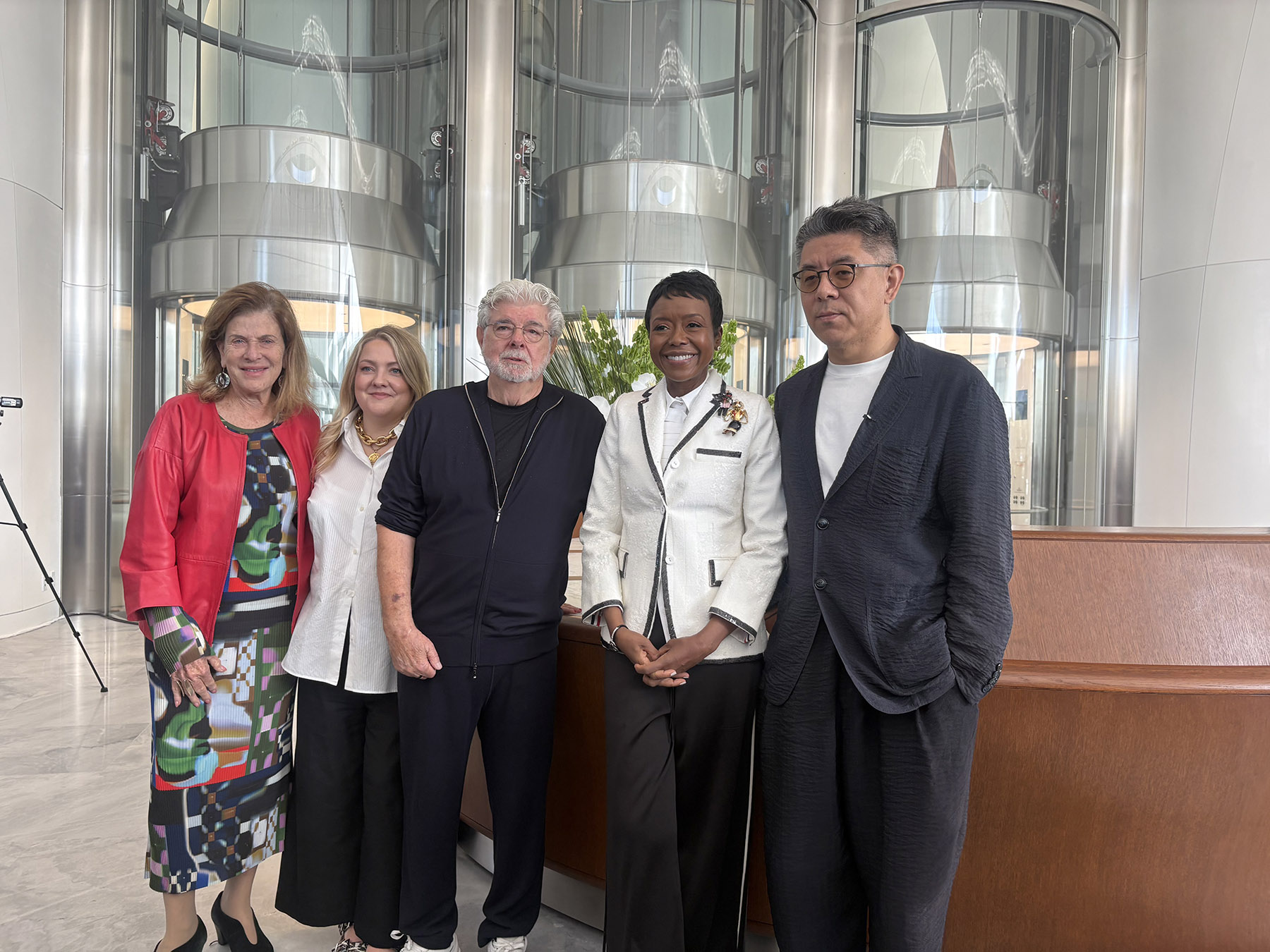
The opening of the Lucas Museum of Narrative Art has added a new cultural landmark to Los Angeles, bringing together film, illustration, comics, murals, architecture and landscape while creating a new space for cross-cultural exchange.
Founded by filmmaker George Lucas, creator of Star Wars, and his wife, Mellody Hobson, the museum opened to the public last month with a sold-out first day. Designed by Chinese architect Ma Yansong, founder of MAD Architects, the 28,000-square-meter museum traces visual storytelling across cultures and centuries, from cave paintings to cinema and murals.
For Ma, the project also represents an opportunity to bring ideas rooted in Chinese architectural tradition to a major United States cultural institution. He conceived the building as a "floating cloud", allowing the landscape and public space to flow beneath it rather than placing a conventional architectural box in the middle of the park.
READ MORE: Building for tomorrow
Ma said his approach was influenced by contemporary technology, traditional Chinese gardens and his childhood experience in Beijing, where lakes, gardens and buildings coexist closely.
"As a Chinese architect, I'm really influenced by traditional Chinese architecture, for example, gardens," he said. "The future building should be something new. You don't repeat the wood structure, the sloping roof, but you should continue to create space, connect to nature, to human emotion."
He said the idea travels across cultures because the relationship between people and nature is universal.
"When I bring this idea to the US or Europe, people love it because nature is a universal topic," Ma said. "Traditional Chinese architecture already talked about this … about emotion and spirituality. It's beyond sustainable and environmental concerns."
For Ma, the Lucas Museum became a way to demonstrate that architectural traditions from China can inform a contemporary global design language without simply reproducing historical forms.
The museum calls Ma's design a form of "emotional architecture", blurring the boundary between building and park and encouraging visitors to experience the architecture before entering the galleries.
The cross-cultural collaboration also extends to the museum's artistic mission.
"I've spent more than 50 years collecting the work of artists who don't always get their due, illustrators, cartoonists, muralists, painters, because I believe their images are as vital as any other art form," Lucas said at the opening. "They deserve to be in a museum."
The permanent collection holds more than 40,000 works, while the inaugural exhibitions feature more than 1,300 pieces across media and historical periods. The galleries place popular and fine art in the same narrative tradition, bringing together artists such as Norman Rockwell, Frida Kahlo, Robert Colescott, Frank Frazetta and Robert Crumb with film materials from the Lucas Archives.
Ryan Linkof, senior curator and head of film programs at the museum, said China offered many avenues for exploration.
ALSO READ: China-US cultural exchanges ring out in Washington
"As such an important part of world culture, China would of course be a place where we could find all kinds of avenues to explore," he said. "Certainly, going forward, we have a lot of opportunities for that."
For visitors, the blend of architecture and art is already part of the experience.
Adira Vasquez, who attended the opening, described the building as both modern and futuristic, saying its curving profile sharply contrasts with the nearby Los Angeles Memorial Coliseum.
"You see a sports stadium there, it's very iconic, the LA Coliseum, and then you turn and you see this little piece of art of architecture right next to it," she said.
Contact the writers at renali@chinadailyusa.com
