

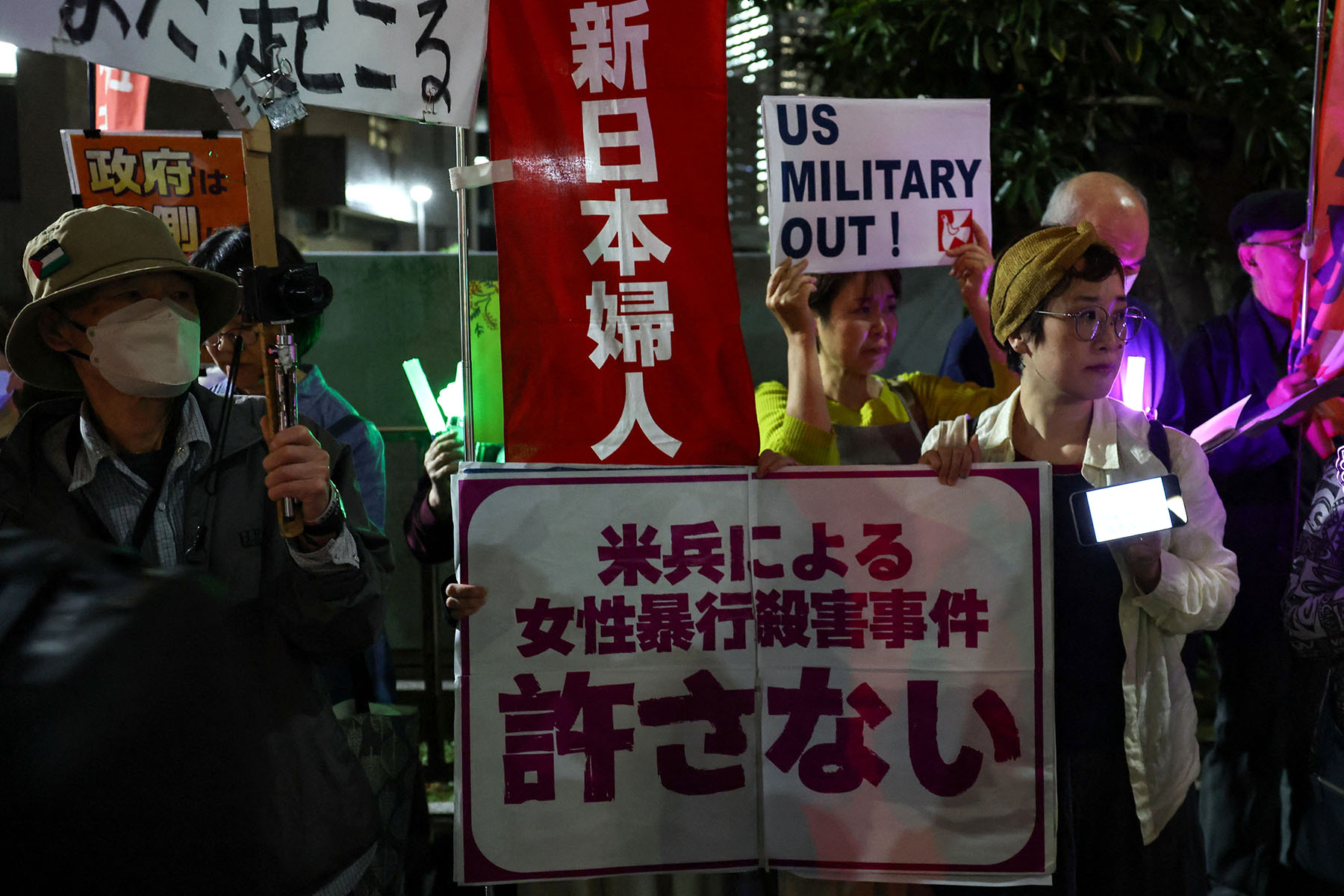
The arrest of a US serviceman in Japan's Okinawa on suspicion of murder has once again triggered anger and distrust among the Japanese public.
Some argued that the US-Japan Status of Forces Agreement effectively granted the United States a degree of extraterritorial privilege.
They called for a reassessment of Prime Minister Sanae Takaichi's efforts to strengthen the Japan-US military alliance, as well as the growing burden such moves placed on Okinawa, which hosts the bulk of US military facilities in Japan.
On Sunday, Okinawa prefectural police arrested US Marine Devin Jacob Ballard from outside a US military base on suspicion of robbing and murdering a local woman at a hotel early on Saturday.
Ballard has denied the allegations, Kyodo News reported.
READ MORE: Takaichi: Japan protests after US Marine nabbed in robbery-murder case
Takaichi expressed regret over the incident at the outset of her policy speech on Monday, calling on the US side to fully cooperate with the investigation, tighten discipline and take measures to prevent a recurrence of such incidents in the future.
Okinawa Governor Genta Koja also lodged a protest with the US military the same day.
However, the US side did not apologize for the incident, saying it could not do so when Ballard had denied the allegations and the facts of the case were yet to be established, media reports said.
Hiroshi Shiratori, a professor at Hosei University in Tokyo, said provisions in the US-Japan Status of Forces Agreement that, in a sense, grant the US side extraterritorial privileges remain a major obstacle to addressing such problems.
Under the agreement, if a US service member suspected of an offense is already in US custody, the US side retains custody until Japan formally indicts the suspect. If Japanese authorities take the suspect into custody, as in this case, the suspect remains in Japanese custody.
Measures taken in the past — including tightening discipline, restricting off-base activities and stepping up patrols — have had little tangible effect, Shiratori said.
Japanese Foreign Minister Toshimitsu Motegi and Defense Minister Shinjiro Koizumi separately lodged protests with the US side on Sunday.
According to Japan's Foreign Ministry, US Ambassador to Japan George Glass said the US would fully cooperate with investigations and make every effort to prevent a recurrence.
Mizuho Fukushima, leader of the Social Democratic Party, said that tightening discipline alone cannot solve the problem. She said the Japanese government also bears political responsibility for its failure over the years to push for revisions to the US-Japan Status of Forces Agreement.
The military alliance has often left the Japanese government with only being satisfied with lodging verbal protests, rather than taking fundamental measures to address the issue, Shiratori said.
Shiratori said the protests lodged by Takaichi and other Cabinet members could, in a sense, be seen as an attempt to shore up public support for the administration ahead of the upcoming extraordinary session of the Diet.
Protests were held in Okinawa and Tokyo over the weekend, with participants calling on the Japanese government to take action over repeated incidents involving US military personnel, reduce Okinawa's disproportionate base burden, and remove US military bases from the prefecture.
Sachika Takara, a House of Councillors member representing Okinawa, told a rally outside the Prime Minister's Office that the Japanese government's repeated calls for the US side to tighten discipline had failed to prevent such incidents.
ALSO READ: Japan protests to US over Marine's alleged robbery-murder in Okinawa
She called for a reassessment of Okinawa's heavy base burden and what she described as Japan's excessive reliance on military means in its security policy.
Okinawa prefectural police handled 101 criminal cases involving US military personnel, civilian employees, and their family members in 2025, the highest figure since 2003.
Police have handled 6,409 criminal cases involving US military-affiliated personnel from 1972 till last year. Of these, 600 involved serious crimes, including murder.
In 1995, the rape of a schoolgirl by three US servicemen sparked public outrage in Japan. The following year, Japan and the US agreed to return land occupied by Marine Corps Air Station Futenma, but that has not yet happened.
Shiratori, from Hosei University, said such incidents have repeatedly occurred in Okinawa since the 1990s, fueling criticism that mainland Japan has left Okinawa alone to shoulder the country's defense burden.
Contact the writers at houjunjie@chinadaily.com.cn
