


This week on Straight Talk, David Lam, Legislative Councillor for the Medical and Health Services constituency, talks about Hong Kong’s healthcare standard and what we need to improve and balance resources to make it more efficient.
Check out the full transcript of TVB’s Straight Talk host Eugene Chan’s interview with David Lam.
Introduction
Chan: Good evening. I'm Eugene Chan, and this is Straight Talk. Are we taking Hong Kong's high medical standards for granted? Is Hong Kong's healthcare standard at risk? With us today is David Lam, the Legislative Councilor for the Medical and Health Services Constituency. A surgeon by training, Lam has served in major public hospitals and held key roles as the chairman of the Health Panel of the Legislative Council. He has been at the forefront of healthcare policy – from tobacco control and screening programs through COVID vaccination, and major legislative reforms in nursing and allied health professions. Welcome to the show for the first time, Lam!
Lam: Hello, Eugene. Nice meeting you here.
How good are we, and rising costs
Chan: Right. Great to have you, and if you look at the title of the show tonight, the viewers will know that Hong Kong medical system or the standard is often cited as world-class.
Lam: Yeah.
Chan: We boast the one of the highest life expectancy and the lowest infant mortality rates globally. But the Hong Kong people, I would say, have a famous sort of being demanding, especially when it comes to public services. We complain about waiting times, cost, and even quality of service. So, are Hong Kong people genuinely taking this for granted, Dr Lam?
Lam: Thank you. You talk about the waiting time, and that's one of our pain points. Now, before going into the waiting time, let's talk about the principle of public healthcare in Hong Kong. The principle is that no one will be denied adequate medical care due to a lack of means. So, anyone who requires any sort of healthcare, they can count on the public health services. However, that generates what you mention. There may be a sensation of taking for granted. You must give it to me, otherwise you know. But that is a problem that stems from a taken-for-granted kind of mentality to the distribution of resources. Resources are limited. We are spending a lot of money in public healthcare. It has actually increased by over 20 times in the past 20 to 30 years' time. So, the increase in the public health dollar is much bigger than our rise in GDP. For every HK$100 spent by the government on public expenditures, recurring public expenditures, about HK$19 to HK$20 is spent on healthcare, public healthcare alone. Another amounts of money, roughly the same size, is spent in private healthcare. So, it's getting very expensive, and that's why we are facing a sustainability problem.
And when healthcare is available to everyone, public healthcare is available to everyone, then you see the situation whereby people tends to move over to the public healthcare sector when the cost of healthcare escalates, and that makes sustainability even more difficult, and that goes to the long waiting time.
Chan: Right, Lam. I think you have summed it up very succinctly because you have mentioned our demand and also limited resources. But government spends a lot of money, but we are an aging population. So, we're going to have a sustainability issue. And another comment that I'm sure the viewers will share with you is that for many of our relatives or friends who actually had the privilege to live in the US, Canada, or even the UK will say that they didn't realize how good we have been in Hong Kong until they moved there. For example, in Canada, even if you want to pay, you can't get access to private care. So, going back to the title of the show, do you think we have taken things for granted?
Lam: In a way, yes, but sometimes that is reasonable. For instance, people who sustain severe trauma, multiple fractures, internal organ damage, and coming in shock, or people who has very severe illnesses that requires services such as a liver transplantation or heart-lung transplantation, then you really need the public health service to take care of that. One, it is too urgent. Two, it takes many specialties and many different facilities to cater to that kind of service. And three, for transplantation, it's also takes into the consideration of fairness. So who are you giving an organ to when you have rare and valuable resources such as an organ? Who are you going to give this organ to? So, that comes to fairness issue. All these have to be taken care of by the public healthcare system.
Apart from these, there is really a means and choice issue. If someone has the means, then by all means they can choose to go for private healthcare facility. But when we still open the door for them in the public healthcare system, and when the cost of attending for public healthcare is kind of a major difference compared to private healthcare, then people become kind of attracted to the public healthcare system even though they are able to pay for the private healthcare, and that's how we have this long queue problem and also, so what you mentioned, a taken-for-granted problem.
Chan: Right. David, you being now our representative in the profession, how would you benchmark Hong Kong to other developed countries for medical standards?
Lam: Okay. We look from different angles. One is the standard of care, as you mentioned. We have the lowest infant mortality rates, lowest maternal mortality rates, and the longest life expectancy almost around the world. Well, life expectancy, we have been the longest living place on earth for many years now. So we are very good, and we provide state-of-the-art treatment for all medical and health services. The only problem with the public healthcare system, as you mentioned, is the long queue. Apart from that, we are doing fine. But then of course, we must not be too happy about what we are doing. We must still continue to move forward and give our public a better healthcare system.
Chan: Right.
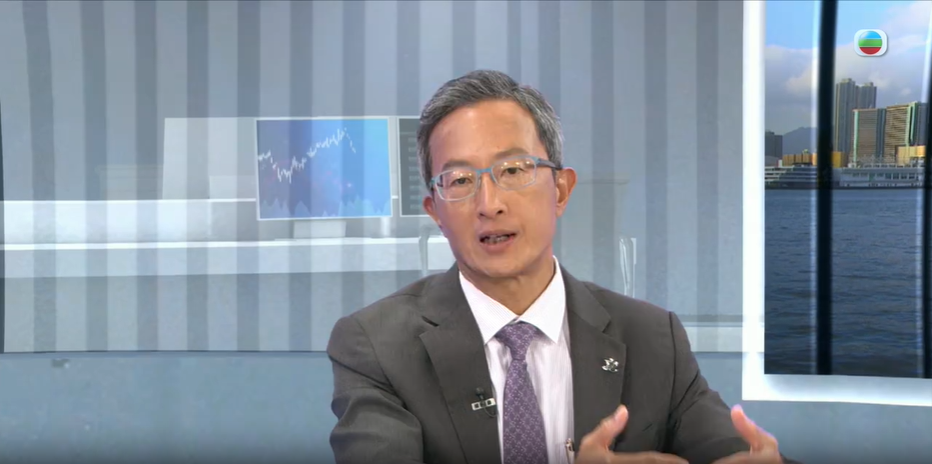
Lam: Now that comes to the allocation of resources. The next step forward may be, may be, a tiered subsidy for public healthcare services so that we can really use our resources more targeted to the underprivileged population.
Chan: Right, I think right at the beginning of the show today, you said no one will be denied medical care …
Lam: Proper medical care.
Chan: … even proper medical care in Hong Kong, I think is a very strong statement. I think the government, we can all be very proud to have that. If we're going to maintain the standards, do you think we have enough doctors, nurses, dentists, and all the healthcare profession so that the whole system can be working together with the aging population?
Lam: Right … which is also an increasing population…
Chan: Right.
Lam: ... with all the talents we are importing right now.
Chan: Now, before moving to the manpower issue, I'd like just to mention one more point that when we look at healthcare system, is it good, is it fair?
Lam: We call it a universal health coverage index. This index is important, and in many parts of the world, the index is kind of high for developed countries and developed places. And we notice that if the government puts in like more than 40 percent of the total healthcare expenditure, those areas usually have a reasonable universal healthcare coverage index. Whereas for places that cannot afford to put in that amount of money for healthcare for their people, lower than 40 percent, then you can see a generally low universal healthcare coverage index ...
Chan: Right.
Lam: … for those places. In Hong Kong, we are spending roughly 50 percent to 60 percent of our … I mean we're contributing 50 percent to 60 percent of the total healthcare expenditure, and we belong to the high end of the universal healthcare coverage. So, that is good. But going back to your question of manpower, do we have enough manpower? Now we cannot only look at doctor numbers or dentist numbers. We have 13 statutory registered healthcare professionals and five more professionals under the administrative registration system of the Department of Health. That together gives us 18 registered healthcare professionals. Using a broader view, we have quite a good number of healthcare professionals, but we seem to be focusing very much on doctors alone and dentists alone. We have not been using our nursing manpower and maybe physiotherapist manpower and maybe Chinese medical practitioner manpower to good. So, if we pool them together, we can have much more manpower in terms of tapping into the entire talents of healthcare professionals in Hong Kong.
If you look from that particular angle, we do have rooms for improvement, but it's not that really bad when we look at the doctor figures, we have roughly 2.2 doctors per thousand of the population. That is low, compared to many places, especially developed countries around the world. But we also have like one point something per thousand Chinese medical practitioners, and they do contribute a lot to …
Chan: True.
Lam: ... our primary healthcare system. And if we make good use of these professionals and make them collaborate with one another in a cross-disciplinary kind of a collaboration, especially in a community, that boosts our manpower greatly instead of just adding doctors, adding nurses. Talk about nurses. The figure is not that bad. We do not have the lowest number of nurses per population around the world. We do have a fair number, kind of in the middle, better than some developed countries and maybe less than others. But then the problem is our nurses have not been providing their full function as a trained professional, five years of undergraduate training. That's a lot of time. So maybe we can find new roles. Depends on the competency of individual.
Chan: Right.
Lam: In the past, we looked at the registration. If you are a registered dentist, you can do something. If you're a registered doctor, you can do something. If you're a registered nurse, you can't do what a dentist or the doctor does. But then in the future, still by registration is the most important. But then by competence, if someone is trained to perform a particular procedure and under a protocol, is it possible to make use of those manpower …
Chan: Right.
Lam: … to use, to perform some medical or dental duties other than doctors and dentists alone?
Chan: Right. David, before we go to the break, I'm going to ask you the last question. You can think about it, let us know your views after the break. Things you mentioned about our manpower issue. I'm going to ask you sort of a more integrated question. You can think about it and we'll come back to it after the break, is that now we have two good medical schools in Hong Kong, a, a third one coming with Professor Ip and Professor Fok came here a few weeks ago talking about that. We have a dental school that's ranked number one in the world as well. But suddenly we're going to have a cross-border healthcare. So, how is our secretary or the policy makers going to plan for our manpower supply for years to come so that our resources will be spent wisely? Not to mention we have the special and limited registration of overseas trained doctors and dentists coming to Hong Kong.
Right, maybe we will take a break now, and we will come back with more Straight Talk.

Cross-border challenges
Chan: Welcome back, viewers. We've been talking with David Lam, the Legislative Councilor for the Medical and Health Services Constituency, about the valuing and maintaining the high healthcare standards we have in Hong Kong. So, Lam, before the break, I asked you a sort of integrated question. What would be your answers to the viewers?
Lam: Okay. Manpower, it's a complicated issue. First of all, Hong Kong is not a silo. We are part and parcel of the Southern China, the Greater Bay area, and of course part and parcel of the entire country, so people can move around. We estimate our manpower requirement by means of healthcare manpower survey, which the government perform once every three years. The last time, and the time before, show that we have a persistence inadequacies of doctors, nurses, and many other healthcare professionals, all the way down to 2045. But is that really true? Depends on the changes in the number of people, a number of healthcare professionals in Hong Kong, and also on the pattern of healthcare profession.
And the pattern changed greatly in recent years, as you see we have more and more people moving across the border to receive healthcare of all sorts. And the number of people coming to Hong Kong to receive healthcare has kind of decreased. So, that gives us a sudden increase in the capacity compared to the demand. When you have a slightly more supply or more increase in the supply than the increase in the demand, that changes the ecology, and we are seeing doctors and dentists having fewer patients these days. Now, that doesn't mean we have absolute oversupply of doctors and nurses and dentists. That depends on how we project our need in the future, and this year, 2026, the government is launching another round of a healthcare manpower survey. Now, that comes with some restriction, because one of the chief assumption is that ... well, all studies come with assumption, and one major assumption is that the pattern of healthcare delivery doesn't change, but we know it is always changing.
With the increase in the primary healthcare and what I mentioned earlier on maybe the increase in service by professionals with certain competency taking over some roles of traditional healthcare professional services, then we may have a better distribution of healthcare in Hong Kong. And when the private sector in Hong Kong is not doing as good as its past decade, then doctors and dentists working in public healthcare system, they may not like to move to the private sector, so you will be having more and more healthcare professionals staying behind in the public healthcare system. That changes the ecology and the terrain as well.
Chan: Right.
Lam: So overall, I think we will be having a period of time when our healthcare manpower supply will be steady and the demand will be either steady or decreasing slightly.
Chan: Right.
Lam: That comes to what we should be doing. Now, something can't be changed too easily. We have a third medical school already prepared and, well, they will have their first batch of intake in two years' time, so we'll be seeing more doctors from a third medical schools within a decade's time.
Chan: Right.
Lam: So, that can't change. But how we are going to make use of our medical education resources is a matter for consideration. Can we do it only for ourselves, or can we do it for other places around the world, for instance, along the Belt and Road Initiative countries? That is a soft power we can project to other places and benefit not only Hong Kong, but the entire homeland, the entire nation.
Chan: Anyway, as a legislator, I'm sure being with that cap as the Medical and Health Services, you will be looking at the manpower supply very closely and advise the government accordingly. Another area that you mentioned earlier in the first half of the show is cost. I've also done some homework. We know that it’s close to 80 percent, 90 percent for the total, recurrent government expenditure, and actually it has increased many times over the last decades. So, how sustainable is Hong Kong's model of providing a highly subsidized public healthcare? I mean, I say this very slowly because every term means something. Highly-subsidized public healthcare. How are we going to … can we afford it? I remember back in the early 1990s, there was the Rainbow Report and the Harvard Report.
Lam: Yeah. And over the years, there are many, many consultation, consultative documents, and each and every time it mentioned the healthcare system in Hong Kong is no longer sustainable. But, you know, you talk about something is not sustainable for 30 years, and it's still going on. It's not dead yet. So, sometimes it becomes a kind of whether you still trust in that notion it is not sustainable because we have been …
Chan: Right
Lam: ... sustaining that for 30 years. Now, truly, it is becoming unsustainable because we did not have that increase in the elderly population as we had before.
Chan: Right.
Lam: We are now having as …
Chan: But let me just jump in.
Lam: Yeah
Chan: With this government, under John Lee, Professor Lo actually has introduced some fees paying for the public system. I'm sure that's going to help.
Lam: Yeah.
Chan: Have we done enough?
Lam: No.
Chan: So, we should actually charge more to the patient?
Lam: Not exactly. Now, you have payments out of pocket, payments by insurance, and payment by the government. Basically, we have these three kinds of payments in Hong Kong for healthcare. Okay, so we have roughly half of our doctors in public healthcare system and half in a private healthcare. But the public healthcare system is doing most of the job in terms of chronic illnesses and also surgical operations. So, if you move a bit more people to the private sector, then you reallocate the resources to those really in need, including the real emergencies and underprivileged people, and those with severe illnesses. And then in the private sector, it's all about how to finance public healthcare. We have a lot to do about our insurance scheme, and also the doctors and the hospital charges.
So on the one side, charges has to be transparent, and on the other side, the reimbursement has to be definite and transparent. So when you have a definite reimbursement system and a very clear and transparent charging system, then the two comes together …
Chan: Right.
Lam: … and shake hands, and then people become more confident in using the healthcare resources like insurance, and that's the way we are looking forward. In terms of the public healthcare system, it is intended to treat the most severe illnesses, the real emergencies, and the underprivileged. So, that comes to how you can divert people who has the means to go elsewhere…
Chan: Right.
Lam: … When they go elsewhere, you have to make sure that they can really pay comfortably, either out of their own pocket or through insurance. And for those who are coming in to the public healthcare system, you should ensure that the queue is reasonable, not too long.
Chan: Right.
Lam: Yeah, so those are the things we have to re-adjust before we talk about the increase, the absolute increase in manpower. So readjusting, adjusting our current service allocation, and money or the fee is the biggest and easiest handle for reallocating the resources and how people would go.
Chan: Right. Lam, when you're talking about this 50 percent of the doctors in the public system doing 90 percent of the work, and then the other 50 percent of doctors doing 10 percent of the inpatient work outside, one of the main reasons people attribute it to being the expensive private healthcare. Do you agree?
Lam: It's not nine to one. According to the thematic household survey, also done by the government, it's roughly like, uh, seven to eight to two and three.
Chan: Right. Okay. So, roughly 20 percent to 30 percent of the surgery are done in the private sector, and about 70 percent to 80 percent are done in the public healthcare system. So, there is still a discrepancy or an imbalance.
Lam: Yes. It is expensive, so that's why people tend to move to the public healthcare system for their services. And the public healthcare services is very good indeed. It's all about how are we going to divert patients to the private healthcare system. That is an issue. When the government rolls out the reform in healthcare fees and charges, it's not really to increase the burden on people in need. It's really to give them more waiver, but at the same time increasing the number, the amounts of …
Chan: Okay.
Lam: ... fee charging, the general population.
Way Forward
Chan: Right. Lam, I ask you the last question. With the 15th Five-Year Plan coming, Hong Kong's first five-year plan in the process, when what goes on across the border, how are we going to deal with all this … I would say unethical dental advertisement over to the border, in short?
Lam: Basically, it has to be limited by law, and to limit it by law, the purpose is to protect the public from unscrupulous advertising, because there is a discrepancy between the understanding …
Chan: Right.
Lam: … of medical need between the healthcare professionals and the public, and we do not want the public to be given notion that they need …
Chan: Okay.
Lam: ... something which they really do not need.
Chan: Right. I'm afraid we have to wrap it up now. And thank you, David, for sharing your insights with us. People in Hong Kong have every right to be proud of the high standards of our medical system, but we can't take that for granted, or we risk losing our system. We will risk losing our edge, and that's a price no health insurance plan can cover. Thank you for watching Straight Talk. I'm Eugene Chan, and good night.
