

Amid challenges, cooperation shows positive sides of working together
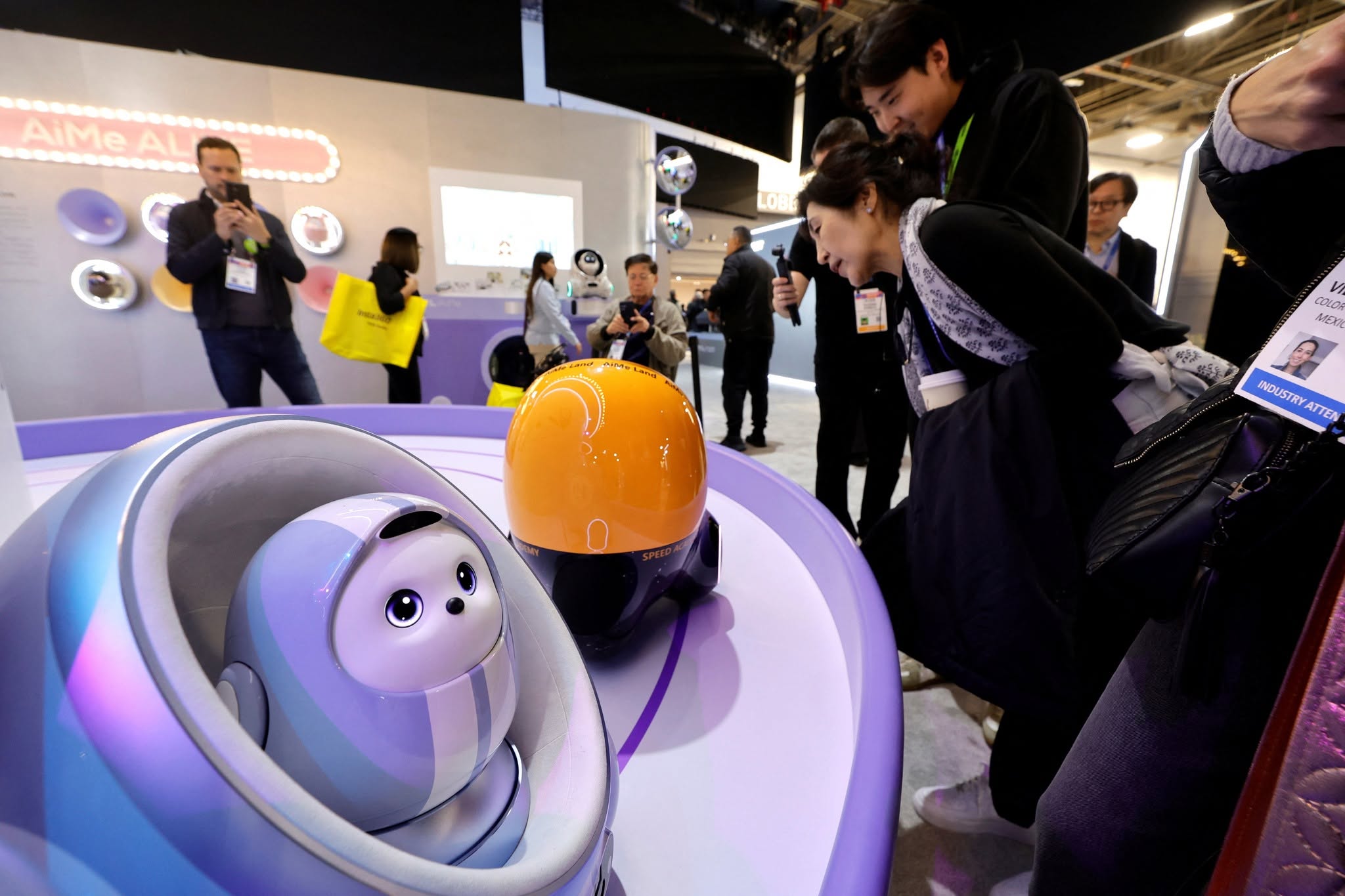
A companion robot is displayed at Chinese electronics company TCL's booth during CES in Las Vegas, the United States, on Jan 6. YONHAP NEWS AGENCY
Despite geopolitical tensions and "decoupling" rhetoric, market forces, specialized skill sets and hardware supply chains are bringing technology companies from China and the United States closer together.
Sean Stein, president of the US-China Business Council, said that China and the US are the world's main players in the field of artificial intelligence.
"China is innovating incredibly rapidly. Some of the world's fastest and greatest innovations are coming out of China. That lays the foundation for China-US cooperation on AI," Stein said.
Large language models are a typical example. A growing number of US AI companies are building products on Chinese models. In August, US legal AI firm Harvey released Tenet, its first post-trained open-weight model, based on Chinese AI company Moonshot's Kimi K3.
Such cooperation comes as China ranks first worldwide in downloads of open-source large language models, underscoring its edge in generative AI innovation, according to China's Ministry of Industry and Information Technology.
In the AI automotive chip sector, US companies remain deeply embedded in China's smart vehicle supply chain. In April, Chery Automobile announced a global strategic partnership with US chipmaker Nvidia to jointly develop physical AI in assisted driving, cockpit AI and robotics.
Meanwhile, US chipmaker Qualcomm also announced in June plans to launch customized AI data center chips in China that comply with US export regulations, deepening cooperation with Chinese automakers and smartphone makers.
Qian Kun, senior vice-president of Qualcomm, said AI is moving from single applications to more terminals such as phones, PCs, glasses, cars and robots.
"China has a huge digital economy, a complete industrial system and a vibrant developer ecosystem," Qian said. "From smart devices to smart cars, Chinese companies continue to create new AI application scenarios and drive rapid commercialization of new technologies. More and more innovations originating in China are not only serving the Chinese market but also going global.
"Close cooperation with Chinese partners has not only promoted local innovation but also brought important experience and inspiration to Qualcomm's global business," he said.
The humanoid robot sector offers an even clearer example of China-US technological "hybridization" and supply chain synergy. In June, Nvidia CEO Jensen Huang announced cooperation with Chinese humanoid robot maker Unitree to launch the Isaac GR00T humanoid robot reference platform.
Tesla's Optimus robot also relies heavily on Chinese suppliers, with Morgan Stanley estimating that Chinese suppliers account for 63 to 70 percent of its core components. If no Chinese components were used at all, the production cost of Optimus Gen 2 would rise from $46,000 to $131,000, Morgan Stanley said.
Hua Ning, senior director of Asia Pacific business operations at the Institute of Electrical and Electronics Engineers, the world's largest technical professional organization, said China has three core advantages in AI and embodied robotics.
READ MORE: Partnership highlights nation's growing AI strength
"First, government policy guidance; second, China's massive and unparalleled scale of engineers; and third, China's very comprehensive industrial chain. Such strengths make the country a crucial player in humanoid robots," Hua said.
In the first half of this year, China shipped more than 40,000 humanoid robots, accounting for 97 percent of global output, according to the Chinese Institute of Electronics. The Ministry of Industry and Information Technology projected that full-year production will exceed 100,000 units.
Zhou Xinhong, vice-president of information technology company HP China, said China has now become an important testing ground for industry-specific AI applications.
"China's manufacturing base generates large volumes of specialized data in sectors including electric vehicles, logistics, healthcare and industrial production. Those advantages could allow multinational companies to develop AI applications in China and later replicate them in other markets," he said.
Zhou said that the combination of industrial scale, digital infrastructure and willingness to adopt AI has created a market that is difficult to replicate elsewhere.
ALSO READ: China scales up embodied AI's reach
In May, China's Foreign Ministry spokesman Guo Jiakun said that China and the US have agreed to launch intergovernmental dialogue on AI, sending a positive policy signal.
Sun Chenghao, head of the US-Europe Program at Tsinghua University's Center for International Security and Strategy, said that despite challenges, the ongoing interaction demonstrates that China-US AI cooperation is not a zero-sum game. Competition will not disappear, but companies on both sides are proving through pragmatic action that in a highly globalized AI industry, decoupling is unrealistic and cooperation offers the way forward.
Contact the writers at masi@chinadaily.com.cn
