

Economists caution failure to act swiftly could weaken trust in world's largest economy
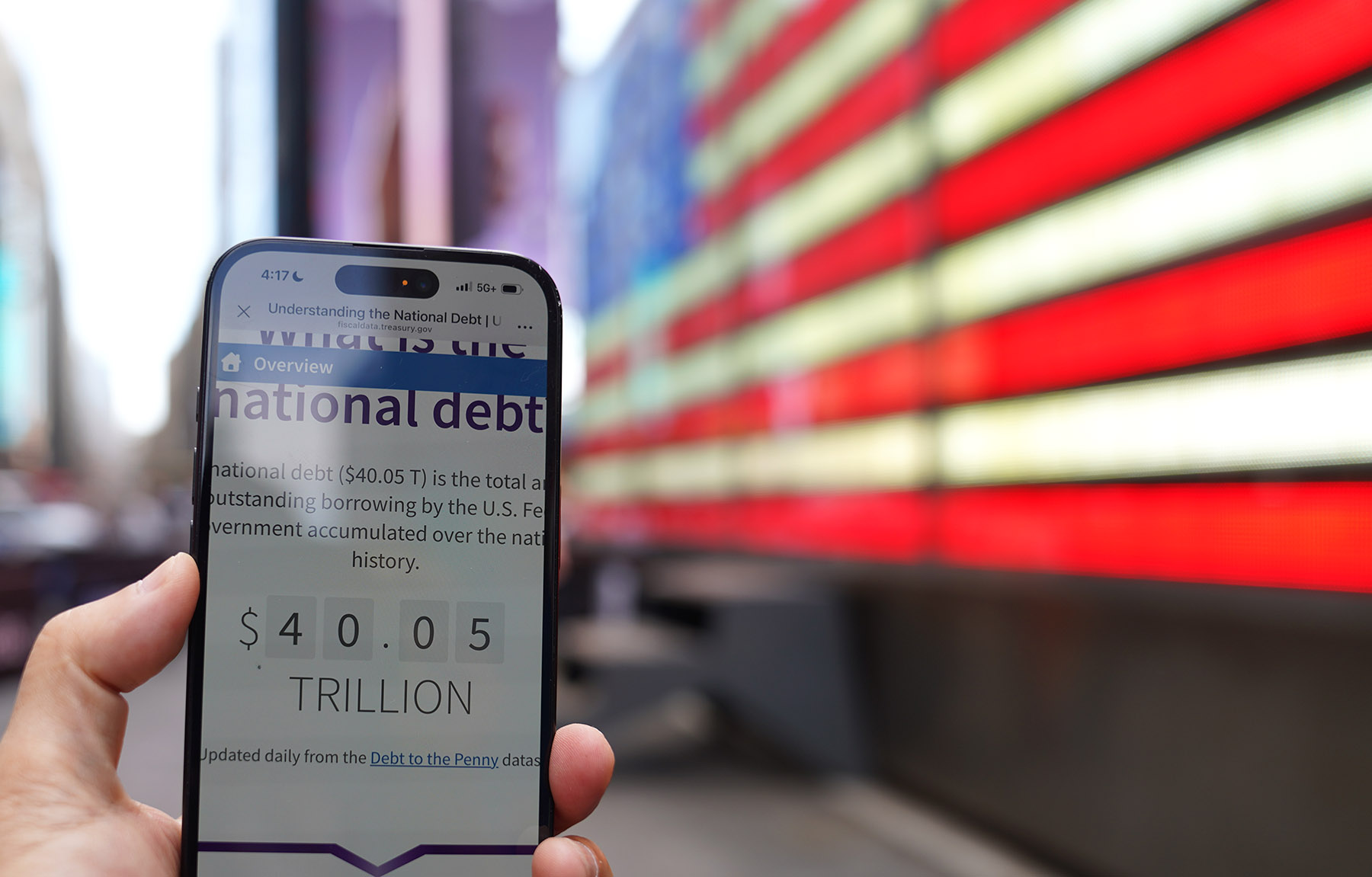
The US Department of the Treasury must find immediate ways to reduce the record-breaking national debt of over $40 trillion, or "feel the pain" of dealing with it later on, warned economists, who said if it remains high it will affect generations of Americans, lead to more borrowing and could weaken international trust in the world's largest economy.
The debt amount reached on Aug 18 is not only of concern for the US government but also for the world economy, much of which relies on the stability of the dollar as the world's reserve currency. It is now of utmost importance to cut spending, said Christopher Ball, an economist at Quinnipiac University in Connecticut.
"Policymakers need to start cutting spending now so that we immediately reduce our government deficit," Ball, director of the university's Central European Institute, told China Daily.
READ MORE: US national debt tops $40t for first time in history
"When overburdened with debt, the last thing you want is to force yourself into a situation of running deficits and thus needing to borrow even more," said Ball, also Istvan Szechenyi Chair in International Economics at Quinnipiac and an associate professor of economics.
The national debt reached the milestone, in part, due to defense costs, and programs like Social Security and Medicare, and the annual interest is $1.2 trillion for US taxpayers, the Federal Reserve said.
The US government will borrow more than $2 trillion this year alone as spending exceeds tax revenue, with President Donald Trump's key priorities being defense costs, including the conflict in Iran, his tax policy and other federal programs, The New York Times reported.
The Peter G. Peterson Foundation, a think tank focused on US fiscal challenges, found that out of the $40 trillion debt, approximately "80 percent was debt held by the public, representing cash borrowed from domestic and foreign investors. The remaining 20 percent was intragovernmental debt, which simply records transactions between one part of the federal government and another".
Japan, the United Kingdom and China hold the most US government debt, according to US Treasury figures from June.
Japan holds about $1.17 trillion, making it the largest foreign owner. The UK ranks second, holding about $939 billion. China is the third largest holder with approximately $633 billion.
A number of countries, including China, Japan, the United Arab Emirates, Canada and India, cut their US Treasury holdings in March.
"The fear is the US is losing its standing as the safe haven," George Cipolloni, a fund manager at Penn Mutual Asset Management, told The Associated Press.
A report by Congress entitled Foreign Holdings of Federal Debts found that as of December 2025, foreign investors held approximately $9.2 trillion, or 31 percent of total US publicly held debt of $30.1 trillion. The interest on the debt paid to foreigners in 2025 was $282 billion.
Economists view debt held by the public as the "most meaningful measure of debt" because it reflects the amount that the Treasury borrowed from outside lenders, the Peter G. Peterson Foundation said.
The US sells an increasing amount of debt to cover the cost of daily government operations, health programs, stimulus benefits and disaster relief.
The Brookings Institution, a nonprofit public policy organization based in Washington, DC, said that "to finance large and persistent budget deficits, the US Treasury borrows heavily on global bond markets".
Peter Chow, a professor in the department of economics and business at The City College of New York, specializes in international trade, development and Asia-Pacific economies.
Chow told China Daily that one of the ways to fix the national debt is that "the US government bond will continue to rely on foreign purchases, and the interest rate in the US will have to be higher than those in other countries".
Ball added that while Americans may not feel the burden from the debt today, the payments will come due at some point, and when that happens they will face very high interest rates and taxes.
He said the high debt could lead to large cuts in basic services like Social Security, Medicare and all other government-supported social services. "The longer we wait, the more the pain when we face it," he said.
Steady increase
The US national debt has slowly increased over the past 50 years during presidential administrations led by both Republicans and Democrats. It rises when the federal government runs a budget deficit and spends more money than it collects in tax revenue.
The US has faced a series of challenges in the past few years that have strained the federal budget.
In 2009, amid the recession, debt climbed. It rose again in 2020 during the COVID-19 pandemic, which shut businesses, hampering economic growth. A 2020 study by Harvard economists David Cutler and Lawrence Summers estimated that the cumulative financial costs of the pandemic were more than $16 trillion, or 90 percent of the annual GDP of the US.
Trump enacted pandemic initiatives in his first term. Former president Joe Biden also spent to stabilize the economy and spur an economic recovery.
But an analysis from the Organisation for Economic Co-operation and Development by The AP described the US as having the worst fiscal position among developed economies. "There are only two ways to trim the national debt. One is to raise tax; the other is to trim the budget. Neither one is pain-free," Chow said.
Under the last two presidents — Trump and Biden — the debt has risen further.
In 2016, Trump vowed to eliminate the national debt within eight years with trade deals and other stimulants of economic growth. But 10 years later, the national debt has doubled.
In another effort to trim government spending at the beginning of his second term in office, Trump established the Department of Government Efficiency led initially by the world's richest man Elon Musk.
DOGE aimed to reduce federal spending by $1 trillion. It reported saving around $200 billion, but the Government Accountability Office reported that as of July 7, this figure may have been overstated.
If the debt is not addressed, investors could seek higher interest rates for US bonds, The New York Times reported. It may even raise questions about the nation's creditworthiness.
Lawmakers in the House Freedom Caucus have pushed for tighter budgets over a number of years. "We could make modest cuts and tweaks to some programs like Social Security and otherwise show we are taking the budget problem seriously over time," Ball, the Quinnipiac economist, said.
The Trump administration pledged to use the revenue from the sweeping tariffs on imports to create a fund that it said would help lower the deficit.
But in February, the Supreme Court ruled that the International Emergency Economic Powers Act of 1977 did not allow the president to enact tariffs.
This led to a US court of international trade ruling that the federal government would potentially have to refund more than $160 billion to companies who paid the import duties.
Gary C. Hufbauer, an expert on international trade and non-resident Senior Fellow at the Peterson Institute for International Economics, told China Daily that for most firms, timely refunds were "essential".
"The data we have collected indicates that, at least through early 2026, companies absorbed most of the tariffs. Tariffs averaged around 15 percent of import value, with a wide dispersion between high and low tariffs. But even absorbing a 10 percent tariff makes a big adverse impact on most firms, since their profit margins are typically under 10."

Impact of war
US Treasury Secretary Scott Bessent has been keen to reduce the deficit to 3 percent of gross domestic product by 2028. It is currently over 6 percent.
Bessent said in August that the US war with Iran and the tariff refunds had contributed to the deficit growing. The war in Iran, and skirmishes over the Strait of Hormuz, which carried one-fifth of global oil consumption before the conflict, caused energy prices to spike in the US. It has also affected economic growth.
Mohammad N. Elahee, a professor of international business at Quinnipiac, told China Daily: "The US is an integral part of a complex web of a global trading and financial system whose stability is essential for a healthy US economy.
"A prolonged period of US-Israel-induced global instability may motivate other nations' need to diversify away from dollar-denominated international transactions."
The US Treasury made a surprise announcement on Aug 19 that it planned to purchase government bonds and double the size of buybacks by increasing the maximum size of its liquidity-support buybacks in the 10-to-20-year and 20-to-30-year sectors from $2 billion to at least $4 billion per operation.
The Treasury said that the increased buyback size will take effect on Sept 9, and remain in effect through Nov 4, the end of the current refunding quarter. The move is an attempt to contain US borrowing costs and calm a jittery market.
Bessent said they may seek more than the planned $4 billion if needed, depending on the market. He said it was a liquidity measure due to the 30-year sector seeing conditions that were "very poor". He did not specify how the purchase would be financed.
Two Treasury sources told US media on Aug 24 that the Treasury could tap into its nearly $1 trillion General Account to help fund its planned purchases of government bonds. The TGA acts like the federal government's checking account that is held at the Federal Reserve. It is funded with government receipts including tax collections. It has approximately $950 billion in it, but this fluctuates daily.
The TGA is controlled by the Treasury and not the Federal Reserve, and is not itself a monetary-policy tool.
The Federal Reserve holds $6.8 trillion worth of government bonds and mortgage-backed securities. The Fed's new chairman Kevin Warsh, who took the helm in May, said it is a top priority to reduce those holdings.
Bessent said in a CNBC interview that his plan could resemble a "Treasury twist", a government or Fed operation where long-term Treasurys are bought and paid for with short-term issuance.
In an analysis published on its website on Aug 24, investment publication Barron's said there is a fear the TGA-funded buybacks would only be a band-aid solution.
The publication reported that bond traders saw the move as "temporary relief" and not a reversal of the "overall high-yield environment" because underlying federal borrowing needs are still large.
If the Treasury draws down money from its TGA, it would leave the government with less of a cash cushion for any future debt limit standoffs, especially if the debt ceiling is reached.
The Bipartisan Policy Center estimates that the US will reach the $41.1 trillion statutory debt limit between late winter and midsummer of 2027. If the limit is reached, the Treasury must use measures to address it.
Congress would have to vote on whether to raise or suspend it, as it is responsible for setting a limit to federal borrowing. It can also adjust or abolish it.
ALSO READ: Tariffs, rising debt expected to sow 'mess', 'chaos' in US
In August, Bessent, in conjunction with Japanese officials, made the rare decision to prop up the weakening Japanese yen, to prevent Tokyo from selling its US Treasury holdings.
The US Treasury market is the largest bond market in the world. Worldwide, yields on the government's debt are used for business loans and mortgages.
The ballooning US deficits are being noted by investors in American bonds. At the end of August, the yield on 30-year US Treasuries hit its highest level in nearly 20 years.
Higher Treasury yields — the interest rates the government pays to borrow money — could mean higher rates of borrowing for American consumers and businesses already scarred by persistent inflation.
Ball said it is important for a concrete plan to tackle the debt to be laid out as this "shows the lenders giving us funds that we are reliable. Failing to do that will mean they will charge us higher interest rates as we borrow more and make the fiscal hole we are in even deeper."
Contact the writers at belindarobinson@chinadailyusa.com
