

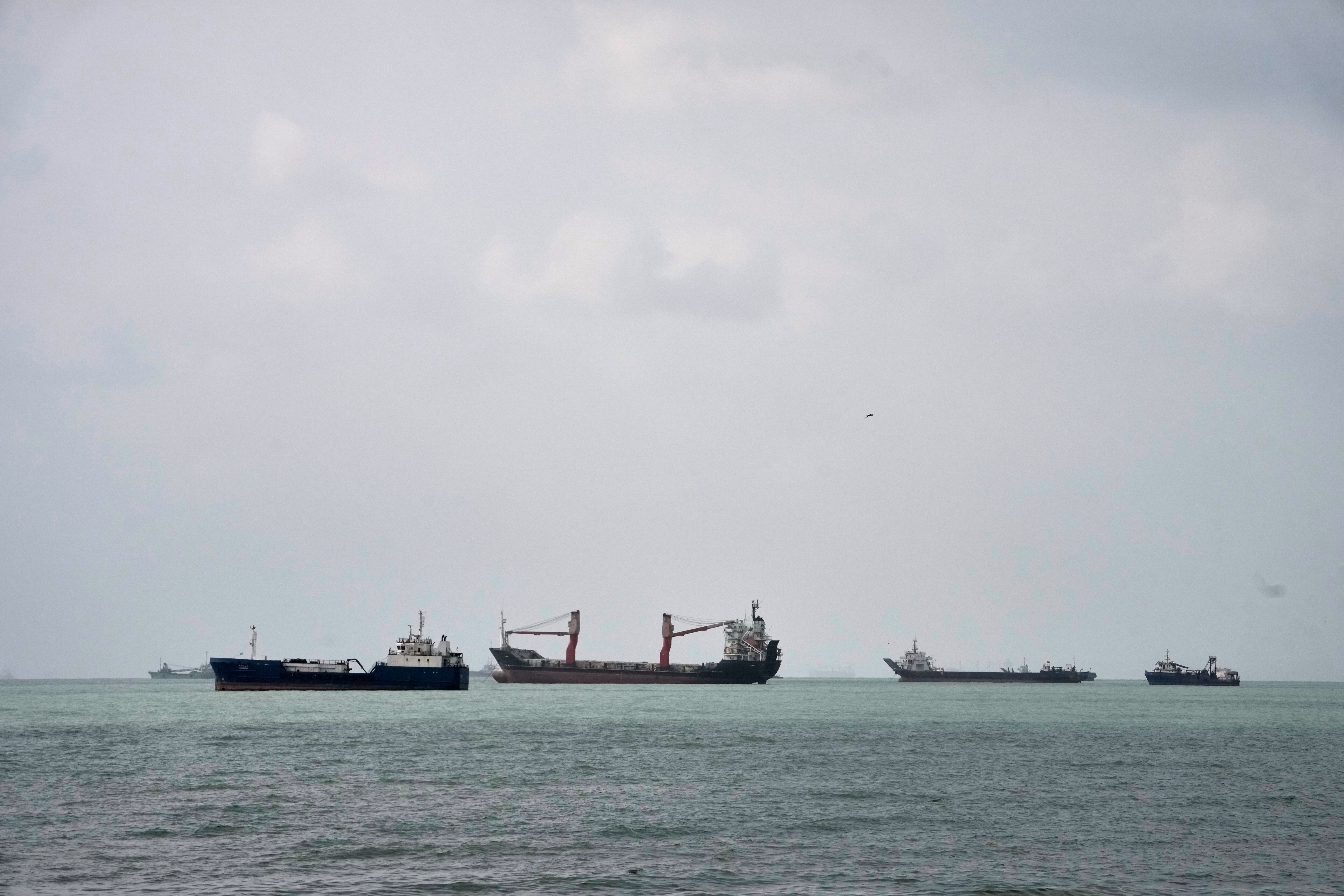
TEHRAN/LONDON/UNITED NATIONS – Iran's Islamic Revolution Guard Corps (IRGC) said Wednesday that if any vessel enters the "restricted zone" to be announced by Iran in regional waters without coordination, it will be subject to the country's sanction measures.
"If a vessel enters this zone without coordination (with Iran), it will be subject to our sanction measures; meaning that if it seeks to use the Strait of Hormuz in the future, it will not be able to do so, and we will also refuse to provide it with port, insurance, and other required services," IRGC spokesman Hossein Mohebbi said, according to the semi-official Tasnim news agency.
He said the zone's exact coordinates will be announced in the future, adding that it will generally begin around Iran's southeastern port city of Chabahar and will include parts of the Gulf of Oman and the Arabian Sea as well as the routes that can lead to the Strait of Hormuz.
He described the Strait of Hormuz as the "strait of Iran's power", adding the country will use that power to respond to the "enemy's aggression" and force it to stop it.
Following US-Israeli strikes on Iran on Feb 28, Tehran restricted passage through the Strait of Hormuz, while US forces imposed a naval blockade targeting vessels traveling to or from Iranian ports and coastal areas.
Also on Wednesday, Iran's Foreign Ministry strongly condemned the US Army's "aggressive" attack the night before against a number of Iranian oil tankers.
Expressing the condemnation in a statement, it said, "The US military attack on Iranian commercial vessels in the Persian Gulf and the Gulf of Oman are considered to be in continuation of the US government's military aggression, naval blockade and economic war against Iran, and in flagrant violation of the United Nations Charter and international law."
It called on the UN and the Security Council to take immediate actions against the "blatant violations" of international peace and security owing to "the US aggressive actions against Iran."
UN chief concerned about escalation over Strait of Hormuz
UN Secretary-General Antonio Guterres is deeply concerned about the latest escalation over the Strait of Hormuz, said his spokesman on Wednesday.
"The secretary-general is deeply concerned by reports of further escalations in and around the Strait of Hormuz over the past days, including attacks against commercial vessels and threats of additional action against maritime and energy infrastructure," said spokesman Stephane Dujarric.
Navigational rights and freedom of navigation in and around the Strait of Hormuz must be fully restored and respected in accordance with international law, said the spokesman.
Explosions in southern Iran
On early Thursday, several explosions were heard in the coastal areas of Iran's southern counties of Sirik and Minab, as well as Qeshm Island, the semi-official Fars news agency reported.
It cited provincial authorities as saying that the blast came from the sea.
The official news agency IRNA quoted official sources as saying that "enemy" projectiles had struck areas in Sirik.
Hours earlier, IRNA reported an explosion Wednesday evening from the Strait of Hormuz, citing its reporter based in the southern Jask County, Hormozgan province.
Nuclear issue to UN Security Council
In an interview with state-run IRIB TV, Iranian Foreign Ministry spokesman Esmaeil on Wednesday denounced the decision by the UN nuclear watchdog's Board of Governors to refer its nuclear issue to the UN Security Council, labeling the resolution "fundamentally irrelevant" after it was passed earlier in the day over alleged nuclear "non-compliance."
Baghaei said Iran has committed no non-compliance, stressing that what they refer to as "non-compliance" stems from the US and Israeli attacks on Iran's nuclear facilities.
ALSO READ: Iran plans 'exclusion zone' outside Hormuz
He also criticized the resolution for demanding Iran fulfill its obligations under the safeguards agreement with the International Atomic Energy Agency (IAEA) while ignoring that Tehran's move to deny the agency access to its nuclear facilities resulted from "aggressive actions" by the United States and Israel.
Merchant vessels attacked in Arabian Gulf, Gulf of Oman
In another development, several merchant vessels came under attack in the northern Arabian Gulf and the Gulf of Oman, the UK Maritime Trade Operations (UKMTO) agency said.
The vessels came under disabling fire amid ongoing military activity in the two areas, the agency said.
UKMTO said it was unable to confirm whether there were any casualties or environmental impacts resulting from the incidents, adding that investigations were ongoing.
