

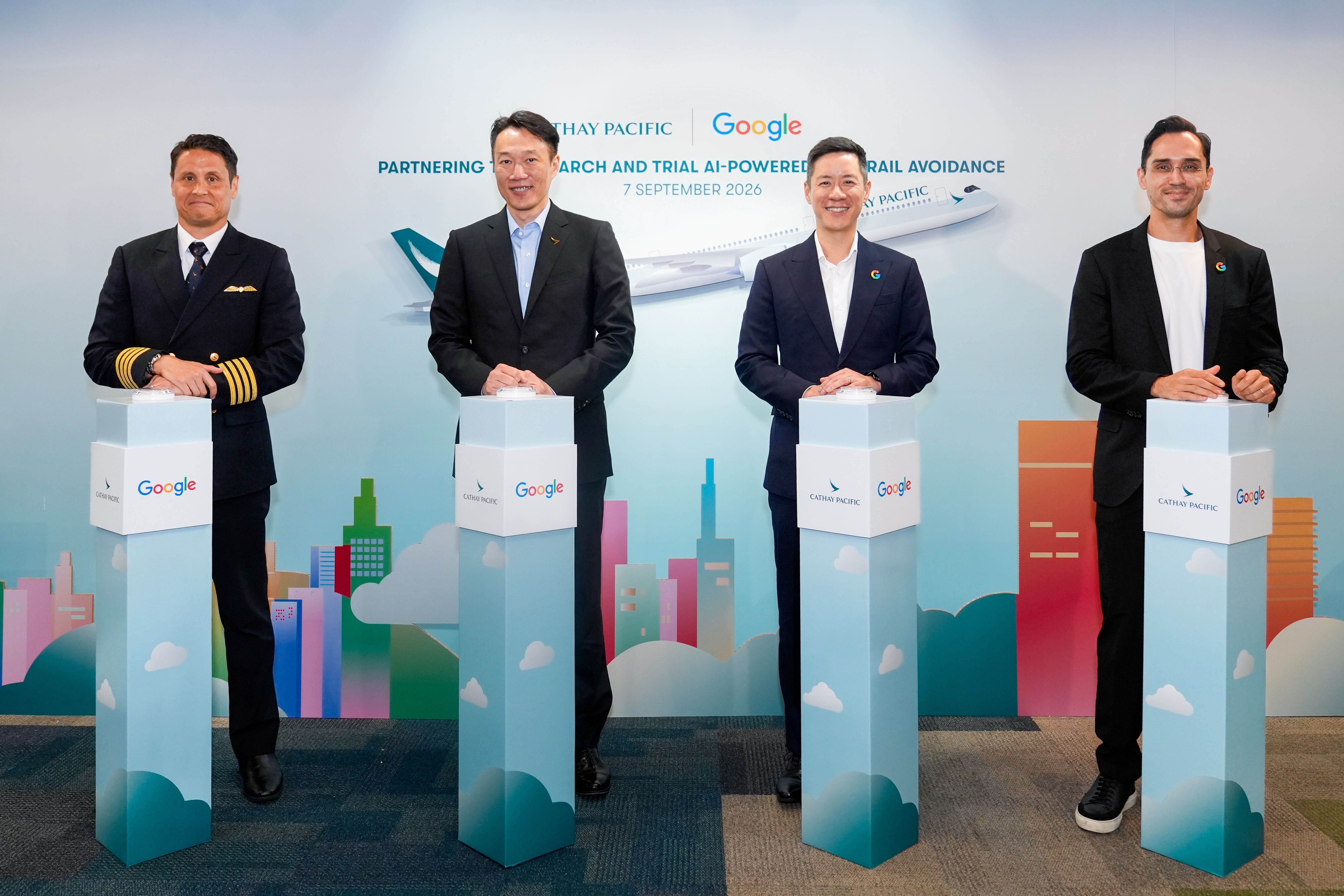
Cathay Pacific, Hong Kong’s flagship carrier, has equipped some of its fleet with artificial-intelligence technology developed by Google to mitigate the formation of contrails — a major source of aircraft emissions.
Cathay was Google's first commercial airline partner in the Asia-Pacific region to test the technology through a trial program, which began late last year.
The innovative system combines satellite images, weather data and AI-powered predictive models to forecast air zones with a high possibility of forming contrails, allowing pilots to make safe altitude adjustments to bypass such zones.
ALSO READ: AI, automation, robot dogs ensure on-site nuclear safety
Contrails are line-shaped exhaust clouds often seen behind jets. They are formed when plane engines’ hot exhaust — composed of vapor water, carbon dioxide and other fuel-combusting emissions — reacts with cold air in high altitudes under certain temperature and humidity conditions. Contrails often dissipate quickly, but some persist and spread into broader clouds that can keep heat in the atmosphere. Previous research suggests persistent contrails could account for one-third of the aviation sector’s climate impact.
At a news conference on Monday, representatives from both companies announced the establishment of a partnership to advance and extend the contrail avoidance trial program, citing the satisfying results yielded so far.
The system has been installed in more than 100 flights across Cathay’s Asia and trans-Pacific routes since the trial’s launch.
Tony Pringle, Cathay’s line operations manager, said the AI-powered system will generate flight plans to help planes avoid zones with contrail-forming conditions.
READ MORE: Celebrities face up to reality of AI image use
The plans will be assessed first by flight dispatchers and delivered to pilots though an application on tablets, he said.
“We have to request any change to the flight path to air-traffic control, and we assess whether conditions like wind temperature, turbulence, anything that may affect any aspects of the flight,” Pringle said. “Safety is always the priority.”
Over 80 flights have followed the routes suggested by the system in the trial, according to Cathay, and Google estimates that these flights reduced the warming effect of contrails by about 40 percent.
The Hong Kong-Singapore route has been picked to participate in the trial as the air corridor has many contrail-forming conditions. The total climate impact reduction achieved by this route accounted for more than half of the overall effectiveness of the entire trial plan, Cathay said.
READ MORE: China launches AI-powered app to combat telecom and online fraud
Lawrence Fong, Cathay’s director of digital and information technology, said the partnership combines Cathay’s operational expertise with Google’s AI prowess.
Encouraged by the initial findings, both companies are preparing for a larger, more-comprehensive second phase. “The goal is to make the second phase larger in scale and get statistically significant results,” said Kemal Armada, Google product manager for climate and AI.
Kemal also said Contrails.org, a nonprofit initiative dedicated to study contrail mitigation, will join the trial in the second phase to deepen scientific understanding of contrail avoidance.
“We still need to have a much bigger system-level change for coordinating all players to do their parts to really in reducing the impact,” said Grace Cheung, Cathay's general manager overseeing group sustainability.
Google has also collaborated with American Airlines to avoid contrails thought AI-powered technology since 2023.
Contact the writer at williamxu@chinadailyhk.com
