

Industry approaches major breakthrough as Chinese companies lead advances in robot embodied intelligence
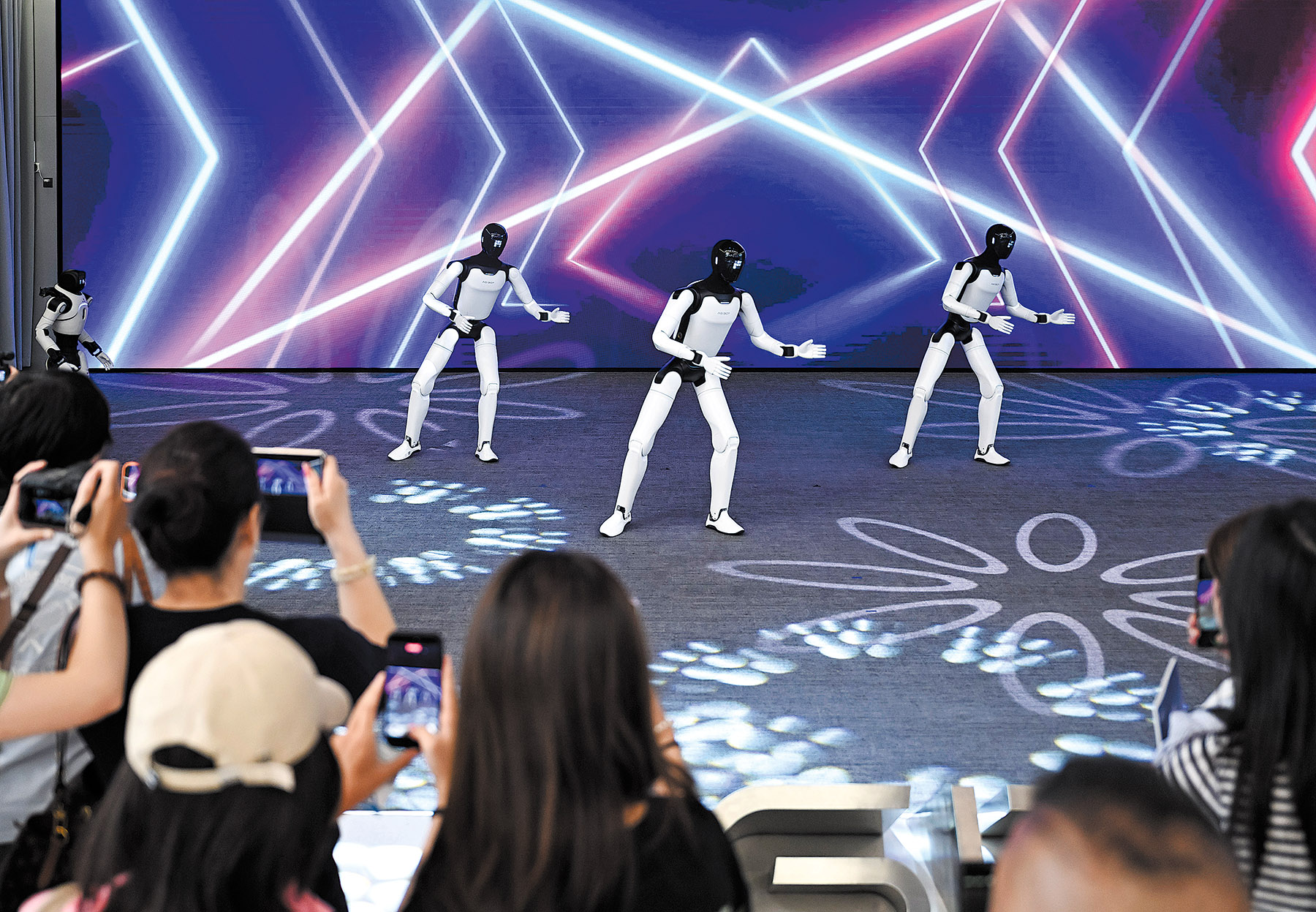
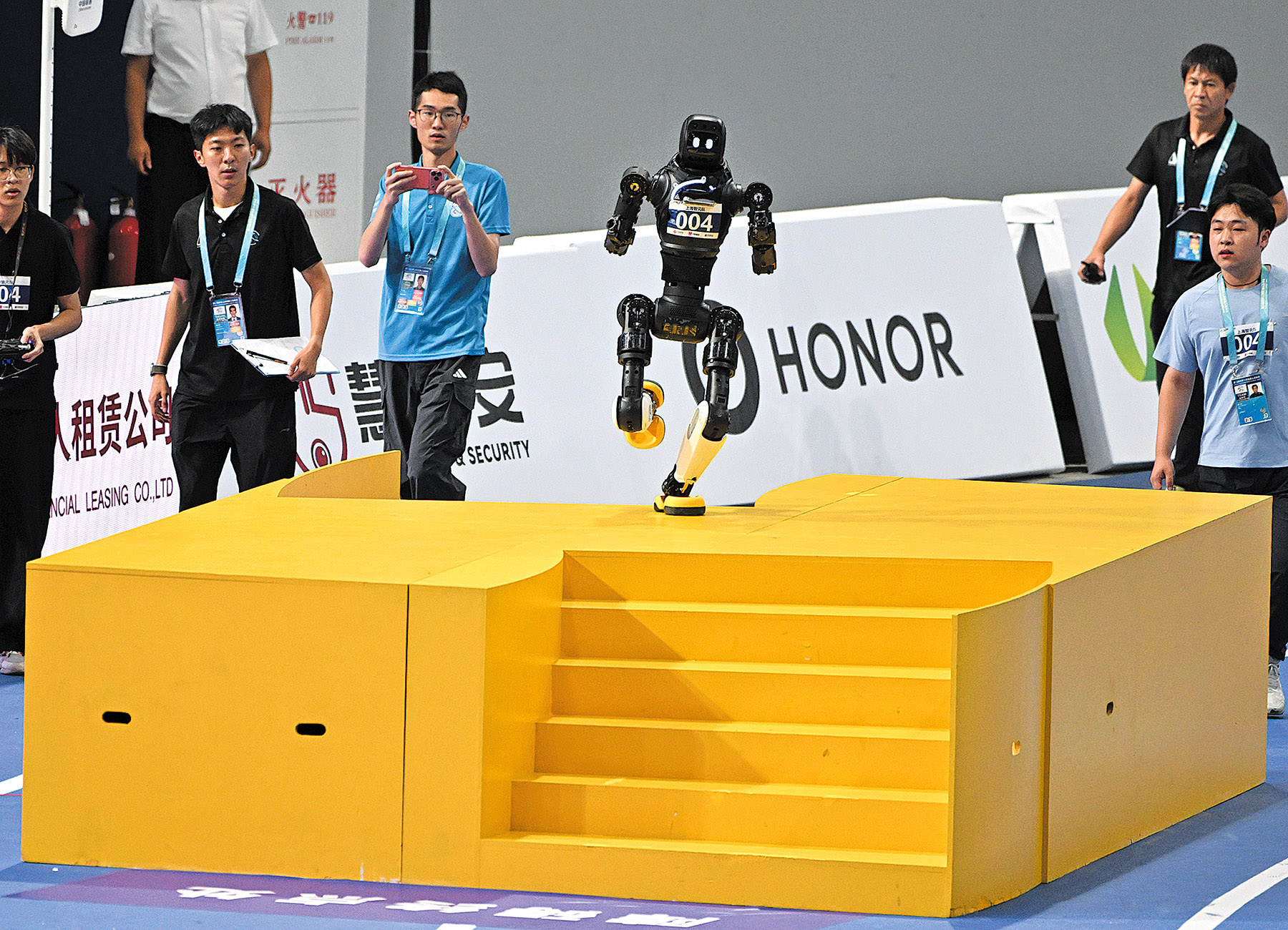
Last month, global attention was focused on the futuristic feats achieved during the five-day World Humanoid Robot Games held in Beijing.
Humanoid robots made in China repeatedly broke human sporting records, including Usain Bolt's 9.58 seconds in the men's 100-meter sprint and Wayde van Niekerk's 43.03 seconds in the men's 400 meters.
As humanoid robots further demonstrate growing capabilities across a variety of fields, companies and professionals across the industry in China are racing to secure a leading position. At the same time, a big question is being asked: Has the "iPhone moment" for humanoid intelligence already arrived?
First used in 2023 by Nvidia CEO Jensen Huang, who referred to ChatGPT as the iPhone moment of AI, the phrase has come to describe a disruptive point when a technology or product moves from a concept to widespread adoption, bringing major changes to an industry and user experience.
READ MORE: Robots rapidly adapt to real-world tasks
Wang Xingxing, founder and CEO of Unitree Robotics, one of China's best-known humanoid robot makers, remained cautious about when embodied intelligence could reach this major turning point.
"Embodied intelligence could reach an industry tipping point similar to a ChatGPT moment in as little as two to three years, or perhaps five to 10 years at the slowest," Wang reportedly told the 2026 World Robot Conference in Beijing on Aug 20. A day earlier, Unitree made its debut on the Shanghai Stock Exchange's sci-tech innovation board, or STAR Market, closing 460 percent higher.
Global pacesetter
The global market for embodied intelligence robots is expected to expand from 94.9 billion yuan ($14.06 billion) in 2025 to 408.4 billion yuan by 2030, according to a paper jointly released by Tencent Cloud and Frost &Sullivan, a US-based consultancy.
Among them, China is the global leader.
By 2030, China is projected to become one of the largest markets, reaching 151.1 billion yuan and accounting for about 37 percent of the global market, according to the 2026 Global White Paper on Embodied AI Technology Innovation and Applications.
Liang Liang, deputy secretary-general of the Chinese Institute of Electronics, said China accounted for 90 percent of global humanoid robot production in 2025.
Global shipments of humanoid robots in the first half of 2026 reached 19,100, with Chinese manufacturers making up 97 percent of the total, a Bloomberg and Smart Analytics Global report released last month showed.
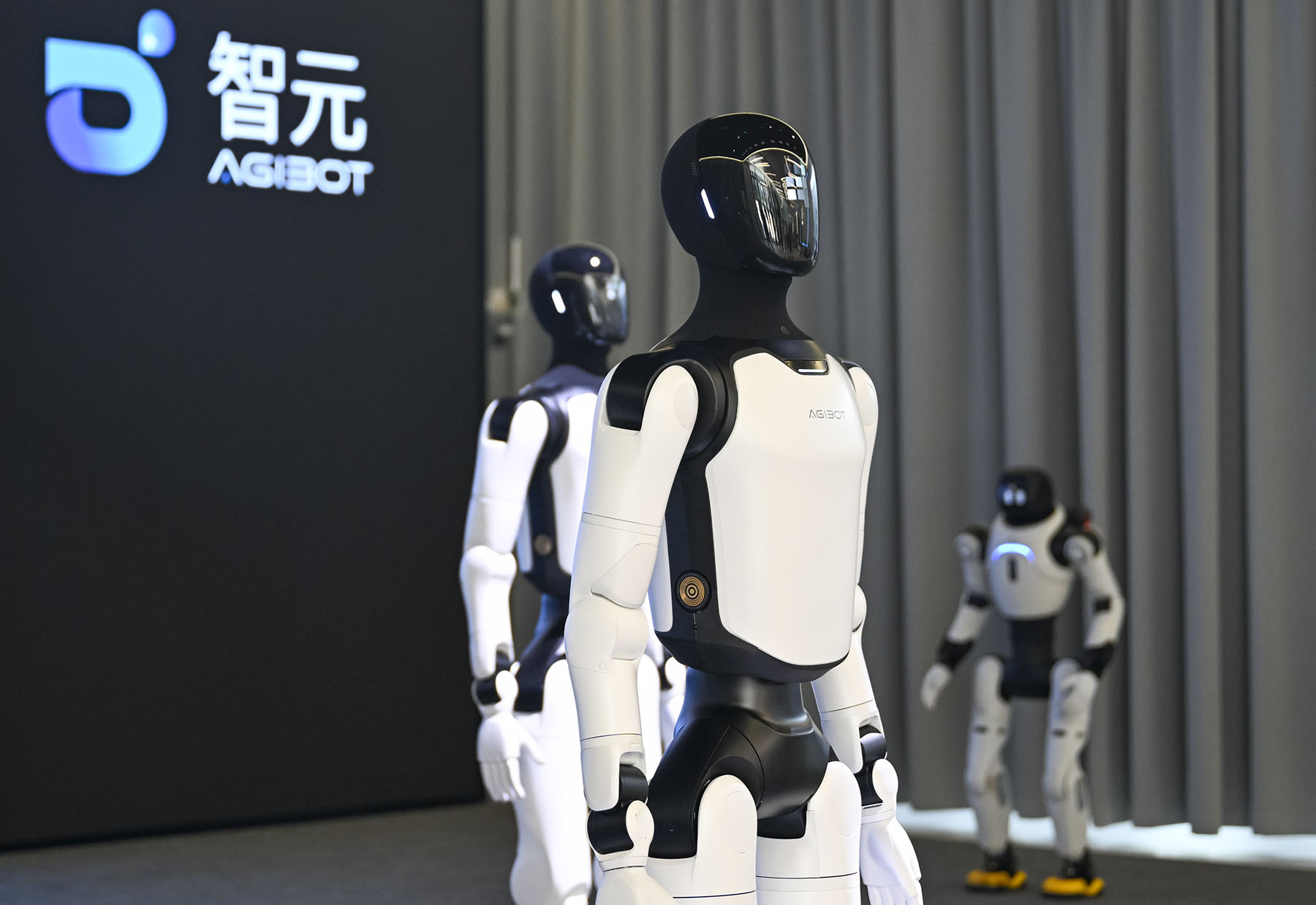
Chinese humanoid robot developers have set their sights on shaping the industry, as evidenced by the advances on display during the 2026 World Artificial Intelligence Conference in Shanghai in July.
Tencent unveiled a series of technology and product upgrades in embodied intelligence and intelligent agents. For embodied AI agents, the company introduced the TairosAgent framework and the Apexio agent, which can integrate the robot's left and right brains, cerebellum and body, enabling continuous perception, decision-making and action.
The Tairos platform, launched in 2025, received an upgrade. It will provide open-source capabilities and services, lowering barriers across the development process and helping bring embodied AI into real-world scenarios faster.
"Robotics is developing rapidly, but the entire industry is working hard to bring these technologies into real-world applications," said Zhang Zhengyou, chief scientist of Tencent and director of the Tencent Robotics X Laboratory.
Zhang believes the robotics industry may follow a path similar to the smartphone market.
Some robot makers may develop a complete ecosystem, covering everything from hardware to software and applications, while others may focus on robot hardware while separating intelligent systems, similar to the Android model.
"There is no single best approach for embodied intelligence companies. Apple, Google and Samsung have all succeeded with different models, and the world will not be built around just one approach," Zhang noted.
Chen Yudong, director of heterogeneous computing research and development at Tencent Cloud, Tencent Holdings Ltd's cloud computing business, said the demand for computing power in embodied intelligence has grown particularly fast over the past year, with areas such as autonomous driving seeing growth rates of 200 to 300 percent.
Zheng Yong, founder and CEO of Geek+, a Beijing-based intelligent robot company, said the value of embodied AI will ultimately be proven in real customer scenarios. "This has been our focus over the past 11 years and will remain our priority for the next decade," Zheng said.
At the conference, Geek+ unveiled Gravity, a unified embodied AI framework for long-horizon complex tasks, along with its core foundation model, the Gravity 4D. The framework is designed to give robots "physical intelligence", enabling them to understand the 3D world, think before acting, and improve function through real-world deployment.
The company also launched its one core, dual engine strategy for advancing general-purpose embodied intelligence, which links model improvement, data feedback and large-scale deployment, to accelerate the commercialization of embodied AI.
"Through the Gino Eco ecosystem initiative, we hope to work with the industry to turn technological visions into measurable business value and productivity gains," Zheng said.
Chen Xi, co-founder of Geek+, who is also CEO of Geek+ Embodied Intelligence Technology Co, said about 30 percent of the company's business comes from China and 70 percent from overseas markets. It serves leading customers across sectors including global e-commerce, healthcare, retail, automotive and new energy manufacturing.
According to Chen, a large number of embodied AI companies emerged in 2024. As a company that has been deeply involved in robotics for years, it recognized the shift in the industry and established an AI R&D team that year to focus on general-purpose robots and general embodied AI models.
"We have now deployed more than 72,000 robots, with tens of thousands of workstations operating in real-world scenarios, providing valuable sources of data for continuous improvement," said Chen.
In Chen's view, for robotics companies the key challenge will be building multi-agent systems that allow different types of robots to work together efficiently in business processes and handle more complex and unexpected scenarios.
From a market perspective, embodied intelligent robots are at a critical stage of transition from technological accumulation to rapid growth, said the paper by Tencent Cloud and Frost & Sullivan.
Race for the future
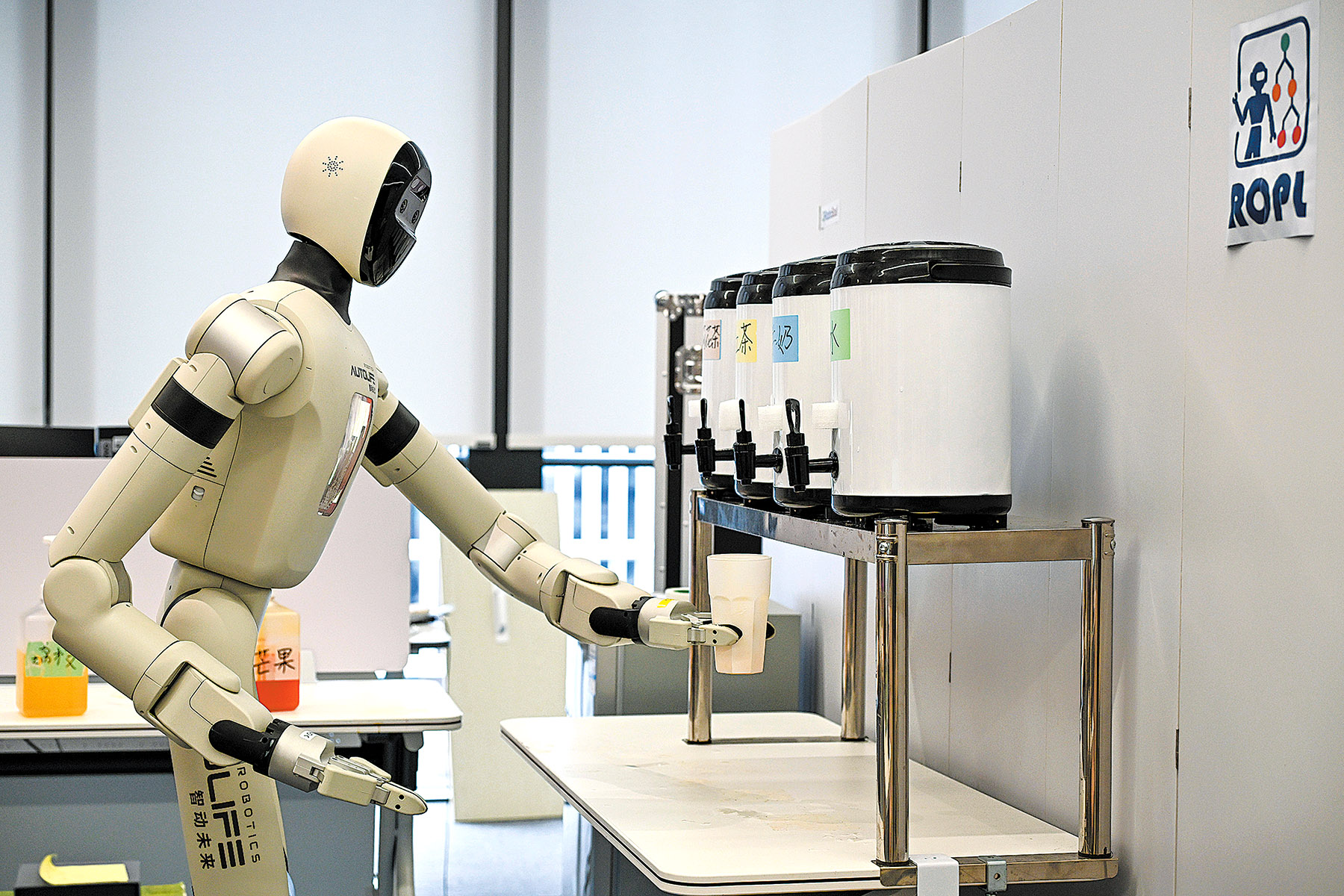
Unitree's Wang said his company is continuing to bring its robots into real-world settings. The robots have already been deployed in automobile factories, while the company's AI team is testing their capabilities in home settings. But he acknowledged that the company has not yet launched large-scale deployment because the robots still fall short in overall efficiency and versatility.
Wang said the "ChatGPT moment" for embodied intelligence can be measured by a clear benchmark: robots should be able to successfully complete about 80 percent of tasks in 80 percent of unfamiliar settings based on voice or text instructions.
The biggest challenge now, Wang said, is aligning the inputs and outputs of AI models with physical robots.
Xu Li, chairman and CEO of Chinese artificial intelligence company SenseTime, said: "Technological breakthroughs and real-world applications rarely happen overnight. Instead, they are built through continuous progress over time."
According to Xu, another important turning point is approaching as world models bring robots a deeper understanding of the physical world.
"Definitions and interpretations of world models may vary, but their core lies in learning the rules of the real world and using them to reason and complete long-horizon tasks in physical environments," Xu noted.
He said the true value of AI is not to replace people, but to enhance human capabilities, expand what individuals can achieve and create more development opportunities.
Next strategic focus
Embodied intelligence is seen as a concept or approach, while intelligent robots serve as one of its main application forms. Industrial robots, service robots and other types of robots can be examples of embodied intelligence when they are able to sense their surroundings, make decisions and interact independently.
Humanoid robots are a more advanced form of intelligent robots. Their human-like design is seen as a promising path toward general-purpose embodied intelligence, as they can better adapt to environments designed for people.
According to the Tencent Cloud and Frost& Sullivan paper, the growth of the embodied intelligent robot market will extend far beyond robot manufacturing itself.
"It will drive the development of upstream technologies such as general AI models, perception and decision-making systems, simulation platforms and cloud computing infrastructure, while expanding into downstream applications including industry, logistics and elderly care, creating a broader ecosystem," the paper said.
Zhang Zhengyou, Tencent's chief scientist, said: "The embodied intelligence industry is still in its early stage and has not yet reached large-scale commercial deployment. Leading robot companies, including Dobot Robotics, Unitree Robotics and AgiBot, are continuing to refine their technologies in real-world scenarios."
"Bringing robots into practical applications requires sustained efforts in both systems development and engineering," he added.
Zhang said that from a broader perspective, China is facing a growing aging challenge, while the shortage of younger caregivers is becoming increasingly evident. Elder care could become an important application area for intelligent robots.
"I hope more investment can flow into this sector and support the development of care robots," Zhang added.
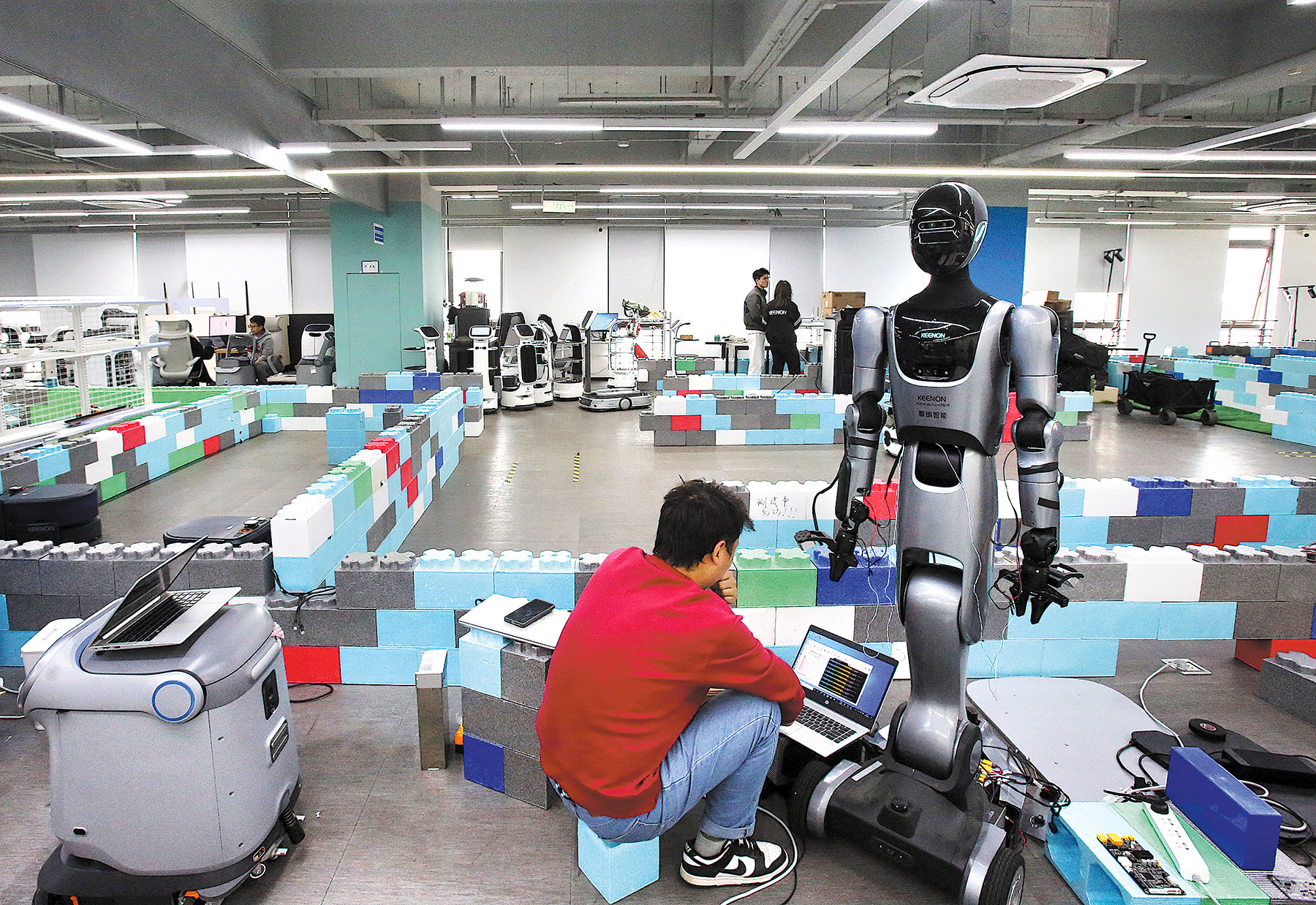
Shanghai still winning
As embodied intelligence has been identified as a key development area under China's 15th Five-Year Plan (2026-30), Shanghai is well positioned to build a world-class AI industry cluster, providing solid support for the growth of new quality productive forces.
"Shanghai has built a relatively complete embodied intelligence industry chain, with several products achieving mass production," said Chen Jie, vice-mayor of Shanghai.
On July 19, the nation's first demonstration center for embodied intelligence training was launched in Shanghai during a forum at the World Artificial Intelligence Conference. The facility is expected to help enable Chinese intelligent humanoid robots to serve global needs.
Formally known as the Embodied AI Training Demo Center, it was jointly launched by the National and Local Co-built Humanoid Robotics Innovation Center and Huawei, with the aim of leveraging real-world scenarios and high-quality data resources to create a role model for embodied intelligence training worldwide.
"Data factories are expected to become a standard tool for technology companies. Supported by domestic public platforms, they can help reduce R&D costs and provide comprehensive support for the development of new technologies and applications," said Jiang Lei, the center's chief scientist.
ALSO READ: Robot on the line
The launch of the center is one of a series of efforts by the National and Local Co-built Humanoid Robotics Innovation Center to boost the humanoid intelligence industry.
In 2025, Shanghai's action plan for embodied intelligence development designated Zhangjiang in Pudong New Area as the core area for building the industry's full value chain. The district is now accelerating the coordinated growth of an AI innovation town and robot valley to strengthen its embodied AI ecosystem.
Zhangjiang has already attracted more than 130 companies across the embodied intelligence industry chain, including nearly 80 involved in the humanoid robot sector. With coverage of more than 70 percent of key segments across the embodied AI value chain, the area is gradually forming a high-end embodied AI manufacturing cluster within a 150-kilometer radius.
Gan Xiaobin, deputy director of the Department of Science and Technology under the Ministry of Industry and Information Technology, said at a news conference of the 2026 WAIC, with large language models, intelligent agents and AI chips advancing rapidly, China's annual production of humanoid robots is expected to surpass 100,000 units this year.
Contact the writers at wang_ying@chinadaily.com.cn
