

City’s innovation landscape, strategic positioning are fostering a rising talent hub
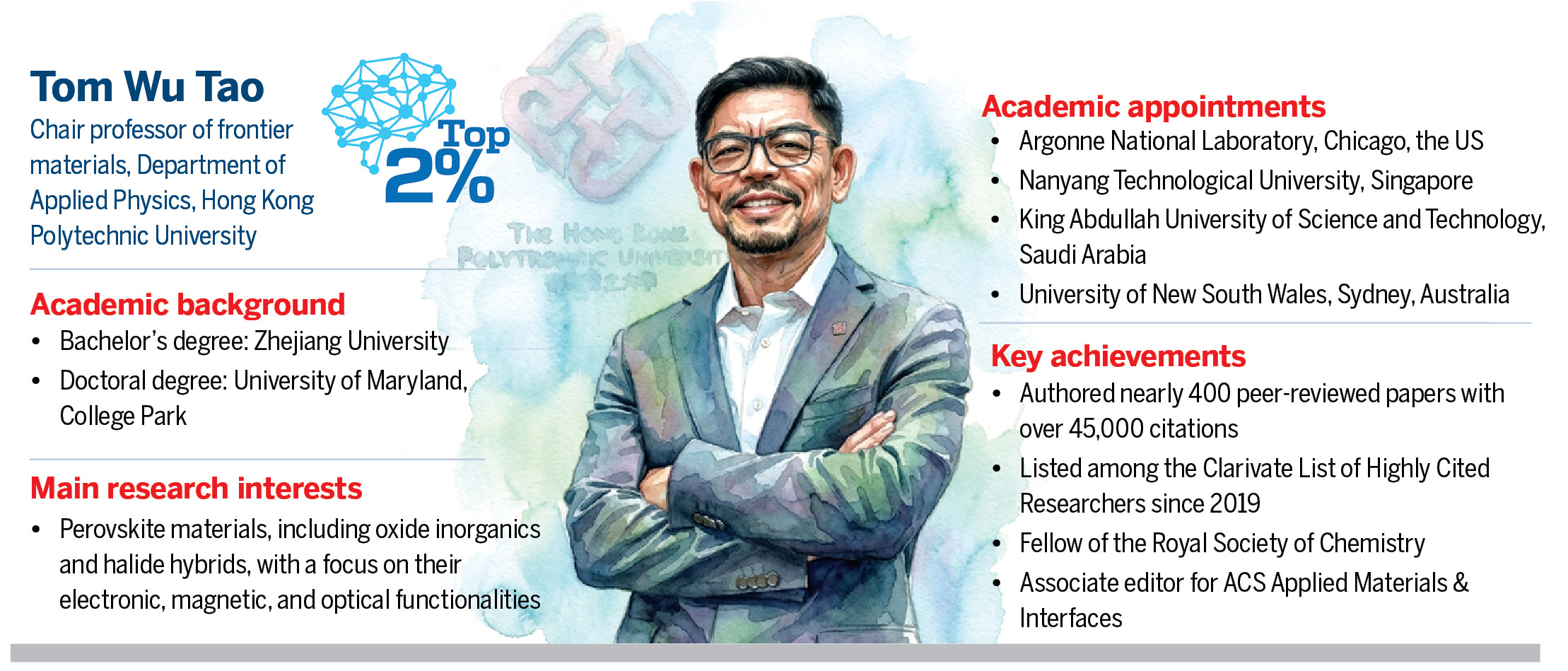
According to materials scientist Tom Wu Tao, Hong Kong’s academic research on perovskites — frontier materials driving breakthroughs in high-efficiency solar cells, light-emitting diodes and ultrasensitive photodetectors — ranks within the top global tier.
The research could generate a surge in industry adoption and mass production by tapping into the industrial bases in the nearby Chinese mainland provinces of Guangdong and Fujian, Wu said.
Wu was listed by Stanford University among the top 2 percent of most-cited scientists in his field in 2025 and is also recognized by Clarivate, a leading global analytics and information company, as one of the most-cited researchers worldwide. He joined Hong Kong Polytechnic University as chair professor of frontier materials in late 2022.
Explaining his decision to relocate to Hong Kong, Wu, who has worked across multiple countries, told China Daily that he was drawn to the city by its innovation-oriented academic environment — an advantage that is expected to be further strengthened with the development of the Northern Metropolis.
Wu’s research focuses on perovskites, which are among the world’s most closely watched frontier materials and a key focus of China’s 15th Five-Year Plan (2026-30). The national blueprint calls for fostering emerging industries and explicitly positioning new materials as a foundational pillar for modernizing the country’s industrial system.
Wu described perovskites as “what materials scientists have always dreamed of — something that can emit light and generate electricity at the same time”. With their low cost and exceptional properties, perovskites have demonstrated game-changing potential in energy, optoelectronics, and environmental technologies over the past decade.
For instance, thanks to years of scientific research, the conversion efficiency of perovskite solar cells has soared from under 4 percent in 2009 to nearly 28 percent today for single-junction devices and over 35 percent in tandem configurations — far outpacing silicon’s decades-long progress and making perovskites the fastest-improving materials in the photovoltaic sphere.
According to Fortune Business Insights, the global perovskite solar cell market was valued at $101.02 million in 2025 and is projected to reach $3.27 billion by 2034.
Prospects, challenges facing HK
Wu said Hong Kong is in the top echelon for perovskite research, with particular strengths in mechanistic studies, interface engineering and structural stability.
Hong Kong’s unique position provides fertile ground for this success, Wu said. “The city maintains a strong voice in international academia, while the (Guangdong-Hong Kong-Macao) Greater Bay Area’s industrial and manufacturing strengths lie right at its doorstep.”
He said that Hong Kong’s five world-class universities have strong academic capabilities, interdisciplinary freedom, and a culture of high-risk, high-reward research. Combined with a highly internationalized social landscape and multiple talent attraction programs, the city has drawn a critical mass of top scholars and researchers.
Moreover, its substantial government funding, strong intellectual property protection and deep capital pools seamlessly accelerate promising innovations from lab to market, he added.
Wu also said that as part of the Greater Bay Area, Hong Kong is well positioned to connect research, capital and industry resources in the vast mainland markets. Scientists can conduct foundational research and build early-stage prototypes in Hong Kong, while engineering scale-up and application validation take place in mainland cities — creating an ideal division of labor for frontier materials.
To further amplify this synergy, Wu suggested authorities could further dismantle policy barriers and improve information-sharing, enabling other Greater Bay Area cities, all in Guangdong, along with other coastal provinces like Fujian, to gain faster access to Hong Kong’s latest research breakthroughs.
Wu envisions Hong Kong building a complete commercialization pipeline locally but notes current limitations. The city lacks a comprehensive industrial base, particularly in materials manufacturing, pilot-scale testing and engineering capabilities. Land constraints and manufacturing economics hinder large-scale deployment, such as gigawatt-level photovoltaic lines.
He looks to the planned university town in the Northern Metropolis as a potential solution, and hopes it will set aside dedicated space for universities to conduct experiments and testing.
His own team at present is focused on integrating materials science with artificial intelligence, and has recently published research results in the journal Science Advances demonstrating how machine learning and high-throughput calculations were used to significantly accelerate the development of next-generation photovoltaics and optoelectronic materials.
Wu said he believes AI is opening a new era for materials research and his own professional journey, and he was impressed by Hong Kong’s commitment to increasing its investment substantially in AI. This “strong alignment” was a key reason why he decided to relocate to the city, he said.
A thoughtful repositioning
“Coming to Hong Kong was not simply a career move,” Wu said. “It was the outcome of a long (period of) introspection — as someone who had lived abroad for three decades — about where the world of research is heading, and where I want to reposition myself.”
Born in 1973 in Liaoning province’s Fushun, a city in Northeast China known for its coal production, Wu earned his bachelor’s degree in physics from Zhejiang University before pursuing further studies in the United States. Later, he held academic positions in Singapore, Saudi Arabia and Australia.
Wu said that amid rising geopolitical tensions in recent years, he has observed that many overseas-based Chinese scholars have faced new hurdles, including difficulties in student recruitment as some countries have tightened visa applications.
In late 2021, Wu heard about the Hong Kong Global STEM Professorship Scheme, launched in June that year to attract top international STEM (science, technology, engineering and math) scholars and their teams. After careful consideration, he applied for the program and relocated to Hong Kong with his family in late 2022.
“The process was very smooth,” Wu said, reflecting on his relocation to and life in the city over the past three years.
Beyond research, Wu appreciates Hong Kong’s vibrant culture, efficient services, and natural landscape — its mountains and coastline provide an outdoorsy family such as his own with much to enjoy and explore.
He added that the city’s many attractions are gaining recognition among researchers worldwide. Several of his former colleagues, whose academic footprints span across the globe, have joined Hong Kong’s universities via the city’s various talent programs. Most of them — with or without Chinese descent — integrated quickly into local life.
Drawing from his experience in Singapore, Wu said he believes local institutions should open more doors to Southeast Asian students and researchers. He said that many young researchers in the region — including those from less-developed countries — are bright and hardworking. And culturally, Hong Kong is closer to their respective homelands than Europe or the US are.
Attracting talent is only the first step, Wu said; the bigger challenge lies in how to persuade them to stay.
The cost of living in Hong Kong, especially housing expenses, remains a significant hurdle for young researchers. Describing this as a “structural challenge“, Wu said he hopes the Northern Metropolis’ development will help ease the city’s land and housing pressures.
He also called for refining the research evaluation and career development systems for young academics. In materials science, for instance, the journey from academic innovation to industrial application typically spans eight to 12 years. He hopes to ease the constraints of excessive performance metrics on innovation and basic research, thus reducing the anxiety and cutthroat competition that researchers face early in their careers.
“I hope Hong Kong can go further — attract talent, retain them, and truly enable them to thrive here,” Wu said.
Contact the writers at amberwu@chinadailyhk.com
