

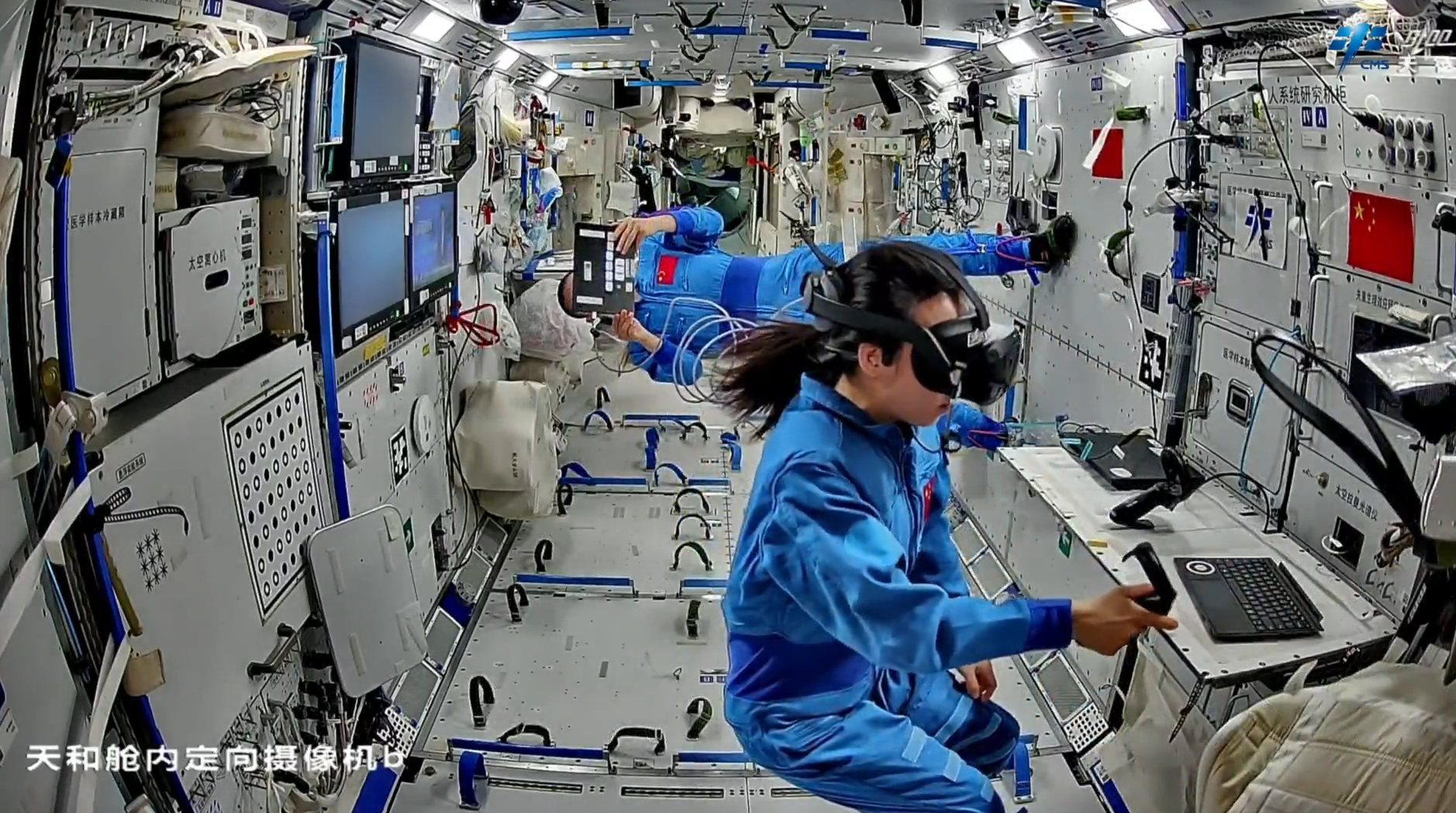
Marking more than 70 days in orbit on the Tiangong space station, Lai Ka-ying, the first astronaut from Hong Kong, and her colleagues on the Shenzhou XXIII manned space mission continued their experiments to make new discoveries, including interacting with a robot and monitoring their muscles under microgravity conditions.
According to a video released by China's Manned Space Program on Tiangong TV, Lai and her crewmates Zhu Yangzhu and Zhang Zhiyuan completed interactive experiments with the robot Xiaohang and underwent behavioral tests while wearing VR equipment from Aug 2 to 8.
In the field of aerospace medicine, the crew used ultrasound diagnostic equipment to complete ultrasound examinations of the soleus, quadriceps, and erector spinae muscles, and conducted grip strength tests using manipulative force measurement equipment.
In the grip strength test, Lai gripped the testing device tightly, putting all her strength into it, while simultaneously squatting down to exert force.
The data obtained will be used to conduct research related to the remodeling of sensitive muscle groups.
ALSO READ: HK's Lai, crewmates reach 60-day orbital mark with experiments
In the multi-person collaborative interface experiment, Lai donned a VR headset, conducting behavioral tests with her teammates, including single-person perception experiments and two-person collaborative experiments.
The three astronauts also interacted with the robot Xiaohang, conducting touch interaction tests and collecting relevant data to optimize subsequent on-orbit robot movement planning methods.
In addition, long-term research on the kinematic characteristics of astronauts in orbit and the dynamics of the space treadmill under microgravity conditions were also conducted simultaneously. Structured light 3D cameras were used to collect data of the astronauts using the space treadmill, which will provide fundamental data support for subsequent research by ground-based scientists.
READ MORE: HK's Lai, astronauts hold experiments as they near two-month mark in space
According to arrangements in the field of space microgravity physics, the crew replaced the experimental samples inside the fluid physics experimental cabinet, completed the cleaning of samples in the containerless experimental chamber, maintained the central mechanism, and cleaned the viewing window cover lens.
Regarding the care of the space station assembly platform, the crew carried out cabin environment cleaning and material organization work.
The crew also completed abdominal, cardiac, and vascular ultrasound examinations, and actively carried out in-orbit training to counteract the physiological effects of weightlessness.
