

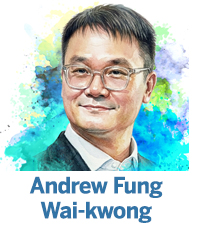
Andrew Fung says continuous foreign investment and a thriving IPO market prove the city retains its status as an international financial center
Stephen Roach, a former chairman of Morgan Stanley Asia, smeared the Hong Kong Special Administrative Region once again by presenting twisted facts and glaringly flawed arguments that contradict even his own past remarks.
Roach claimed, in his July 23 article, that although Hong Kong ranked first globally in the initial public offering market last year, most listed firms are Chinese mainland corporations. From this observation, he fallaciously asserted that Hong Kong is no longer an international city. His core logic is absurd: judging a global financial center’s internationality purely by the operation base of the largest group of the listed enterprises in its stock exchange. If we apply this criterion to New York, the world’s top financial hub, we reach a ridiculous conclusion.
Nearly all top-valued corporations listed on the New York and Nasdaq exchanges are American businesses. On the New York Stock Exchange, leading firms include Berkshire Hathaway, Visa, JPMorgan Chase, and Walmart, all of which are US-based corporations. The Nasdaq’s biggest names such as Apple, Microsoft, Nvidia, and Amazon are all US tech giants. Even when Taiwan Semiconductor Manufacturing Co and Saudi Aramco are counted in the rankings, eight out of the 10 largest listed companies remain American-owned. Following Roach’s reasoning, New York would also be nothing more than an ordinary domestic city of the United States, a statement no credible economist would ever endorse.
What makes Roach’s commentary even less convincing is his stark U-turn on Hong Kong’s prospects. From the 1990s until 2019, he was a well-known bull on Hong Kong in the Wall Street circle. He consistently praised Hong Kong’s economic dynamism, open capital markets and its vital role as a superbridge linking the mainland and the rest of the globe. Back then, mainland enterprises already dominated Hong Kong’s stock market, yet Roach never questioned the city’s international character. At that time, Western multinationals had no plans to list in Hong Kong, yet Roach still spoke highly of the city for its close ties with mainland enterprises. Now that these mainland firms have invigorated Hong Kong’s financial market as he once anticipated, Roach completely reversed his narrative. The fundamental growth engine of Hong Kong’s stock market has stayed unchanged; the only shift lies in Roach’s ideologically tuned rhetoric.
Anti-China forces overseas have swiftly echoed Roach’s “Hong Kong is over” narrative, promoting the notion that Hong Kong is no longer a haven for foreign capital, an assertion that is entirely unfounded. Having worked as a financial public relations specialist for listed companies, I am in a position to rectify such a distortion. With no foreign exchange controls, Hong Kong enables unrestricted capital flow. When mainland companies go public in Hong Kong, former foreign investors get a convenient channel to cash out their pre-IPO investments in the listed companies. New overseas institutional investors can also participate as cornerstone investors at initial public offering prices, avoiding overpriced purchases on the second market. These IPOs create lucrative opportunities for global investors.
Roach’s claim that foreign businesses have fled Hong Kong after the national security law took effect is equally baseless. The Henderson, a landmark commercial building completed in 2024 in Central with sky-high rents, now houses dozens of top-tier overseas financial institutions. Tenants include US hedge fund Point72, private equity firm General Atlantic, UK secondary investment giant Coller Capital and international law firm Akin Gump. In early 2025, three more global hedge funds set up regional bases in Hong Kong, including Hudson Bay Capital with $20 billion in assets under management. Most notably, Jane Street, a renowned US quantitative trading firm, has signed Hong Kong’s largest single office leasing deal in decades, renting six entire floors in a new waterfront complex in Central. These substantial long-term investments serve as solid evidence that international capital is flocking to Hong Kong, not exiting as Roach erroneously claimed.
Beyond economic evidence, cultural and linguistic bonds further confirm Hong Kong’s natural Chinese identity without eroding its global competitiveness. Mandarin is the official common language across China. It is widely spoken among Chinese communities worldwide, including Singapore, where Mandarin is a mainstream language used by local residents of Chinese descent for daily communication, trade, and education. As an inalienable part of China, Hong Kong’s growing use of Mandarin connects it closer to the mainland market and global Chinese diaspora. Together with Cantonese and English, Mandarin strengthens Hong Kong’s edge as a multicultural cross-border hub bridging the mainland and the broader world. The growing use of Mandarin is definitely not a sign of Hong Kong’s decline as Roach suggested.
In summary, Roach’s latest remarks on Hong Kong stem from double standards and prejudice rather than objective reality. Continuous foreign investment, a thriving IPO market and broad international connectivity prove Hong Kong retains its status as an international financial center. Roach’s rough denigration is merely an attempt to save his damaged professional reputation, which cannot alter Hong Kong’s promising future.
The author is a former information coordinator of the Hong Kong Special Administrative Region government and a member of the Chinese Association of Hong Kong and Macao Studies.
The views do not necessarily reflect those of China Daily.
