

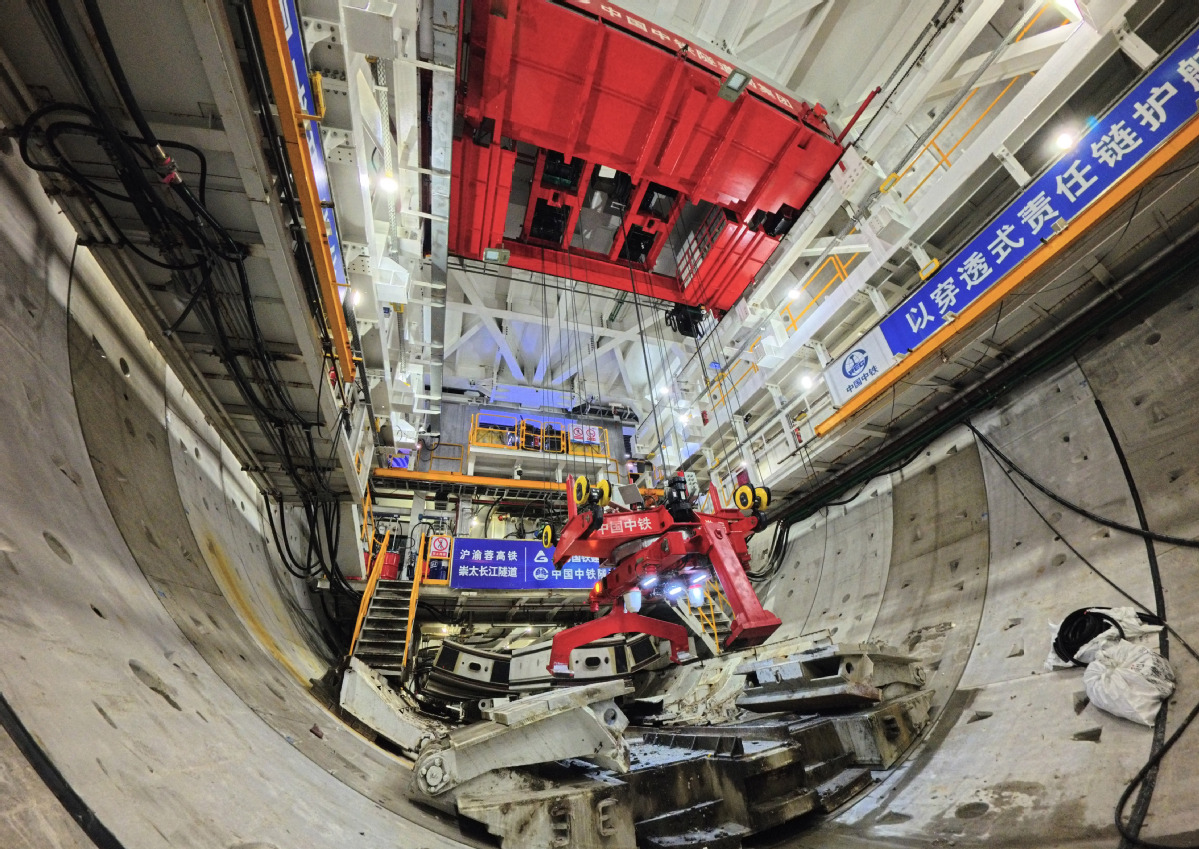
A giant shield tunneling machine developed by China for high-speed railway projects completed on Thursday the underwater section of a tunnel traversing the Yangtze River — a breakthrough that will allow trains to run beneath the river at a top speed of 350 kilometers per hour without slowing down.
The machine, named Linghang, which translates as "navigator", bored a continuous 11.325-kilometer underwater passage from Chongming Island in Shanghai to a reception shaft near Taicang, Jiangsu province, without using any intermediate shaft, setting a world record for the longest continuous underwater drive by a 15-meter-class shield machine, according to the China Railway Tunnel Group, the builder of the project.
READ MORE: Yangtze River underwater rail project goes full speed ahead
The tunnel, with a total length of 14.25 km, forms a critical link in the Shanghai-Nanjing-Hefei section of the planned 2,100-km Shanghai-Chongqing-Chengdu High-Speed Railway, a major east-west route along the Yangtze.
The full tunnel is expected to be completed by the end of this year. Once operational, it will end Chongming's lack of high-speed rail access, and cut the travel time from Chongming via Taicang to Shanghai's Baoshan Railway Station to just 17 minutes, compared with 2 hours by road, significantly improving regional connectivity.
Li Bin, chief engineer of the project, said the Linghang measures 148 meters in length and weighs around 4,000 metric tons, and it features a 15.4-meter ultra-large cutterhead, making it the world's largest-diameter tunneling equipment for high-speed railway construction.
The machine operates as a mobile underground production line, with its rotating cutterhead boring through the riverbed and integrated systems removing soil while simultaneously erecting pre-cast concrete segments to form the tunnel lining, engineers said.
"To allow high-speed trains to cross the river at full speed, we had to get three things right — the tunnel had to be wide, precisely aligned and structurally stable," Li said. "Achieving all three simultaneously was extremely challenging, as subsurface conditions are highly variable and not every risk can be anticipated."
For engineers, maintaining an exceptionally straight alignment was critical. "Any deviation had to be restricted within a machining tolerance of millimeters. There was simply no margin for sharp curves or uneven gradients," Li said.
The soft, unstable strata near the Yangtze estuary made the tunneling work especially challenging. At its deepest point, the tunnel sits 89 meters beneath the water surface, which is equivalent to the height of a 30-story building. This, Li said, subjects the structure to hydrostatic pressure nearly nine times that of normal atmospheric level.
Since any movement in the riverbed could induce long-term tunnel deformation, engineers reinforced both the surrounding ground and the tunnel structure. Automated systems tracked subsurface conditions in real time, fine-tuned the alignment of the machine and maintained earth-pressure balance throughout the underwater tunneling work, the China Railway Tunnel Group said in a statement.
ALSO READ: Shield machine achieves Yangtze tunnel milestone
As the project continued directly beneath the Yangtze's busiest shipping lanes and critical flood-control levees, construction was tightly managed to prevent interference with navigation routes and safeguard the integrity of the flood-defense system, it said.
Protecting the Yangtze's ecology was also a major concern, as the tunnel passes beneath a protected fish habitat, the statement said. A fully enclosed slurry system captured and recycled the muck and turbid water generated during tunneling, while engineers maintained tight pressure control at the cutting face to minimize disturbance to the riverbed and aquatic life, it added.
The Linghang needs to carry out another 1.8 km of tunneling work — mostly land-side tail sections and ancillary tasks — before the critical high-speed railway tunnel is fully constructed by the end of this year.
Contact the writers at luowangshu@chinadaily.com.cn
