

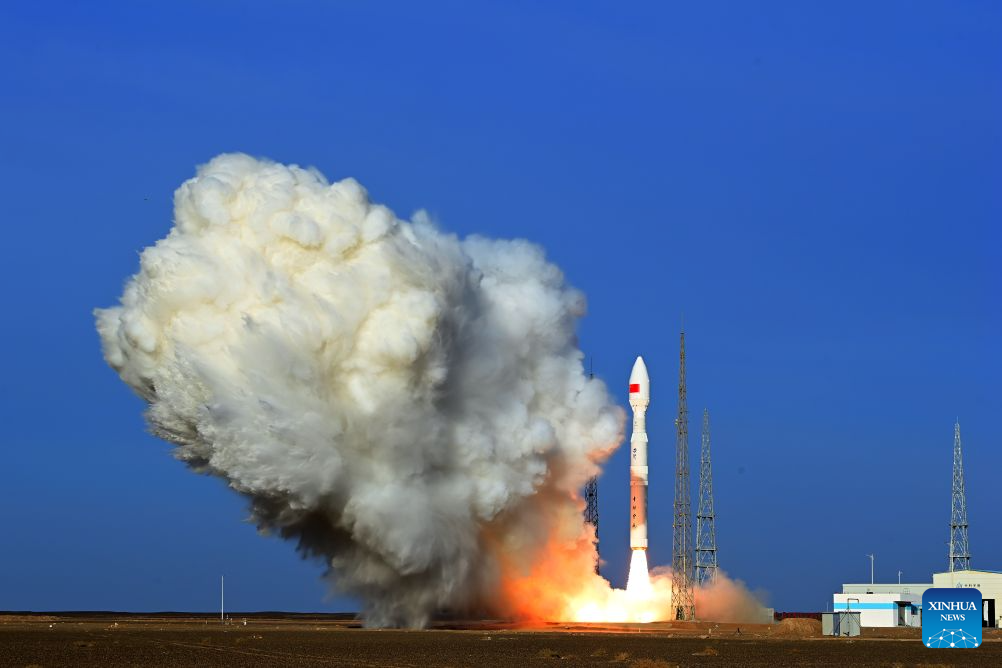
BEIJING – China has begun deploying its first commercial constellation dedicated to space debris monitoring, a 120-satellite network that aims for round-the-clock all-orbit target detection.
The first satellite of the Gande Constellation lifted off on Friday aboard a Lijian-1 commercial rocket from Northwest China.
The successful launch fills a gap in China's commercial space-based debris monitoring capabilities and marks "a key step in space traffic management," according to Fan Wei, chief engineer of the constellation.
Developed by ATmoto Technology, a Beijing-based private aerospace company, the constellation is planned in three phases, with full deployment targeted before 2030.
The first phase, designated LX630, will consist of 14 satellites. Jointly built by Liangxi Aerospace Technology Group in East China's Wuxi and ATmoto Technology, these satellites are designed to support comprehensive monitoring and cataloging of targets across low, medium and high orbits.
The developers highlighted that the first satellite is equipped with an onboard artificial intelligence-aided computer, which enables the satellite to flexibly carry out routine surveillance, emergency response and rapid tracking missions, without frequent ground intervention.
It also features orbital transfer capability, allowing it to conduct close-range observation and other sophisticated in-orbit operations, the developer added.
ALSO READ: China's most powerful single-body rocket debuts
As the number of rocket launches, planetary missions and satellite activities continues to grow, so does the junkyard in space.
Last year, China's Shenzhou XX crewed spaceship experienced an extended stay at the Tiangong space station due to its return capsule viewport window having suffered an impact from space debris during its mission.
In 2024, meanwhile, the Shenzhou XVII crew carried out two spacewalks to repair the core module's solar wings, which had also been damaged by orbital debris.
According to media reports, the number of space debris pieces larger than one centimeter, which is big enough to pose a potential threat to spacecraft, was estimated to have surpassed one million. These fragments are hurtling at a speed of approximately 7.9 km per second, carrying immense kinetic energy upon impact.
While scientists are working to enhance spacecraft shielding against debris strikes, they are also stepping up monitoring efforts, and the planned Gande Constellation is the latest such endeavor.
Interestingly, the constellation shares its name with Gande, a Chinese astronomer from the Warring States period (475-221 BC), who is credited with some of the earliest known star catalogs.
READ MORE: Chinese aerospace leaders engage industrial thrust
Its developer has noted that the second phase of the project will add 36 satellites equipped with high-resolution imaging and electromagnetic environment sensors, while the third phase will add 70 AI-enabled satellites for object recognition, behavioral analysis and autonomous decision-making.
