

Once confined to framed silk artworks, traditional needlework is expanding into global brands, cultural experiences and digital platforms, reshaping a centuries-old craft into a fast-evolving creative industry, Yang Feiyue reports in Suzhou.
A Zippo lighter engraved with Suzhou silk embroidery. A Hello Kitty collaboration reimagined in fine stitches. A porcelain tea canister in which silk embroidery is embedded into ceramic form.
These objects do not immediately resemble what many would associate with Suzhou embroidery, or Suxiu, one of China's most refined traditional crafts with a history spanning more than two millennia.
Yet for Zhang Xue, a fourth-generation embroiderer based in Suzhou, Jiangsu province, they represent exactly where the craft is heading.
"We believe almost anything can be embroidered," he says, presenting a series of collaborations that span global brands, lifestyle products and cultural intellectual properties.
READ MORE: Embroidery converses across centuries
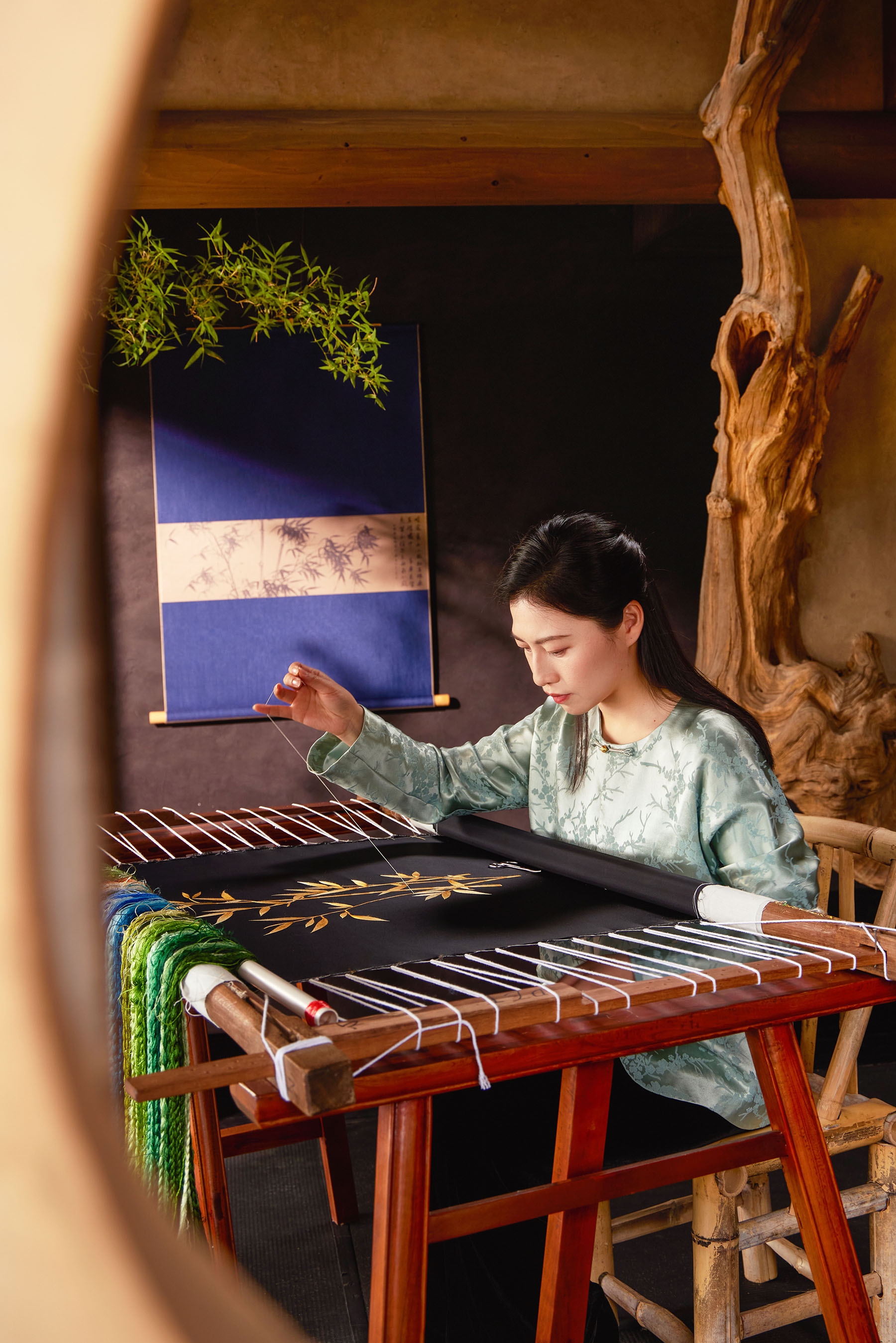
For centuries, Suzhou embroidery was defined by its delicacy and restraint, with silk threads layered into landscapes, flowers, birds and figures with near-photographic precision. Traditionally framed as artworks or high-end decorative pieces, they were meant to be observed rather than used.
But a quiet transformation is underway.
Across Suzhou, embroidery is increasingly moving beyond the frame into products, experiences, educational systems, and digital platforms that are reshaping how the craft is made, taught and consumed.
Zhang's trajectory reflects this shift.
Born into a family of embroiderers spanning four generations, he grew up surrounded by silk threads, wooden frames and the rhythmic repetition of needlework. His mother continues to specialize in traditional fine embroidery, often reproducing classical Chinese paintings with meticulous detail, while earlier generations of his family devoted their lives to mastering classical techniques.
Zhang, however, has taken a different path that leads outward from tradition rather than inward.
He has worked on nearly 100 collaborations with intellectual property holders and brands, ranging from international consumer labels to Chinese fashion companies and lifestyle brands.
These projects vary widely in scale. Some involve limited-edition collectible pieces, while others adapt embroidery designs into patterns for broader commercial use.
For Zhang, the craft is no longer confined to framed works.
"It can become a language for communicating with contemporary audiences," he says.
One of his most distinctive experiments lies in combining embroidery with porcelain. Working with ceramic makers, he developed pieces that integrate silk embroidery into ceramic vessels, ranging from tea canisters to decorative vases.
The concept draws on three symbolic materials long associated with China's cultural exchange with the world: silk, tea and porcelain. By combining them into a single object, Zhang aims to reinterpret traditional cultural symbols through contemporary design logic.
The result is something in between — a hybrid object shaped by heritage and market demand.
While designers like Zhang are pushing embroidery into new commercial territories, another transformation is unfolding on the ground, in the form of participation.
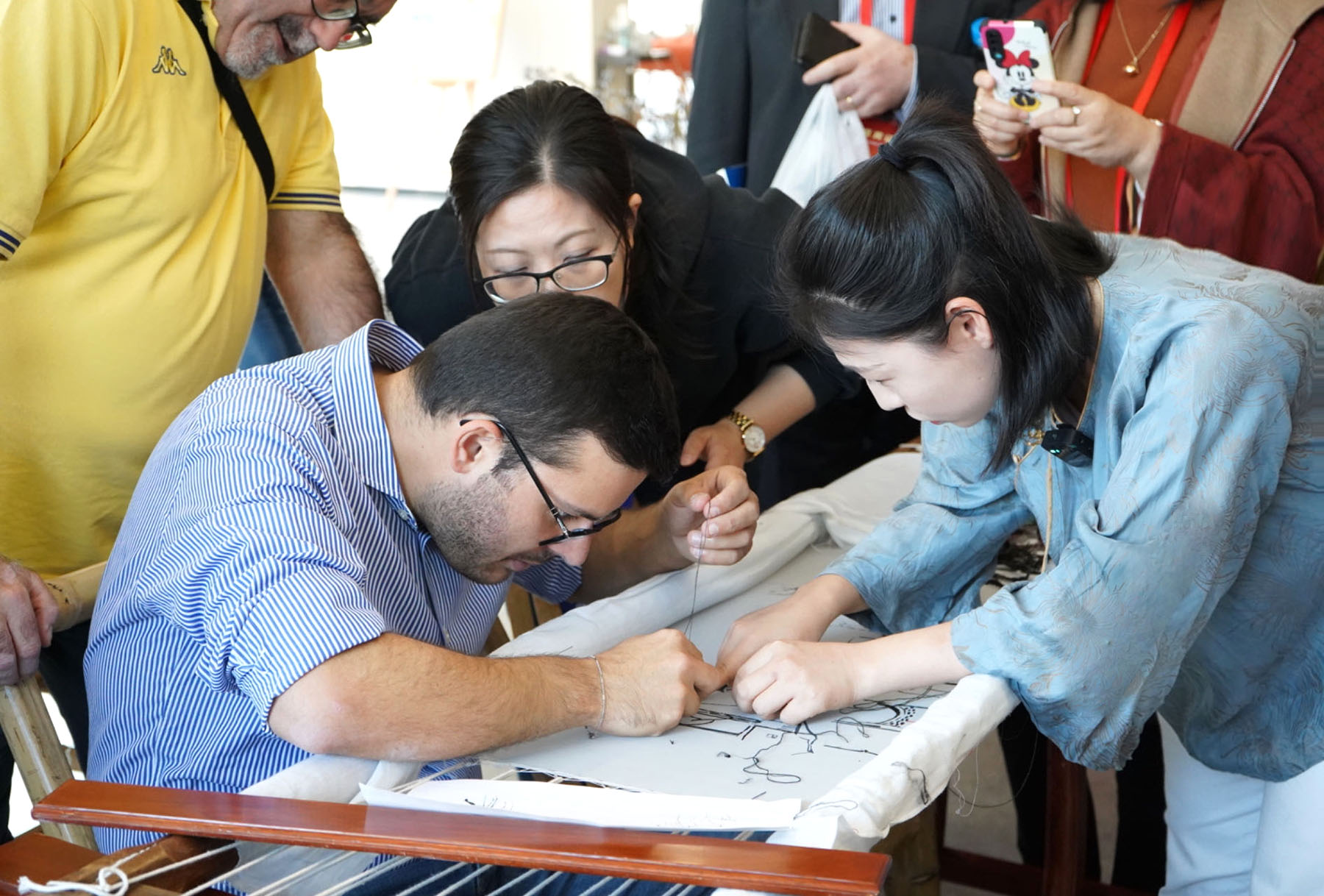
At a Suzhou embroidery experience center operated by practitioner Wu Haoxi, visitors are not simply observers but also makers.
Students, tourists, corporate groups and international guests have been invited to pick up needles and try their hand at stitching basic patterns. For many, it is their first encounter with embroidery as a tactile experience, Wu notes.
The center hosts hundreds of activities each year, ranging from school programs to cultural exchanges involving visitors from home and abroad.
For Wu, embroidery is as much about memory as it is about technique.
"I grew up watching my family stitch," she says. "By the time I picked up a needle, it felt like continuing a conversation that had been going on for generations."

Participants often begin hesitantly, struggling with threading needles or maintaining even stitches. But by the end of a session, many leave with a completed bookmark or hand-held fan.
"The experience is all about the memory of having touched the thread," Wu says.
Beyond tourism and experience-based learning, Suzhou embroidery is also developing structured talent pipelines that extend beyond the city.
One such initiative involves trainees from Jinzhou in Northeast China's Liaoning province. A group of around 100 young learners was brought to Suzhou for intensive training, beginning with foundational stitching techniques and gradually moving toward design concepts and creative applications.
The program is divided into phases, consisting of initial training at vocational institutions, followed by hands-on learning in Suzhou-based workshops. After completing their training, participants are expected to return to their home region, where they can contribute to the development of local embroidery industries.
The model reflects an emerging approach in heritage industries: distributed cultivation. In this system, Suzhou functions as a training hub for wider regional development.
The approach is also reflected in the broader education structure surrounding embroidery in the city, which now spans primary school courses, university electives, vocational programs and public workshops.
Behind these changes is a sustained framework of institutional support.
Suzhou high-tech zone, also known as Suzhou New District, has been one of the key centers of embroidery development. It has established a structured system of support for traditional textile crafts and provided funding for embroidery-related talent development projects since 2017.
In addition to financial support, the region has built physical and cultural infrastructure to support industry clustering, including embroidery-themed commercial streets, exhibition spaces and museums. Together, these form an integrated cultural environment that connects production, display and commerce.
Rather than treating embroidery solely as a heritage asset, local development strategies increasingly position it as part of a broader cultural and creative industry.
Recent local initiatives have begun exploring how artificial intelligence, digital design tools and cross-border e-commerce systems can be integrated into traditional craft production.
In May, Suzhou high-tech zone launched a program known as the "Stars Plan", which includes an "AI embroidery" support system developed to provide design tools, digital services and international market access for practitioners.
ALSO READ: Traditional brands use technology to meet modern demand
Despite rapid transformation, many embroiderers emphasize continuity rather than disruption.
One of Wu Haoxi's most personal works, Child's Eye View of the World, began with drawings made by her daughter. A child's sketch of Beijing's Tian'anmen was translated into silk thread, forming part of a broader composition that depicts everyday life, educational scenes and cultural exchange.
A single red thread runs through the entire piece, linking each scene.
For Wu, that thread represents connection — not only between individuals and generations, but also between tradition and modern life.
"The techniques remain rooted in history, and the silk remains unchanged, but the contexts in which embroidery exists have expanded," she says.
Contact the writer at yangfeiyue@chinadaily.com.cn
