

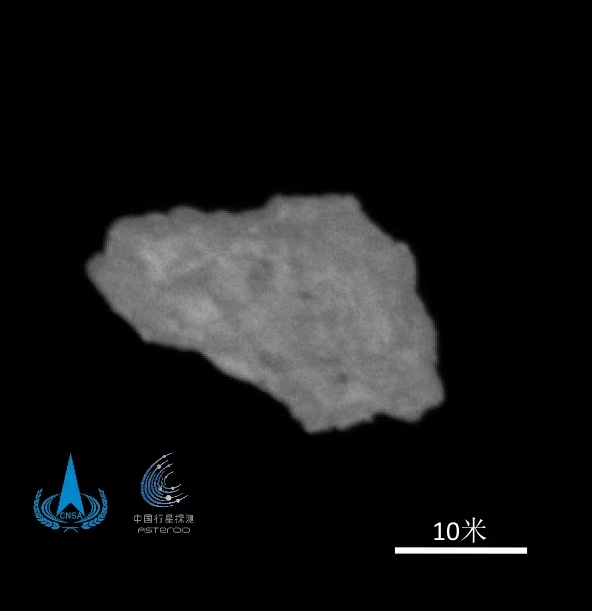
China's Tianwen 2 asteroid sampling spacecraft rendezvoused with its target — a near-Earth asteroid called 2016 HO3 — and has begun to carry out scientific surveys, the China National Space Administration announced on Monday
According to the administration, the Tianwen 2 robotic probe reached a position about 20 kilometers away from 2016 HO3 last week and started traveling alongside the asteroid.
Prior to that, the spacecraft had traveled around 1 billion km in a 400-day interplanetary journey, the CNSA noted, adding that the probe will conduct detailed scientific explorations in a phased manner to acquire data on the asteroid's topography, material composition, and internal structure to support preparations for the sampling mission.
ALSO READ: Tianwen 2 spacecraft halfway to target asteroid
During Tianwen 2's approach to the asteroid, the probe obtained images of the celestial body — the CNSA released one such image taken by the craft's camera. While the position of the asteroid was previously determined solely by ground-based observations, the mission team used optical navigation data — which was collected during the approach process — to refine the asteroid's ephemeris and reduce its position error from hundreds of kilometers down to the kilometer scale, according to the administration.
The Tianwen 2 mission, which is China's first attempt to bring pristine asteroid samples back to Earth, was launched on May 29, 2025, when a Long March 3B rocket carrying the robotic probe blasted off from the Xichang Satellite Launch Center in Sichuan province.
En route to the asteroid, the probe carried out a series of operations, including deep-space maneuvers and mid-course corrections.
On June 6, the craft detected and identified the asteroid for the first time. The next day, it executed capture control at a distance of 30,000 km from the asteroid, achieving coplanar flight with the celestial body. It reached a position about 2,000 km from the asteroid on June 19.
The 2016 HO3, also known as 469219 Kamo'oalewa, orbits the sun and, therefore, is a constant companion of Earth. While it is too distant to be considered a true satellite of Earth, it is the best and most stable example to date of a quasi-satellite.
The Tianwen 2 will study the celestial body up close using a suite of 11 instruments — including cameras, spectrometers, and radars — before deploying special devices to collect surface substances.
