

Beijing is willing to work with Dhaka to maintain good-neighborly relations
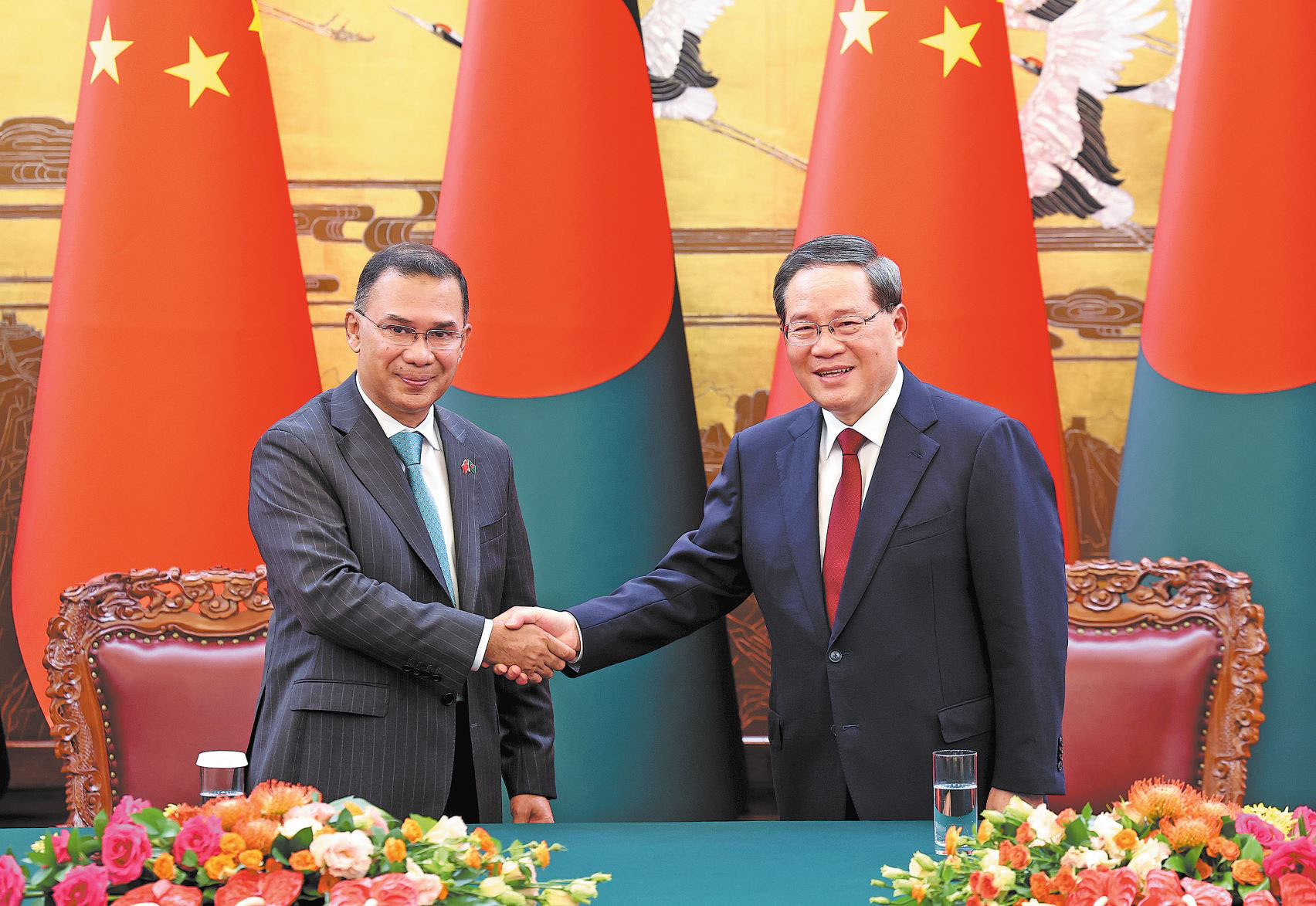
China and Bangladesh signed an array of cooperation agreements on Thursday as the two countries vowed to enhance bilateral ties.
Premier Li Qiang and visiting Bangladeshi Prime Minister Tarique Rahman witnessed the signing of the documents after their talks at the Great Hall of the People in Beijing.
On Wednesday, Rahman began a three-day official visit to China, his first to the country after assuming office in February. He also attended the opening plenary of the 17th Annual Meeting of the New Champions of the World Economic Forum, or the Summer Davos forum, in Dalian, Liaoning province.
READ MORE: Bangladesh PM Tarique Rahman to visit China
During their talks, Li expressed China's willingness to work with Bangladesh to maintain good-neighborly relations, consolidate strategic mutual trust, expand practical cooperation and continuously achieve greater development in bilateral ties to deliver more benefits to the people of both countries.
China is willing to work with Bangladesh to promote high-quality Belt and Road cooperation, steadily advance major landmark projects in port and water conservancy, and strengthen cooperation in trade, industrial and supply chains, and finance to promote the common development and prosperity of both countries, he said.
The premier expressed the nation's readiness to import more high-quality products from Bangladesh, support Chinese enterprises in investing in the South Asian country and expand cooperation in emerging industries such as new energy, digital economy and artificial intelligence.
China hopes that Bangladesh will continue to provide a favorable environment for Chinese enterprises, he said.
Noting that both China and Bangladesh are developing countries, Li said that China is willing to enhance multilateral coordination with Bangladesh to defend common interests, promote solidarity and self-reliance among developing countries, and make greater contributions to the development of the Global South.
Rahman said the Bangladeshi government firmly adheres to the one-China principle, and looks forward to maintaining close high-level exchanges with China and promoting economic, trade and cultural cooperation under the framework of the Belt and Road Initiative.
Bangladesh firmly defends the postwar international order based on the Cairo Declaration, the Potsdam Proclamation and the United Nations Charter, supports the vision of a community with a shared future for humanity and the four major global initiatives proposed by China, he said.
Bangladesh is willing to strengthen multilateral communication and coordination with China to promote regional and global peace, stability, and development, he added.
Among multiple cooperation items, the flagship Padma Bridge, built by Chinese companies, has become a model of partnership between the two countries. Chinese enterprises have also participated in solar and wind power projects in Bangladesh, supporting efforts to diversify the energy mix and wean the country off fossil fuels.
ALSO READ: Summer Davos closes, highlighting China's role in scaling up innovation
Imtiaz Ahmed, executive director of the Centre for Alternatives, a policy research forum based in Dhaka, the capital of Bangladesh, said that Rahman's visit to China is expected to help bring Bangladesh back onto its development trajectory through deeper bilateral cooperation.
Investment should be high on the agenda for the new Bangladeshi government, as investment had declined over the past two years amid political uncertainty and instability, Ahmed said in a recent interview with Xinhua News Agency.
He said that apart from infrastructure, Bangladesh also expects more investment in the health, education and energy sectors. "There is strong public support for China and for Chinese investment," he said.
Contact the writers at caodesheng@chinadaily.com.cn
