

Chinese companies positioning themselves as indispensable architects of region's future green power landscape
As Southeast Asia accelerates its shift away from fossil fuels, Chinese energy companies are positioning themselves as the indispensable architects of the region's future green energy landscape.
Facing the mutual challenges of surging electricity demand, climate change and the urgent imperative for economic decarbonization, the two regions are actively forging a highly integrated, resilient clean energy network that transcends geographic boundaries. This macro-level partnership is being anchored by concrete, massive capital injections.
The US-based Center for Strategic and International Studies said China represents both a significant and a wide-ranging investment partner in Southeast Asia's energy sector, a role that has become increasingly important as Southeast Asian countries pursue ambitious energy transitions while safeguarding energy security.
READ MORE: Green projects power up China-ASEAN ties
A senior Singaporean official said Chinese energy enterprises are acting as vital contributors to Southeast Asia's extensive green transition initiatives, which center on linking regional power grids.
This strategy could culminate in a massive cross-border network stretching from Singapore to southern parts of China, crossing through intermediate nations like Malaysia and Thailand, said Puah Kok Keong, chief executive of the Energy Market Authority, Singapore's energy regulator.
Puah highlighted that this regional push would unlock fresh avenues for Chinese enterprises, which already enjoy technological dominance across key sectors and maintain a strong project presence in the area.
"China stands as the undeniable global leader not only in implementing solar infrastructure and smart-grid battery storage, but also in manufacturing and exporting the core technologies underpinning them," he said. "When developers need to execute solar-plus-storage projects efficiently, Chinese suppliers are typically the go-to choice for speed, cost-effectiveness and dependability."
Chinese companies have recently confirmed deals to deliver several major energy infrastructure projects in the region. Among these, the China General Nuclear Power Group and China Southern Power Grid cross-border initiatives stand out as premier examples of this accelerating regional clean energy integration.
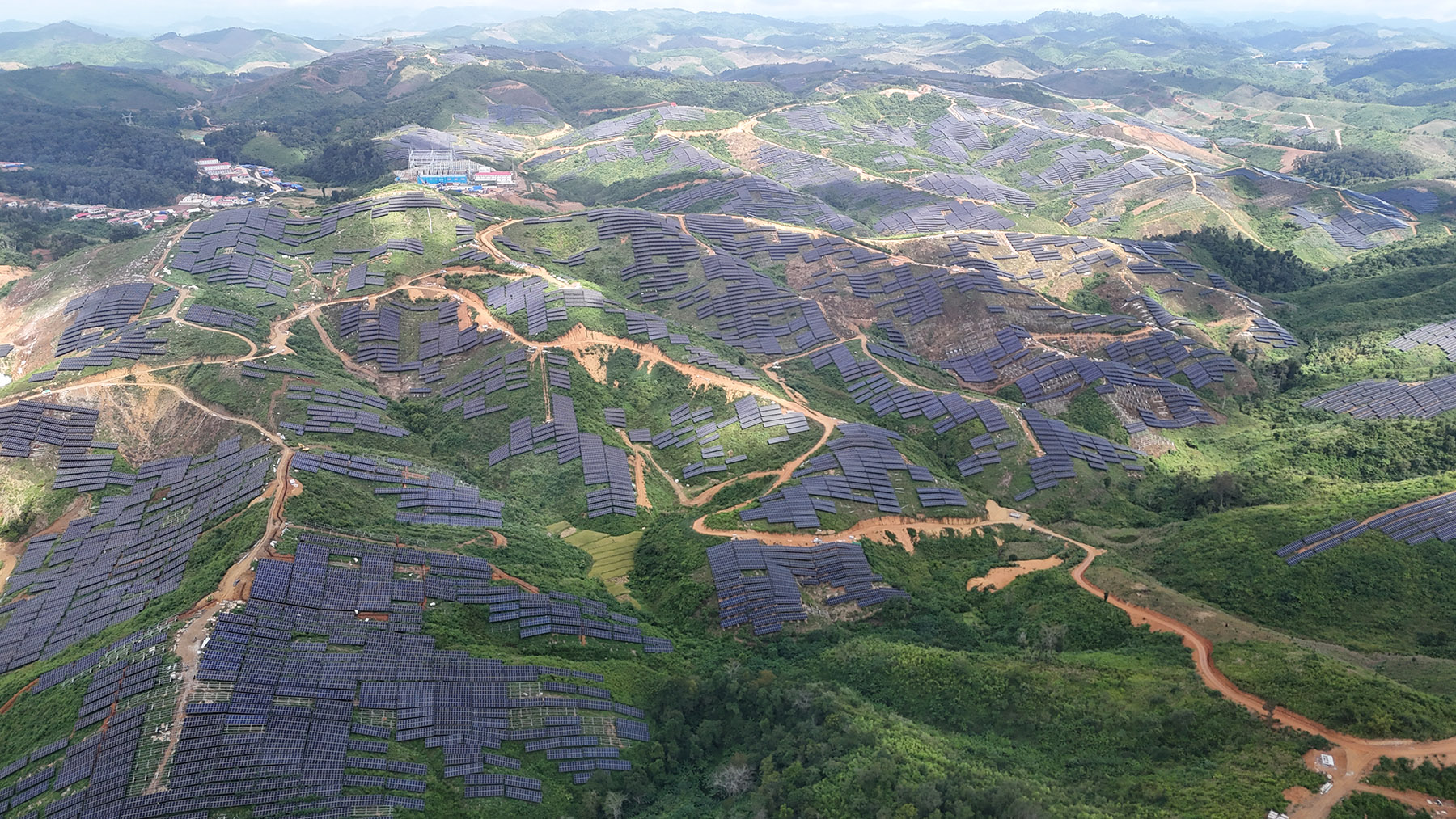
A flagship cross-border photovoltaic power initiative in Laos — the China-Laos 500-kilovolt power interconnection project — had delivered nearly 200 million kilowatt-hours by end-May, demonstrating the massive potential of cross-border solar infrastructure.
Driven by the coordinated efforts of CGN and CSG, the project — put into operation in April — marks the first time that overseas new-energy electricity has participated in China's marketized power trading system.
Currently, these initial cross-border power transactions are utilizing high-voltage infrastructure to deliver electricity directly to Southwest China's Yunnan province. Moving forward, grid operators plan to organize the next phase of transmission to send this clean energy further east to the high-demand, technologically advanced hubs of Guangdong province.
Industry experts said this achievement represents far more than a technical connection; it is a structural breakthrough in how renewable energy is traded, dispatched and utilized across borders in the Asia-Pacific region.
As Southeast Asia pursues its ambitious green transition plans amid surging electricity demand, Chinese enterprises — commanding deep technological and manufacturing advantages in renewable energy and grid infrastructure — are poised to play an indispensable role in making this regional vision a reality, said Lin Boqiang, head of the China Institute for Studies in Energy Policy at Xiamen University.
Construction of the pivotal interconnection project began last year. Spanning a total length of 177.5 kilometers, the transmission line weaves through complex topography, comprising a 145-km Chinese section and a 32.5-km Lao section.
While Lao hydropower has previously been transmitted to Yunnan via lower-voltage lines and subsequently delivered to the Guangdong-Hong Kong-Macao Greater Bay Area, this new project breaks fresh ground.
As the largest cross-border grid project and the highest-voltage power link between China and Laos, it introduces highly variable solar power into the cross-border equation for the first time, requiring sophisticated grid management capabilities.
The project is expected to transmit roughly 1.1 billion kWh of solar-generated electricity to China this year alone, signaling a transition toward a more standardized, institutionalized and market-oriented phase of power interconnectivity between neighboring countries.
Beyond the grid infrastructure, Chinese energy titans are actively establishing major clean energy positions across maritime Southeast Asia.
In October, CRE International — a unit of China National Nuclear Corporation — signed an agreement with Singapore-based Equator Renewables Asia to build a solar photovoltaic facility with a maximum capacity of 900 megawatts and a 1.2-gigawatt-hour battery storage system in Indonesia.
The project is set to be completed by 2029 and will generate 830 GWh of clean energy annually. CRE International will invest in, construct and operate the project, Equator said via its website.
Chinese battery giant Contemporary Amperex Technology Co, meanwhile, will supply half of the battery storage systems for another massive solar-and-battery project in Indonesia, which is slated to export 300 MW of clean electricity directly to Singapore once operational.
The implications of these interconnected projects extend far beyond bilateral trade, serving as a microcosm for the broader energy security goals of the Asia-Pacific region, said Lin.
As geopolitical tensions, supply chain disruptions and the rapid dawn of the artificial intelligence era drive unprecedented electricity demand, regional grid connectivity is transitioning from an abstract goal to a vital strategic imperative, he said.
Puah emphasized that energy security today is fundamentally about resilience, diversification and adaptability, in an increasingly uncertain global environment.
"For Singapore, as an import-dependent country with limited land, this means taking a diversified portfolio approach for our energy mix, maintaining strong international partnerships and ensuring reliable infrastructure," Puah said. "No single country can secure its energy future in isolation. Regional cooperation and cross-border connectivity will become increasingly important in strengthening long-term energy resilience."
Puah said AI and digitalization are fundamentally reshaping energy demand globally, requiring power systems that are not only cleaner, but also highly flexible, efficient and interconnected.
"A more integrated regional energy system would allow economies to diversify energy sources, reduce vulnerabilities and draw on mutual support from neighbors, laying the foundation for a more secure energy future across Asia-Pacific," he said.
While acknowledging that a fully integrated regional power market in the Association of Southeast Asian Nations will take time and require complex coordination across technical standards, financing and regulatory frameworks, Puah pointed out that foundational efforts are already well underway.
While the physical realization of these ambitious cross-border grids and mega-solar parks relies heavily on a robust and scalable supply chain, China's competitive advantage remains unparalleled, providing the economic foundation that makes regional energy transitions feasible and affordable for developing nations, he said.
A recent report by global research firm Wood Mackenzie said China holds a dominant position in the global renewable energy manufacturing sector, producing over 80 percent of the world's wind turbines, solar panels and energy storage batteries.
This sheer scale translates into profound cost advantages that competitors struggle to match. Products manufactured by Chinese companies at their overseas facilities are, on average, 28 percent cheaper than similar Western alternatives for wind turbines, 4 percent cheaper for solar modules and 31 percent cheaper for energy storage batteries.
Li Xiaoyang, director of China power and renewables research at Wood Mackenzie, said the fundamental economics of Chinese manufacturing efficiency mean that these companies maintain competitive advantages that are actively reshaping global supply chains, even in the face of international trade frictions.
As global local content policies, such as the European Union's Net-Zero Industry Act and the United States' Inflation Reduction Act, attempt to spur domestic production, Chinese manufacturers have adapted dynamically.
Rather than deterring Chinese companies, these policies are forcing more sophisticated international strategies.
The overseas expansion of China's new energy sector is rapidly transitioning from traditional engineering, procurement and construction contracting toward the independent power producer model, which integrates investment, construction and long-term operations.
CGN's gigawatt-scale solar project in Laos, independently developed and operated by the Chinese enterprise, is a prime example of this evolution.
"The focus of renewable investment is shifting toward the Middle East, Asia-Pacific and Caspian markets," Li explained. "With high-quality products made in China, greenfield investments are becoming more appealing to investors looking to establish projects in easily accessible markets. These regions act as both manufacturing hubs for global market entry and local demand centers, effectively creating parallel supply chains."
Wood Mackenzie projects that Chinese enterprises may control nearly 80 percent of utility solar and wind capacity in top markets involved in the Belt and Road Initiative by 2030. This creates a distributed, resilient network of manufacturing and energy production that effectively supports local transitions while bypassing traditional trade barriers.
The deep complementarities between China's industrial might and Southeast Asia's strategic positioning present vast opportunities for multilateral cooperation.
China's extensive capabilities in long-term planning, technology deployment and manufacturing align seamlessly with the financial, standard-setting and regional project development strengths of international hubs like Singapore, said Puah.
ALSO READ: Green growth, stable energy prioritized
"Singapore and China have complementary strengths ... China's experience highlights the importance of infrastructure development, innovation and industrial capabilities in supporting the energy transition. Singapore contributes strengths in finance, connectivity and regional project development," he said. "As Southeast Asia's energy demand continues to grow, there will be increasing opportunities for collaboration in areas such as clean energy infrastructure, energy storage, digital energy solutions and regional connectivity."
Puah stressed that policy coordination, transparency and trusted partnerships will be key to unlocking long-term investment.
The tie-ups between China's energy firms and countries across Southeast Asia should prove mutually beneficial, Puah said. Singapore will gain access to low-carbon electricity, while neighboring countries will receive investment in their energy sector and a boost to their export revenues.
Contact the writers at zhengxin@chinadaily.com.cn
