

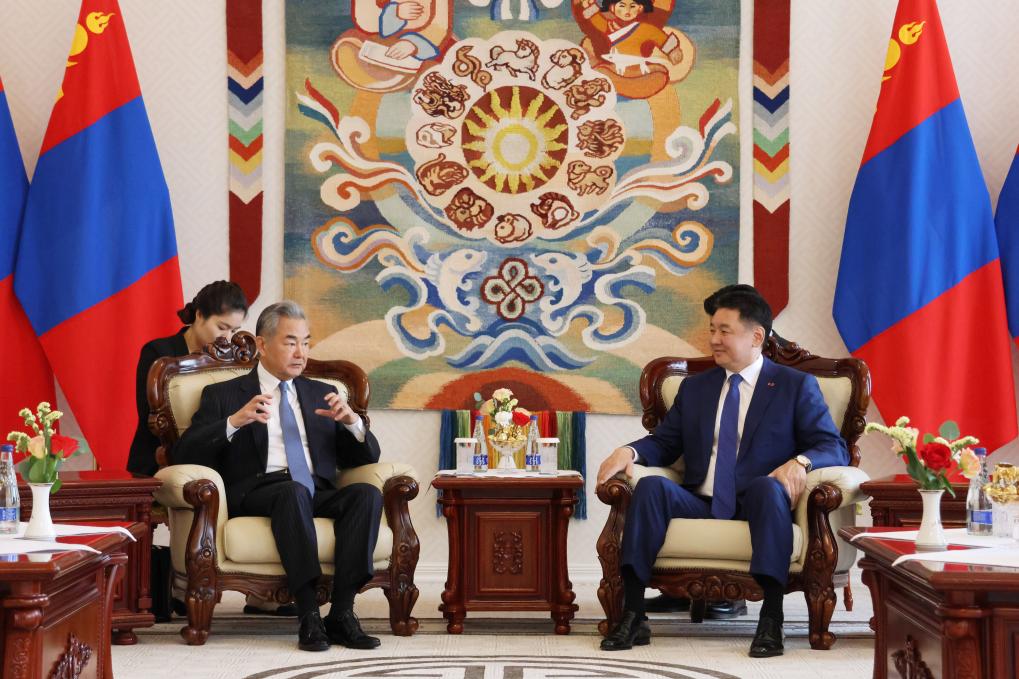
ULAN BATOR – Mongolian President Ukhnaa Khurelsukh met with Wang Yi, a member of the Political Bureau of the Communist Party of China Central Committee and Chinese foreign minister, here on Saturday.
During the meeting, Khurelsukh said the Mongolia-China relationship has become a model for inter-state relations in the region.
The two countries have consistently respected each other's independence, sovereignty and territorial integrity, while deepening mutually beneficial cooperation across various sectors, he said, noting that bilateral trade is expected to reach $20 billion this year.
Describing China as Mongolia's good neighbor, Khurelsukh said that developing friendly relations with China is a top priority of Mongolia's foreign policy.
Khurelsukh said Mongolia is committed to the one-China principle, regarding Taiwan as an inalienable part of China's territory, and opposes any form of "Taiwan independence" activities. It also considers matters related to Hong Kong, Xizang and Xinjiang as China's internal affairs. Mongolia will not do anything that harms China's interests, regardless of its relations with other countries.
He also noted that Mongolia is willing to strengthen cooperation with China in regional and international affairs.
For his part, Wang said China has always put China-Mongolia relations at an important place in its neighborhood diplomacy, noting that China has both the will and the capability to be a neighbor that Mongolia can rely on, a trustworthy friend, and a partner in accelerating its development.
Wang reaffirmed China's respect for Mongolia's independence, sovereignty and territorial integrity, as well as the development path that Mongolia has chosen for itself.
He expressed readiness to work more closely with Mongolia to align development strategies, tap into the full potential of bilateral cooperation, advance existing collaboration in areas such as connectivity, energy and mineral resources, trade and investment, and create new growth drivers for cooperation in key minerals, green development, the digital economy, and other emerging fields.
During his three-day visit, Wang is also scheduled to meet with Mongolian Prime Minister Nyam-Osor Uchral and hold talks with Foreign Minister Batmunkh Battsetseg.
Cooperation agreements signed
During talks with Mongolian Foreign Minister Batmunkh Battsetseg in Ulan Bator the same day, the Chinese foreign minister said that China attaches high importance to ties with Mongolia in its neighborhood diplomacy, and actively promotes good-neighborliness and friendly cooperation between the two countries.
He said China is willing to continue to be a trustworthy and reliable partner to Mongolia and to provide sustainable support for Mongolia's development and revitalization.
Noting the strong complementarity between the two economies, Wang said greater alignment of development strategies would help expand cooperation and create new growth opportunities. China is willing to work with Mongolia to advance high-quality Belt and Road cooperation, expand trade and economic ties, and achieve more concrete outcomes.
For her part, Battsetseg said developing relations with neighboring countries, especially China, has always been a priority in Mongolia's foreign policy.
The Mongolian side firmly adheres to the one-China principle and supports China's efforts to safeguard its territorial sovereignty and achieve national reunification, Battsetseg said.
She said closer cooperation is needed amid growing global uncertainty and expressed Mongolia's interest in strengthening the alignment of development strategies with China, expanding trade and investment, enhancing connectivity, and deepening cooperation in areas such as critical minerals and ecological governance.
After the talks, the two sides signed documents on cooperation between the foreign ministries of the two countries.
