


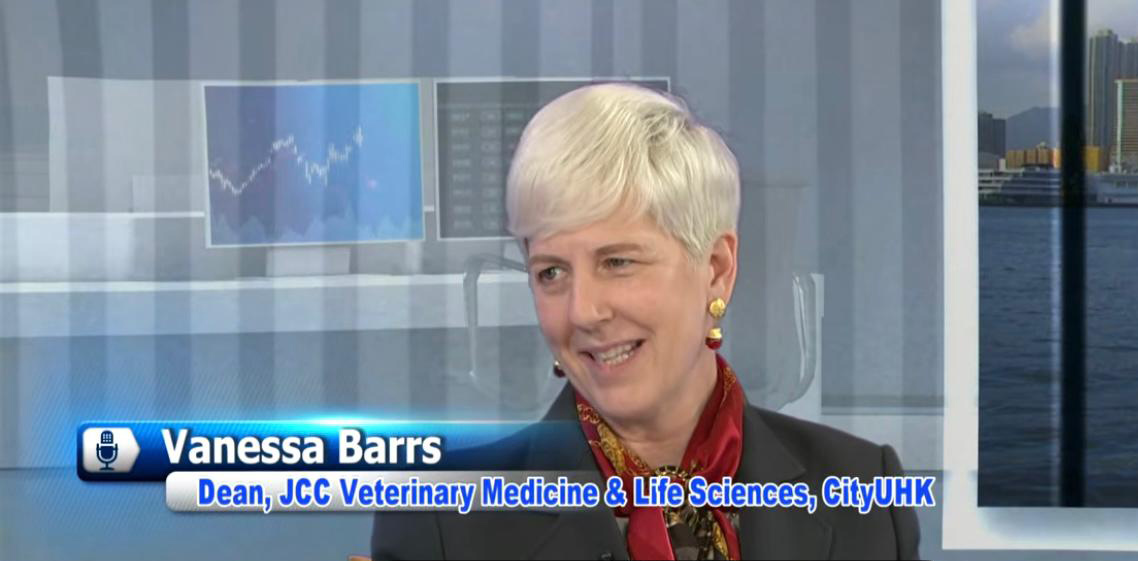
On Straight Talk this week, Vanessa Barrs, dean of Veterinary Medicine and Life Sciences at City University, talks about pets in Hong Kong and the standard of veterinary care in the city.
Check out the full transcript of TVB’s Straight Talk host Eugene Chan’s interview with Vanessa Barrs:
Chan: Welcome to Straight Talk. I'm Eugene Chan. “Are we spoiling our pets or just trying to love them right?” My guest is the person in charge of training Hong Kong's only homegrown veterinary surgeons. Barrs is the dean of CityU's Jockey Club College of Veterinary Medicine and Life Sciences and the Bank of China Hong Kong Chair Professor of Veterinary Medicine.
She led the team that earned Hong Kong's first internationally accredited vet degree with Cornell University. Before joining CityU in 2019, she spent over 15 years at the University of Sydney's Veterinary Teaching Hospital. She is an internationally renowned infectious diseases researcher and has authored over 200 scientific papers. Professor Barrs, welcome to Straight Talk.
Barrs: Thank you.
Spoilt or well cared for?
Chan: This is a show that we've been talking about for over a year now and finally we have you on the show and thank you very much for coming. I understand that you have trained and practiced over like 15 years in Australia and you have seen sort of in veterinary medicine in different cities with different cultures. So, when you come to Hong Kong or came to Hong Kong in 2019, I suspect one of the first things that you might have noticed is that many people in Hong Kong treat their pets quite in their own special way, like we have strollers pushing them around, birthday cakes or even designer clothes. So, let me ask you directly, as our title suggests, as a veterinary scientist, when you see a pet, or say a dog, in a pram or a cat wearing a sweater, do you think how lovely they look? Or do you think the animal may not be ... may better off with something else? What do you think?
Barrs: I think that people in Hong Kong love their pets and I think that they are no different to pet owners anywhere else in the world. I think that wearing clothes for animals is not something that animals really like. Not that I'm not a big fan of.
Chan: Right. But in general, I mean you've been in different cities.
Barrs: Yes.
Chan: Would you say that the pet owners in Hong Kong, are we spoiling our pets or are they trying to care, give them the best? What do you think?
Barrs: I don't think we're spoiling our pets. I think in Hong Kong, just like anywhere else in the world, pet owners regard their pets as a member of the family. And that's the same whether you're a pet owner in Sydney, in London, in New York, the same the world over.
Chan: So I'm sure, as you just said, I mean everywhere in the world they want to, because they're part of their family, they want to do the best for them. Sometimes you might use the term overindulgence or maybe better to say they're looking after their well-being. So, how do we actually draw the line and have you ever seen cases that such overindulgence might actually harm the animal?
Barrs: Look, I think that those sorts of cases are pretty rare. I think that, like I said, most people regard pets as members of their family. Where it can sometimes go wrong would be if an animal had a disease that was incurable. And sometimes we need to put animal welfare first. And if an animal is suffering, it's not right to treat that animal for the sake of the fact that you love it very much. We always have to remember that as pet owners, we are responsible for their welfare. We are the guardians of their welfare.
Chan: Right, when you mentioned that I, being a dental professional, I do have to think of the patient's benefit. But in case of a human being, you can actually ask them or you can gauge them. But then as for a pet, how can you tell?
Barrs: Exactly. It's very difficult and so pet owners need to look at whether their animal is eating? Is it drinking, is it showing normal behaviors? Does it want to go outside? And if it's not, then we have to think about what is that animal's quality of life.
Chan: Right. I think, Professor Barrs, I'll call you Vanessa. I've known you for quite some time now through our work at City University. I must say that when I always see you, I'll talk about pets, but being the dean, you're talking about, it's different, it's animals.
Barrs: That's correct.
Chan: Maybe you can tell the viewers how you see sort of this vet school in terms of how they versus the pets that we talked about.
Barrs: Thank you.
Chan: That's a good time to start there.
Barrs: That's a great question. And the first thing I would say is that a veterinary school, a vet school is not a pet school. And veterinarians have many important functions in society. One of them is as guardians of veterinary health care and not just the health care of pets but also of our livestock production animals, cattle, sheep, goats, pigs, poultry, horses, also zoological animals and exotic animals. So, that's one function. Another really important function is that veterinarians are the first line of defense against emerging zoonotic diseases like rabies or avian influenza. They have a really important function in advising governments, advising government bodies like the World Health Organization, the Food and Agriculture Organization, the World Organisation for Animal Health. They also have an important role in scientific discovery. You might have heard of Salmonella, the bacterium that was actually discovered by a veterinarian called Daniel Salmon, who was a graduate of Cornell University. They also have an important role in food safety, in the detection of drug residues in animals before they're consumed for meat. And they have an important role in educating society about responsible pet ownership. So, lots and lots of different functions.
Chan: Yeah, sure. I think we'll go back to the sort of vet training further on in the show. So, when you're talking about, I mean, the reason why I started with this topic right at the beginning is letting the viewers know that pets, of course, are a very important part of our lives in Hong Kong, but don't underestimate the importance of the whole animal world in relation to Hong Kong. When you talk about, say, pets, let's go into pets for a little while, what would be the most common problem that we see that can be easily overlooked by owners, that can be something very important? Or even, as I said earlier, whether we could be caring them too much, ending up they could be eating too much or not having enough exercise or all these inappropriate accessories, for example.
Barrs: Sure.
Chan: So, do you see any of that? Maybe is it? Can you share with the viewers?
Barrs: I think pet obesity is a big problem as a result of feeding them too much and them not having enough exercise. That's one of the big problems that we see today. But there are lots of different diseases that pets can get. They get arthritis as they get older, just the same way that humans do. They get heart disease in the same way that we do. And it is very hard for pet owners to know when an animal is sick. They often have quite an advanced disease compared to a human because they can't tell us that they feel sick.
Chan: Yes. I mean, unless you see them having a loss of appetite or loss of weight, then that could be a very long process.
Barrs: Yes, it could be a very long process or sometimes a very sudden process.
Chan: I see. And also another fact about Hong Kong as compared to, say Australia, or Europe in England is that our homes are sort of typically quite small, that despite our high population density and also the sort of the tininess of where we live, pet keeping culture has been quite established in Hong Kong. I'm sure we see that there are a lot of that in Hong Kong. So, with a pet and it will be predominantly cats and dogs, I know you are sort of cat specialists, and that sort of grew markedly, especially during the pandemic. Do you think there are certain breeds that we should not be sort of having that at home, especially we're having such a small place as compared to houses or farms in Australia or England?
Barrs: Sure, that's a great question. And actually there's a number of different breeds that we need to be really careful about. And one of them is breeds called brachycephalic dogs. And by that I mean dogs that have really short noses. So, things like pugs, for example, and Boston terriers and bulldogs. They have problems breathing because they have been overbred and they have been bred to really accentuate these cute short-nosed baby faces. In a city like Hong Kong, where it's really hot and humid, it's very common to see these animals coming into hospital with heat stroke, unable to breathe. They go into intensive care and sometimes unfortunately they pass away. So, that's the first thing. And also, you know, sometimes we see dogs like the big woolly Newfoundlands or Samoyeds, you know, with a full hair coat in summer again. We need to think about, I think the decision for what type of pet you want to get really depends on an individual's circumstances, where they're living, what kind of environment it is. Are they able to take it out? Is it able to be walked? Can it be cared for properly? Is it a hot environment? Do they have to go up six flights of stairs? All of those kinds of things.
Chan: True. I mean, I think one comment I'm sure the viewers would have picked up, like myself, is that all pet owners all over the world, they do care for their pets and they treat them like they're part of the family.
Barrs: Absolutely.
Chan: But would you say that in Hong Kong, because of the crowdedness in Hong Kong, is it how we see it sort of be more visible about it? Or do you think you see that also in Australia and England?
Barrs: I think pet ownership in Hong Kong is still a lot lower than it is in some other parts of the world. So, currently it's estimated about 10 percent of households in Hong Kong own a pet, a pet dog or a cat.
Chan: Right.
Barrs: There's about half a million pet dogs and cats in Hong Kong. If you look, for example, in Australia, two-thirds of households have a pet. So, the actual rate of pet ownership is lower than in some other countries.
Chan: And also in Hong Kong, many of our friends actually call them, usually call them, their daughters or their sons are calling them daddy and mummy. Do you see that in Australia as well?
Barrs: Yeah, look, I think, like I said, a lot of people will consider pets to be part of their household. Younger couples, you know, they're waiting for longer to have children. They're having children older, but they want to have something in their household to love. But I think also, you know, we need to look at the benefits of pet ownership as well, and there are many. It's been shown actually that it improves mental health, physical health, social well-being. So, actually, cardiovascular risk is decreased in pet owners.
Chan: Really?
Barrs: There have been surveys that show you're less likely to have a heart attack. You have lower blood pressure.
Chan: Maybe as compared to kids.
Barrs: Yeah. Lower blood pressure, lower cholesterol, lower triglycerides, decreased stress hormones, decreased loneliness, decreased anxiety. All of these things are associated with pet ownership and they're very positive, especially when you also consider some isolated elderly members of the community. Having a pet can really enrich your life.
Chan: Yeah, I'm sure. Right, Professor, let's go for a short break now. We'll be back with more Straight Talk.
Chan: Welcome back to Straight Talk. We are talking to Professor Vanessa Barrs, the dean of Veterinary Medicine and Life Sciences at City University, about pets in Hong Kong and the standard of veterinary care in our city. So, Vanessa, I think the very clear message is all pet owners love their pets and it's great because it brings a lot of benefits and in Hong Kong we are doing just fine.
Barrs: Absolutely.
Chan: Great to know.
Barrs: We are doing fine.
Vet care
Chan: All right, let's move on to something sort of more sort of more medically orientated. As we said, in Hong Kong we have small places. We still have half a million pets and we have to be very careful that all these diseases won't be developed through them. I just want to ask you, what type of medical conditions in Hong Kong are most common that our pets will have such that like emergency treatment or even cancer management? How does the standard of care in Hong Kong as compared to those in Australia or the United Kingdom?
Barrs: It's very similar. So, I would say that the standard of veterinary health care is very similar and the reason that it's similar is because in order to become registered as a veterinarian in Hong Kong you have to have a degree that is accredited by the Royal College of Veterinary Surgeons in the UK or the Australasian Veterinary Boards Council. That accreditation of veterinarians really determines that basic level of veterinary medicine and healthcare that's practiced throughout the city.
Chan: When you talk about the current, if I want to talk about the current ecosystem of the sort of veterinary healthcare in Hong Kong,
Barrs: Yes.
Chan: You said we have half a million pets.
Barrs: Yes.
Chan: Not to mention other animals.
Barrs: Yes, many exotic pets.
Chan: Exactly. I mean, how many sort of vets in Hong Kong that we have?
Barrs: Yes, so we have 1,500 registered veterinarians in Hong Kong, but probably only about 1,000 of those are practicing. And there are about 205 small animal veterinary clinics in Hong Kong currently.
Chan: Right. So, would you say that it's a very healthy environment or you think we are sort of underdeveloped?
Barrs: No, it's a healthy environment. It is a healthy environment. We have a number of specialist clinics and also primary care clinics around the city.
Chan: And one thing I'm sure the viewer is going to say to me, “Eugene, you must ask Professor because a lot of people are saying that when they bring their pets to see the vets, sometimes the fees can be quite expensive, even more expensive than a dental bill or even a medical bill”.
Barrs: Yes, that is …
Chan: Is that true or is it just a sort of saying in the public?
Barrs: Well, it's certainly not more expensive than human health care but if you think about it, the way that we have evolved with our pets, most pet owners want a similar level of care for their pets as they do for their children. And unfortunately, having a veterinary clinic to provide those services, it needs to function like a full-service human hospital for animals. And there are a lot of, that's very expensive, without the benefit of government subsidy. There's no Medicare for pets, there's no Medicaid and also the uptake of pet insurance is low. If you look at the type of equipment that you need to have in a veterinary hospital to provide those services, you need a digital X-Ray.
A lot of clinics now have got CTs. Some of the speciality clinics have got MRI machines. All clinics will have their own in-house laboratory services. They'll have an intensive care ward, a hospital ward. So, these things are very expensive to buy, to maintain. Labor costs are also expensive. You have a team of professionals, veterinarians take six years to go through university. If you go to a speciality clinic and you see a specialist, they've been in training for over 10 years.
Chan: True.
Barrs: So, that’s why some of the cost …
Chan: So, that's similar to the classical medical and dental training.
Barrs: That’s right. It’s very similar.
Chan: And also one comment you made earlier is because the pets won't be able to express themselves.
Barrs: Yes. Very often you only see things happen at a later stage of the disease. And naturally that's going to cost more.
Chan: Yes. Right. Actually, I'm just going to ask you some questions from the Consumer Council. They were saying that there were some complaints about veterinarian fee transparency and saying that sometimes they could be charged for procedures that they're unaware.
Barrs: As we've spoken earlier, this may be some sort of communication issue.
Vet training
Chan: As the dean, how will you make sure your students, when they graduate, will be able to sort of not fall into that little trap so that there'll be a more harmonious relationship between the community and the veterinary circle?
Barrs: Yep, that's a great question. And as Dean, I'm also a member of the Hong Kong Veterinary Surgeons Board. But for our students, we teach them, first of all, about communication and being professional.
It runs from when they first start veterinary school all the way through. They have professional skills and practice courses where they really learn about integrity. And in fact, veterinarians are often regarded as trusted professionals in society because they're still seen as professionals that have that integrity. But we also teach them about legislation, duty of care and codes of conduct, and codes of practice. They must be very familiar with the Veterinary Surgeons Act and they're examined on that before they graduate.
Chan: So, they're very familiar.

Barrs: There are two things that they need to be familiar with. One is the legislative environment, the legislative requirements that they must observe. But secondly, and just as important, is communicating with clients, not assuming that you know what your client wants.
We can't judge people and we also have really embraced something called contextualized care or spectrum of care and what that means is not necessarily making clients think or pet owners think that they must have the gold standard treatment, that they're not doing the right thing if they can't afford an MRI scan. There is a level of care that can be provided for every patient
Chan: Right.
Barrs: And it's our job as veterinarians to make sure that we work with the client to work within the decision, you know, to help them make the decision that is best for the health care in that situation.
Chan: Right. You know, with the advent of AI and all the technology, would there be anything applied to sort of daily management of such cases?
Barrs: Absolutely. AI is already very embedded in veterinary medicine. So, for example, nowadays many veterinarians, when they do a consultation and they take a history from the client, in the old days they would make notes, make medical records. Nowadays it's all AI. AI can take that history; it can give you a list of differential diagnoses; it can help veterinarians; it can save them an hour a day.
Chan: And have more time on the patient. And also one more thing I read up as well is last year in the Legislative Council, they're saying there's a rising trend in pet abandonment, meaning they're sort of not keeping pets anymore.
Barrs: Yes.
Chan: And they thought to be at least partly due to the high cost of sort of the, as we just said, the vet cost in terms of Medicare. Is there anything that can be done about that?
Barrs: Yes, I think that we need to educate the community and educate pet owners about the responsibility of having a pet. A pet is for life. Also, consider adopting, not shop. You can spend thousands of dollars, thousands and thousands of dollars on a purebred animal when you can adopt a perfectly healthy cat or a dog from the SPCA and save that money for the healthcare for that patient.
Chan: Yes.
Barrs: Invest in health insurance for animals. That also means that when something unexpected happens, you can be prepared for it.
Chan: Right, just now you mentioned interacting with the community and sort of makes me remind me of your outreach program.
Barrs: Yes.
Chan: So, how do you sort of reach out to the people?
Barrs: Yes, okay. At the Jockey Club College of Veterinary Medicine and Life Sciences, we have a fully serviced specialty and general practice hospital, the City University Veterinary Medical Centre in Sham Shui Po, that provides up to very high-end services. But within the Vet School we also have a veterinary community outreach program which is purely there to provide services for marginalized and underserved communities in Hong Kong, for the elderly, for people in remote and rural villages, for the vision-impaired, for people with mental health challenges. We have a team that works with our students to deliver subsidized desexing programs for those animals as well as vaccination, worming, parasite control, preventive health care.
Chan: Professor, last question.
Barrs: Yes.
Chan: Give me a very brief answer. We know that Hong Kong standard is very high, but given the Guangdong-Hong Kong-Macao Greater Bay Area, the proximity.
Barrs: Yes.
Chan: We have a lot of people bringing the sort of services across the border. Does that apply to the vet circle?
Barrs: Actually, it is illegal to transport an animal across the border into the Chinese mainland. There is rabies in the Mainland. Every time you smuggle your pet across the border, there is the risk of introducing rabies into Hong Kong SAR.
Chan: Well, I'm afraid we have to leave it there, and thank you so much, Professor, for sharing your insights.
Barrs: My pleasure.
Chan: Animal welfare matters, not because pets are trendy, but because they depend on us completely. As Professor Barrs said, “A healthy planet needs a healthy environment, healthy people and healthy animals”.
Have a good evening and see you next week.
