

At Athens forum, scholars discuss how classical studies can help world
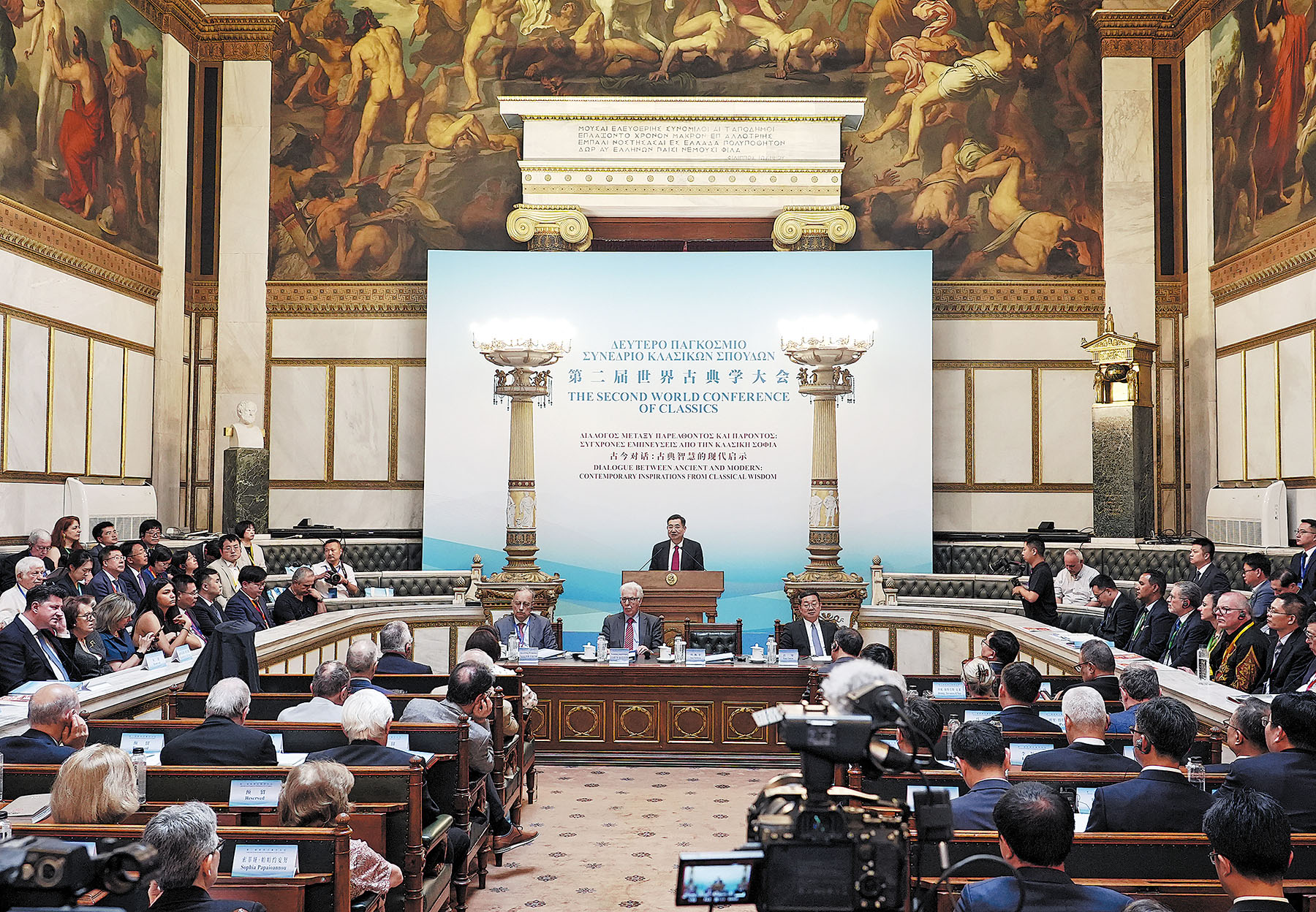
Walking past the marble statues of Aristotle and Plato, classical studies scholars from around the world entered the auditorium of the Academy of Athens on June 9 for a dialogue spanning the East and West, from the past to the present day.
The Second World Conference of Classics was held in Athens, the capital of Greece, from June 9 to 10, to seek inspiration from classical wisdom in addressing the questions of our time. The event was jointly organized by the Chinese Academy of Social Sciences, the Greek Ministry of Culture and the Academy of Athens.
“This is not only an academic gathering, but also a profound act of putting ideas into practice,” said Nikiforos Diamandouros, president of the Academy of Athens and moderator of the conference’s opening ceremony.
“Our goal is to ensure that classical wisdom … becomes a living force that continually provides inspiration and guidance for the advancement of human society and civilization.
“Plato, Aristotle, Hesiod, as well as Confucius, Laozi and Sun Tzu — these great sages remain present among us today.”
As two of the oldest civilizations in human history, Greece and China possess distinct yet mutually enriching cultural traditions, which “complement one another and can make a decisive contribution to this dialogue”, he said.
Hu Heping, deputy head of the Publicity Department of the Communist Party of China Central Committee, said that classical civilizations provide spiritual resources for human development, as well as power for the prosperity and progress of countries.
Hu stressed the need to relearn, reactivate and retransform ancient great wisdom while making modern interpretations of classics, to refresh classical wisdom and lead human civilization.
“We should focus on the holistic development of individuals to nurture citizens’ moral character through classical wisdom. We should focus on the prosperity and progress of the nation to strengthen the foundations of the spirit of modernization through classical wisdom. And we should focus on harmony and shared flourishing in the world, drawing on classical wisdom to address global challenges.”
Lina Mendoni, minister of culture of Greece, highlighted the establishment of the Chinese School of Classical Studies in the Greek capital in 2024, following the inaugural World Conference of Classics in Beijing.
She said the most important outcome of this cooperation demonstrates that when different cultures engage in open and sincere dialogue, seeking understanding rather than imposing their own views, “conflict is not inevitable”.
“There is an ancient saying: When the winds of change blow, some people build walls, others build windmills.
“In an age of profound change, … let us choose dialogue over isolation, understanding over prejudice, and cooperation over confrontation. This is the enduring wisdom that the classics offer us, and perhaps the most valuable legacy we can pass on to future generations,” Mendoni said.
Gao Xiang, president of the Chinese Academy of Social Sciences, said that no civilization evolves in isolation, but only grows, develops and thrives through exchanges and mutual learning.
However, there exists a certain notion of “civilizational superiority”, as some continue to believe that their civilization is superior to others, deeming their own standards as the only valid standards.
“This is not the right path. It only serves to deepen conflict and division,” said Gao. He warned that “the world must not be permitted to regress to the law of the jungle, nor should the principle that the strong prey on the weak be allowed to once again define international relations”.
“I believe that every civilization possesses its own unique value, deserves respect, and should be treated as an equal,” Gao added.
Drawing from classical wisdom, scholars held discussions in four parallel subforums on virtue and paideia, friendship and community, peace and order, and technology and civilization.
Contact the writers at wanghuazhong@chinadaily.com.cn
