

Shenzhou XXIII commander's passion for the sky blossoms aboard Tiangong
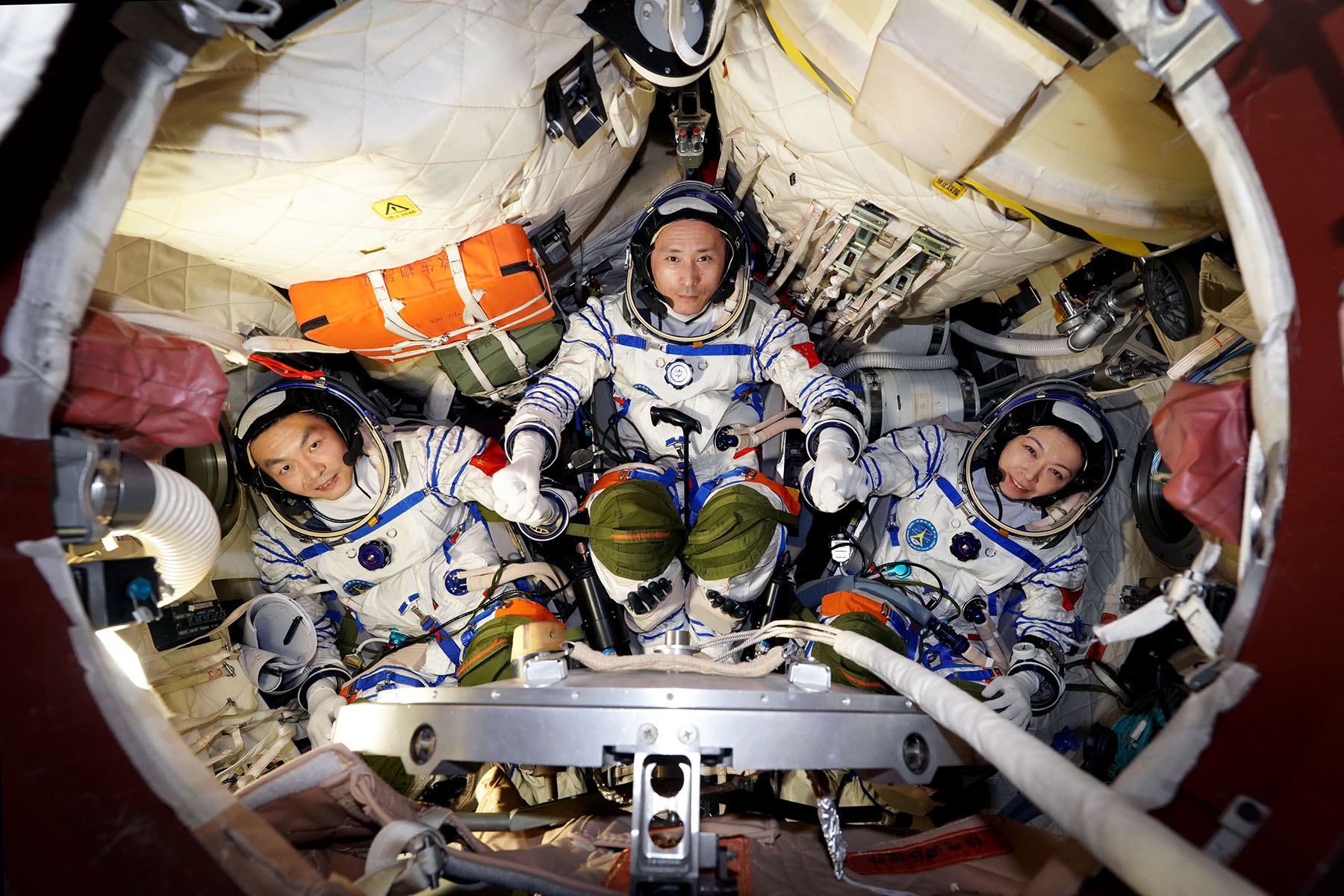
Colonel Zhu Yangzhu, commander of the Shenzhou XXIII mission, said he plans to grow petunias in space during his stay aboard the Tiangong space station.
"I will bring some petunia seeds with me. I plan to plant them once I get aboard the space station and see if they can bloom. I hope they will grow into lovely blossoms.
"I picked petunias because they are fairly easy to grow, and their flowers are quite beautiful. What's more, the blooms give off a vibrant and uplifting vibe, which can cheer people up. Just as we feel delighted seeing flowers and plants growing on home balconies, the same pleasure is even stronger in space. The view of green vegetation, along with blossoms and fruits if they grow, can tremendously brighten our spirits," he said in an earlier interview with reporters at the Astronaut Center of China in Beijing before setting out for the Jiuquan Satellite Launch Center in northwestern China for the launch on Sunday night.
READ MORE: Shenzhou XXIII crew heads to launch tower after a see-off ceremony
Zhu, 39, said Chinese astronauts have a "space garden" inside the Tiangong space station. Recalling his participation in the Shenzhou XVI mission, he said he and his crewmates grew plants, mostly lettuce and green onions.
"We ate them after they matured," he added.
According to Zhu, new planting equipment was sent to Tiangong after his flight, enabling astronauts to harvest more vegetables and fruits.
The astronaut noted that the Shenzhou XXI crew has harvested cherry tomatoes three times in orbit. They also planted wheat, which has begun to form ears. In addition, they have grown three generations of mint.
"We will continue to take care of those plants, and will cultivate carrots during our stay," Zhu said.
Earth vistas
Recalling his first and only spacewalk during the Shenzhou XVI mission, Zhu described the eight-hour activity on July 20, 2023, as "an experience that will stay with me for life".
"The awesome vistas of Earth seen outside the space station are very different from those viewed from inside. Floating out into space, anyone would be instantly overwhelmed by the breathtaking scenery. The blue sky and oceans lie directly beneath me. As we orbited above the atmosphere, blue skies spread out both ahead and underfoot, with clusters of white clouds drifting far below.
"I also gazed upon deep blue oceans and lush green lands. When passing over deserts, sharply defined stretches of brown and tan terrain came into my sight. Countless rivers were clearly visible as well," the astronaut said.
What struck Zhu the most was a gigantic typhoon eye he observed when the space station flew across the Atlantic Ocean.
"Suspended amid the endless expanse of space, our home planet appears small, yet breathtakingly beautiful in its blue hue. All these magnificent sights have filled me with even greater reverence for life, nature and the universe," he said.
During the spacewalk, the astronauts also soared over the Qinghai-Tibet Plateau. The landscape unfolded clearly before Zhu's eyes, with towering snowcapped mountains and the estuary of the Yellow River visible from orbit.
"The land of our motherland lay right in front of me. At that moment, I couldn't help wondering what made our space journey possible. It is our great motherland that sent us into space. Countless space industry workers toil behind every space mission, lifting us high toward the stars," he said.
Flight path
As one of the first two members of China's third group of astronauts to take part in a space mission, Zhu said he was destined for flight.
When he was a middle school student, Zhu often used pilot training equipment at his school, which cooperates with the People's Liberation Army Air Force in selecting students for flight school.
In his fifth year in middle school, Zhu planned to apply for an Air Force flight training program. However, his head teacher believed he had great potential for scientific research and persuaded him to reconsider. Still, his passion for the sky never faded.
"I said to myself: 'If I can't fly into the sky myself, I'll dedicate myself to researching flight technologies instead,'" Zhu said.
Before taking the national college entrance examination in 2005, he applied for a major in spacecraft systems and engineering at the National University of Defense Technology. His second choice was aircraft design and engineering at Nanjing University of Aeronautics and Astronautics.
Thanks to his high scores, Zhu was admitted to the College of Aerospace Science and Engineering at the National University of Defense Technology in Changsha in the summer of 2005.
After obtaining a bachelor's degree, he went on to pursue master's and doctoral degrees in fluid mechanics at the same university.
After a decade of study, Zhu graduated in 2015 with the highest academic score in his major.
ALSO READ: Shenzhou XXIII takes off with first HK astronaut
He was then assigned to an infrastructure construction unit of the PLA, where he assumed his first engineering post. In the position, he led a group of soldiers working at construction sites in remote mountainous areas. He also took part in a postdoctoral program run by the Army Engineering University of PLA in Nanjing, Jiangsu province.
In 2017, Zhu was transferred to the Space Engineering University under the former PLA Strategic Support Force to help establish a mechanics laboratory.
In the summer of 2018, he learned about the selection of China's third-generation astronauts and decided to apply.
"I didn't make it into the Air Force to fly fighter jets in blue skies, but then came this opportunity for me to fly spacecraft outside Earth's atmosphere, so I was determined to try my best to chase it," he said.
After many rigorous tests, Zhu stood out among thousands of applicants and was recruited by the PLA Astronaut Division in October 2020.
Due to his lack of flight experience, Zhu found it difficult at first to learn spacecraft control operations at the Astronaut Center of China.
To master the skills as quickly as possible, he made full use of a desktop simulator for manual rendezvous and docking installed in his apartment, conducting extra training after daily sessions. After thousands of hours of practice, he developed solid muscle memory and eventually achieved precise manual rendezvous and docking operations.
On May 30, 2023, Zhu was launched into space, beginning a five-month orbital mission as the spaceflight engineer for the Shenzhou XVI mission.
"I think the experience of my first mission is very important because it let me know exactly what and how I should work in space," Zhu said before setting out on the Shenzhou XXIII mission.
Contact the writers at zhaolei@chinadaily.com.cn
