

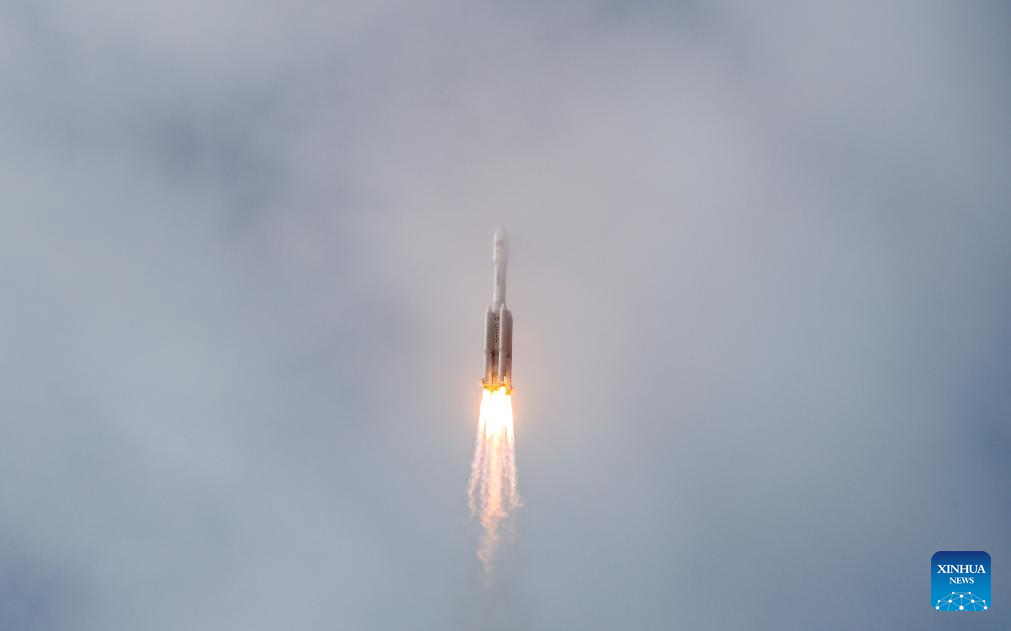
The Hong Kong Special Administrative Region’s first locally-developed scientific payload has been launched into space -- aboard the Tianzhou 10 robotic cargo mission which blasted off on Monday morning to deliver supplies and propellants to China’s Tiangong space station.
The payload will be deployed on the station for research and applications, marking a milestone in the SAR’s participation in the national space program.
The instrument is the world’s first lightweight, high-resolution, high-precision payload for synergistic observatory of carbon dioxide and methane. The research team said it’s designed to precisely monitor greenhouse gas concentrations in specific areas, quantifying their emission fluxes, and providing critical data for formulating and assessing carbon reduction policies.
The Tianzhou 10 cargo spacecraft lifted off at 8:14 am on Monday atop a 53-meter-tall Long March 7 rocket from the Wenchang space launch center on Hainan province’s southeastern coast.
ALSO READ: China launches Tianzhou 10 robotic cargo mission to space station
Shortly after liftoff, the rocket successfully placed the Tianzhou 10 into its preset low-Earth orbit, and the spacecraft’s solar wings unfolded -- confirming a successful launch.
The spacecraft carried nearly 6.2 metric tons of mission necessities, science equipment and about 700 kilograms of fuel, including the multi-spectral imaging carbon observatory developed by an interdisciplinary research team led by The Hong Kong University of Science and Technology.
Contact the writer at amberwu@chinadailyhk.com
