

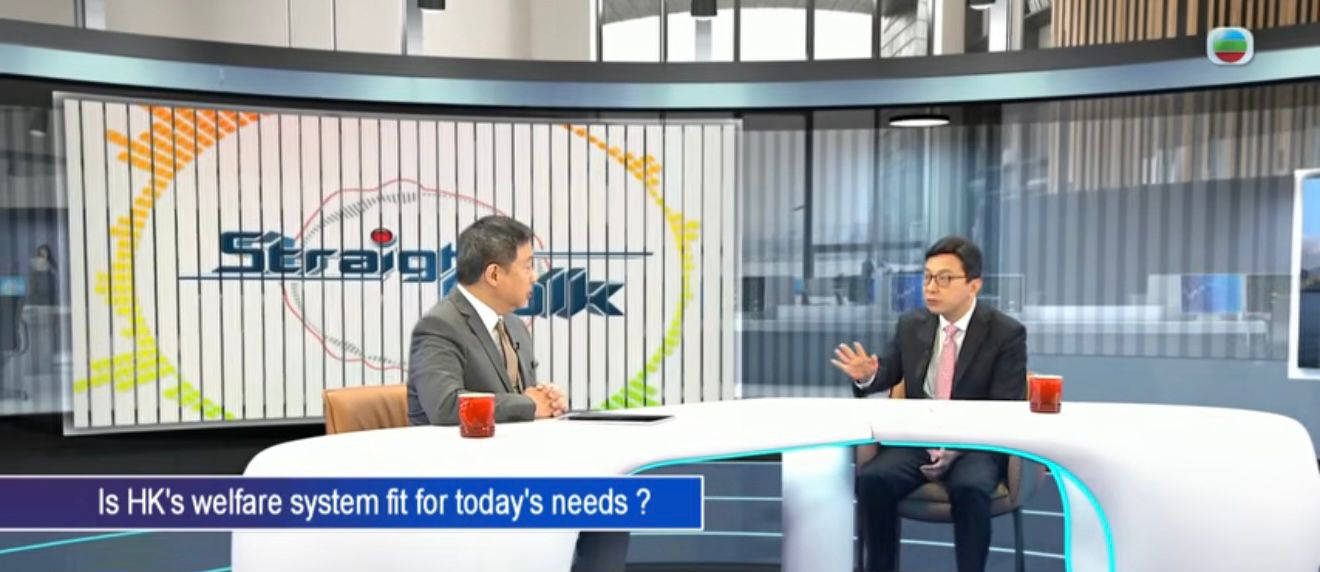
Secretary for Labour and Welfare Chris Sun Yuk-han exploring our welfare system is on the show this week, to discuss the topic "Is it keeping pace with today’s needs and how should assistance be balanced with long-term sustainability?"
Check out the full transcript of TVB’s Straight Talk host Eugene Chan’s interview with Chris Sun.
Chan: Welcome to Straight Talk! I'm Eugene Chan. With us is Secretary for Labour and Welfare, Chris Sun. He has been with the government service since 1994, serving in various bureaus and departments.
He was the deputy secretary for Food and Health, Financial Services and the Treasury, and then Commissioner for Labour in 2020 before being appointed to lead the Bureau of Labour and Welfare four years ago. Welcome to the show again, Chris!
Sun: Thank you so much for having me again.
Background
Chan: Chris, we have previously had you on Straight Talk talking about talent attraction, for which we have seen very good results. But today we want to focus on another area of your portfolio, which is the welfare system – social welfare. So, before we go on specific policies and reforms, can you give the viewers an overview of Hong Kong's social welfare system at the moment and how does it help our community?
Sun: Sure. Simply, we have a very comprehensive welfare system in place. We're taking care of the old, the weak, the disabled, the underprivileged, and also the disadvantaged. If you look at our expenditure, for every HK$5 we spend, more than one is spent over welfare. So, this is by far the largest spending item.
Chan: Right. Secretary, you've hit directly on my second question because I read that the expenditure for 2025 to 2026 is roughly about HK$125.2 billion, which is about 22 percent of total government expenditure, the largest policy area. So, as you just said, the main groups as you mentioned, the old and the needy and the weak or disabled, roughly what proportion of Hong Kong population actually benefit from it?
Sun: I think the best way to look at it is look at the elderly. By far, our expenditure over the elderly is the biggest. I think the magic figure is for every four elderly people in Hong Kong, three, they are getting some form of a subsidy from the government. So, that's a huge number. And adding to that is the direct services we're providing to the elderly, including residential care services, daycare services and home services. So, we're covering a large proportion of elderly.
Chan: When you mention that, I'm just thinking Hong Kong have 7.5 million population at this moment. Would you say one in seven or even two in seven are having this direct sort of indirect and direct subsidy?
Sun: It's a large number, but mainly in terms of subsidies, mainly for the elderly. So, if you look at the elderly number, it's three-fourths of our elderly population, i.e. those who are over the age of 65, they're receiving some form of a cash subsidy from the government. So, every day, if you look at the everyday, the cash transfer is almost HK$300 million a day.
Chan: Wow! So, quite a substantial number we are looking after. So, how would you assess Hong Kong's welfare system as compared to other economies in Asia?
Sun: I think we have one of the most viable that aligns with our societal needs in here in Hong Kong. But you have to bear in mind we have a very low tax regime, we have an open economy that is thriving, but at the same time we have put in place over the years a welfare system that works for us, that can take care of the needs of elderly people, the disabled, even the young and the disadvantaged families.
Chan: Right. So, in terms of say a global scale, how would you say Hong Kong standing?
Sun: I think we are among one of the best in the world. You have to look at from the totality. We are not comparing with the welfare state in Europe. They charge you a very, very high tax rate. But here in Hong Kong, if you look at our very low tax regime, and yet if you look at the amount and coverage of our welfare system, it's just amazing. And I have every confidence to speak to my interlocutors from all over the world that we have a very, very good welfare system to make sure that all those in need will be taken care of by us. I think the viewers by now will have to say to ourselves that we're very fortunate to be in Hong Kong, low-tax regime, but having such a comprehensive welfare system.
Chan: Indeed, indeed. How about compared to our mainland? Does our system differ?
Sun: It's very different. During my almost four years of tenure as the secretary for labour and welfare, I've come into contact with a lot of my mainland counterparts. I think we run on different systems. We know our country is catching up. More money is being invested in social welfare to help those in need. We have a lot of collaboration, a lot of experience sharing. So, we show them what we're doing and we also learn from them.
Chan: Right. When you mentioned about the social system, I mean the welfare system, I'm sure the viewers could ask you, what would be the guiding principle of your sort of policies? Are we going to, the primary objective is sort of poverty alleviation or promoting social mobility or even just having a basic safety net? What would you say would be the most appropriate descriptive term?
Sun: We are moving far beyond providing a basic safety net. We have achieved that years ago. By now, I would say if you have to describe the welfare system in place in Hong Kong, it's more about building a caring society. So, we care those who have a need. I'll just give you an example. For the elderly people, they might not be financially disadvantaged, but of course they have needs. They are lonely. They want people to talk to them, to engage them. This is the services we are providing to them through hundreds of elderly centers all over town.
Chan: Yes, I must say that, being a district council member, I see there are a lot of elderly centers in the community that maybe many of the viewers are not aware of.
Sun: I think all of us should look for those centers and they are something for everybody.
Chan: When you mentioned about needs, how does the government actually determine the actual need and what sort of indicators will you use to say you are eligible or you may not be eligible? Because you said three quarters is quite a high number. How do you determine that?
Sun: Two of it. If you look at diverse services, again, I'm using the elderly as an example. Say if you are applying for subsidized residential care service or day service, you have to undergo an assessment. We have a standardized assessment tool to assess whether or not an old people can take care of himself, whether or not he can no longer take care of himself and he needs support from the government in the form of different subsidized services.
For that tool, it was developed in conjunction with the University of Hong Kong. So, we take into account a lot of academic experience. This is the tool. For cash subsidies, except for the old age allowance, what we call the fruit money, for the rest, it's all means-tested. We have to make sure that for limited public resources, it's given really to those who have the need for it.
Chan: Right. Secretary, another sort of figures that I've noticed when I was doing research is that the welfare spending kind of has risen nearly 10 percent year on year. Would you say this growth is mainly driven by your policy expansion or demographic changes like more elderly people or even increasing social needs? Where would you put that increases to in terms of why we're having a 10 percent?
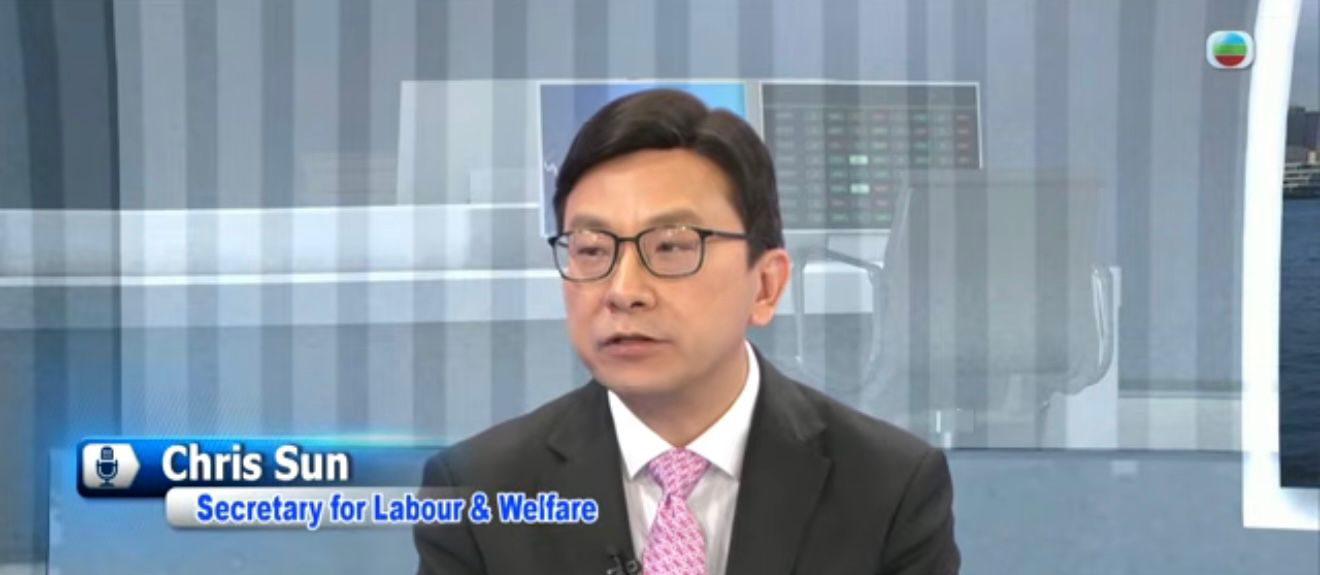
Sun: It's quite a high number, isn't it? I think the number one driving factor, of course, is demographic change. We are right now in the process of an aging society. So, this is going to drive up spending on welfare. This is one of it. Of course, the second is policy change. We are providing more services, more subsidy to the elderly. One of the examples is the Old Age Living Allowance. So, it was, you can say it's the newest addition. So, this is, of course, going to drive spending on welfare.
Chan: Secretary, another one of your key programs, I'm sure many people will know is the CSSA, the Comprehensive Social Security Assistance Scheme. I read it up. It says it's supposed to support households with basic living needs, but government shows that more than half of the CSA recipients receive it because of actually old age rather than unemployment.
If that's the case going forward, when you mentioned about our demography, does that mean that the 10 percent increase is going to keep on going up or even maintaining at that gradient? I don't have a crystal ball to foretell the future, but surely because of the demographic change, we expect there will be increase in welfare expenditure over the long term.
Sun: This is undeniable. So, for our job is to make sure that we spend money wisely, making sure that public resources are really spent on those who have in need. Most of them will be the elderly, so, it's for sure.
Transport fare changes
Chan: Right, when you say spending money wisely, is one of the reasons why you have the latest adjustment introduced to the change of the HK$2 public transport fare concession scheme. Like two days ago, you have changed it to a HK$2 fare or 80 percent discount, depending on the journey cost. Can you explain why this change is necessary right at this moment?
Sun: Oh yeah, the change is mainly for two purposes. Number one, as you said, we have to find a way to make sure the arrangement is physically sustainable in the long term. Instead of just a HK$2 flat rate, we have modified it a little bit. So, it will be HK$2 flat rate or 80 percent off. And the second purpose is to introduce a system in place that will encourage people to make a choice.
So, if there are options available for you to take on a short-haul route, that will cost you less. And with now 80 percent of people will avoid taking a long haul ride just for short trip travel purposes.
Chan: Right. Secretary, we'll come back to that after the break. And let's go for a break right now.
Chan: We are back on Straight Talk with Secretary for Labour and Welfare Chris Sun, exploring our welfare system. Is it keeping pace with today's needs and how should assistance be balanced with long-term sustainability?
Secretary, I think in the first half of the viewers have heard you very clearly that sustainability is something that right at your heart. And with the recent, the new introduction of the HK$2 sort of travel concession scheme, you have put in some new changes as well. Will the sort of these changes because you have seen more misuse or inappropriate use of funds? Because this is one of the fastest growing welfare expenditures. Can you tell the viewers a bit more?
Sun: Let me just share with you some of the key figures. For those who are now enjoying the benefits of having a JoyYou Card, right now the number of JoyYou Card holders is 2.67 million. 2.67 million. That's about a third of our population.
Chan: Wow!
Sun: But if we project it five years from now, because we are aging right now, so our projection is five years from now, the number of JoyYou Card holders will be nearly three million. And then you project it for another five years, so 10 years from now, it will be 3.2 million.
Chan: Wow, nearly half.
Sun: About 40 percent of our …
Chan: Very high, isn't it?
Sun: … very, very large number of people being covered. I think it just is our duty to look at how we can make it a sustainable system physically. So, that's why we propose a small change to it. So, instead of just a HK$2 flat rate, let's make it a HK$2 flat rate for those fare that's at HK$10 or below. And then for those fare that's above HK$10, we turn it into an 80 percent off. Still for the government, we are bearing 80 percent of the fare. And for the elderly people, they only have to shoulder 20 percent.
Chan: Secretary, someone's going to say to you right in front of television saying that we've heard that over the Chinese mainland, everything is free. So, how will you answer them in this sort of comment?
Sun: I think for any welfare arrangement, you have to be practical and look at it. Can you sustain it over the long term? I think for Hong Kong, there is undeniable that among all the cities in our country, Hong Kong is in a leading position in terms of aging. So, we are in the middle of an aging process. So, I think for any government that is responsible and look at the long-term arrangement, we have to find a way to make sure that this is such a good arrangement for elderly people to travel in Hong Kong, travel around Hong Kong at a very, very low cost. But we have to make sure it is sustainable in the long term.
Chan: Secretary, I must ask you a very direct question as on Straight Talk because some elderly residents could be living in the outer districts that they need longer trips and they need to go for health care and family visits. Would you say they will be disproportionately being affected?
Sun: Not really. I met quite a number of them. They have to make use of a long-haul ride. It could be a ferry or could be a long-haul bus. But I keep on saying to them, because if you look at the percentage being subsidized by the government, it's up to 80 percent. And for the cost saving arising from this arrangement for the coming financial year, our estimate it will be HK$550 million. It will be spent on Hong Kong's needs, including, I think mostly will be over the elderly people.
I'll just give you an example. So, alongside with the new arrangement, the financial secretary has also announced that for those receiving cash subsidy from the government, including those receiving Old Age Allowance, receiving Old Age Living Allowance, the CSSA, and also the Disability Allowance, they will get an extra month of payment.
That will be out once the budget is approved. So, our expectation is it will be credited to their bank account around May.
Chan: Right, I'm sure after the same period you're going to have a formal review of the implementation. But do you see this sort of a one-off technical adjustment or part of a broader rethink of our concessionary welfare policies in Hong Kong? Where do you see this leading us to?
Sun: For sure, by moving from a HK$2 flat rate into a HK$2 or 80 percent off regime, it will be for the long term. As I said, it's affecting. There are 2.67 people using it, and we're projecting that it will be going up to 3 million. So, we want to make sure there is stability. Once people know about it, they know how it works. We want to make sure this is in place. So, this is for the benefit of those who are holding JoyYou Card.
But going back to our welfare arrangements, as you pointed out quite rightly, apart from providing direct subsidy or direct services, say I just give example about day services or residential care services, we're increasingly moving towards giving them a voucher.
So, by giving you a voucher, we're still providing subsidy, but then you have choice. We put a choice back into the hands of the elderly. They can decide with that voucher which care home you want to go to or which day service you would like to receive. So, I think this is the right way to go.
Chan: So, Secretary, I think your clear message is the beneficiaries or the JoyYou card holders should not see this as any reduction in support, but rather as a smarter way of sustaining this game.
Sun: Exactly. We want to make sure that this is such a popular arrangement for the elderly people. We want to make sure that it can continue into the long term. But for that to happen, we have to make sure that the expenditure is sustainable.
So, we believe by making such a small modification, it's going to help us physically. But you have to bear in mind, right now, around 60 percent of all public service routes, the fare is at 10 or below. That means around 60 percent of all the public transport routes, they are still within the HK$10 or below range. That means they still just have to pay HK$2.
Challenges
Chan: Right. Secretary, I know you have been the Commissioner for Labor for quite some time before you are leading us in this area for the last four years. If I'm going to ask you what would be the biggest challenge, I'm sure the real would say has to be the aging population. Would you call that that's the only single, the most challenging factor you are facing, or there are other factors that we are not aware of?
Sun: For me, aging for sure is the single most important biggest challenge we have to face because it's more than government expenditure. It affects our labor market. Because that means our labor force is aging. More people are leaving the labor force and into their retirement. And also we have to look at the ways how can we take better care of them.
And not just the money, including the signage. We have to get a bigger font to make sure that they know how to live a worthwhile, a productive, healthy retirement life. And how can we encourage more of the people into their retirement life to have a second career?
They're still young, they're still healthy. We want to make sure that for those who are still healthy and productive, they can rejoin our labor force and be part of it to drive the growth of our economy. So, it's a systemic impact.
Chan: I think from what you've been telling us this evening, I'm starting to see your model. Not just looking at this aging population or welfare as a single issue. You're joining it, looking at the retirement, looking at the healthcare system all together in a package. Am I correct to say that?
Sun: You're right, exactly right, because for aging, it will be going to impact on every aspect of a society. So, we want to make sure that while we are facing an aging challenge, I don't see that as a problem.
Sometimes it could be, say, this is, we're getting the advantage, because for the whole world, they all have to grapple with the challenge of the Asian society. And just that we are ahead of them. So, we can make use of our own experience, sell our solutions to them.
Let's set a good example to not just our own country, but to all of those in the rest of the world that they're facing the same problem. Only that we're ahead of them.
Chan: Right. Secretary, I'm just going to ask you an even more direct question because as I looked at the CSSA scheme earlier, I said that there are more people on the unemployment, I mean, aging rather than unemployment. Hong Kong has a relatively low unemployment, despite the recent sort of challenges we have. But we still see many families still struggle to make ends meet. There will be definitely those families in Hong Kong, especially our standard living is quite high, even to housing costs. What would you do to help these people that actually might just miss out on all this welfare because they could be what I call the not just above the threshold for eligibility? How do you address this sort of in-between classes of people that may be struggling right at this moment?
Sun: I think the best way to help people is to get them a job. For them to get a job, they have to have the right qualities and the right skills. So, I think retraining is very, very important. And that's why we are revamping the Employees Retraining Board. It's going to be renamed as the Upskill Hong Kong. So, we're going to amend the law, give them a bigger mandate to upgrade its function, but still it will retain its existing function, which is to train, retrain those in the many jobs, including to be a security guard, to be a caretaker.
So, this is what we're going to help them. But at the same time, I think it's also important for us to look at the needs of those. Right now they're having white-collar jobs. But with the coming of the AI age, many of them, they are worried about their own jobs. They're worried about what AI is going to do to them. So, we want to retrain them, to equip them with some basic AI knowledge and skills so they can stay relevant and they keep their jobs. This is what we're doing.
Way forward
Chan: Right, I'm going to ask you the last question of this interview. Do you believe Hong Kong's welfare system is already fit for today's needs or are we now at the beginning of a necessary transformation?
Sun: I'll put it this way: by and large, it fits with the needs of a society. But we have to keep changing, keep updating it, keep making sure that it stays relevant and it can respond to the changing needs of a society. I think this is how I'm going to say it.
Chan: Well, I'm afraid we have to leave it here. Thank you, Chris, for sharing your insights with us. This evening, we have examined how Hong Kong's welfare system aids those in need, the challenges it faces from an aging society, and the rising living costs, and the importance of keeping it sustainable for the future.
Have a good evening and see you next week.
