

Chinese players making waves on global stage in promising sector
Artificial intelligence has drawn billions of dollars in global investment as pharmaceutical giants race to accelerate new drug development, yet the AI drug discovery sector is still defining its viable commercial models. In China's vibrant biotech ecosystem, two industry heavyweights with deep roots in the country are now offering different answers.
Recent financial results from XtalPi Holdings Ltd and InSilico Medicine Cayman TopCo show the sector diverging into two distinct business models — one built on selling AI-powered research services, the other on using algorithms to create entirely new biotech pipelines.
The difference is already visible in their financial performance, as the two companies navigate the capital markets, with XtalPi being among the first specialized tech firms to list under Hong Kong's new Chapter 18C rules and InSilico delivering Hong Kong's largest biotech listing of 2025 by funds raised.
READ MORE: TCM on verge of expansion, AI main driver
XtalPi reported revenue of 802.6 million yuan ($111 million) in 2025, representing a 201.2 percent year-on-year increase, and posted its first full-year net profit of 134.6 million yuan, with adjusted net profit reaching 258.2 million yuan. The figure makes it the first profitable AI for Science company listed on the Hong Kong H-share market.
InSilico, by contrast, generated $56.2 million in revenue, but reported an adjusted net loss of $43.8 million, which the company said "was primarily attributable to the decline in revenue and partially offset by the decrease in research and development expenses".
The contrast highlights a broader debate across the global artificial intelligence drug discovery sector: whether AI should be commercialized primarily as a research platform or as the foundation for building biotech companies.
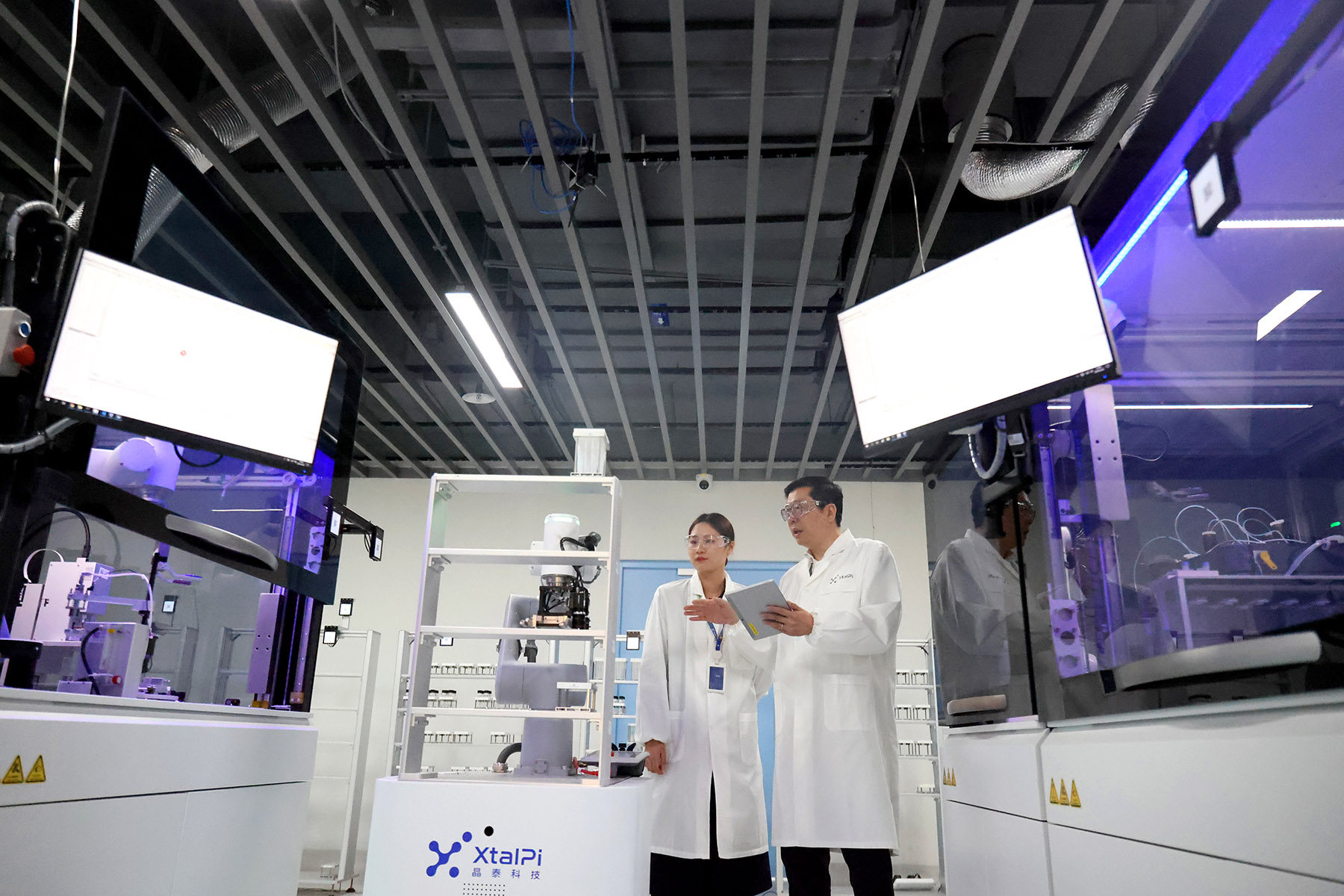
XtalPi has positioned itself as a technology platform for pharmaceutical companies. Its core business combines AI-driven molecular simulation with automated laboratories and robotics systems designed to accelerate early-stage drug discovery.
Rather than relying on developing drugs itself, the company primarily generates revenue from research services and experimental infrastructure provided to global pharmaceutical groups, adopting an approach that resembles an AI-enhanced contract research organization.
Analysts at JPMorgan wrote in a recent report that XtalPi's model essentially provides the infrastructure for AI-driven drug discovery. Because revenue is tied to research contracts rather than drug approvals, the model offers relatively predictable income.
The company's drug discovery solutions segment generated 537.9 million yuan in revenue last year, up more than fourfold year-on-year, while AI4S intelligent solutions contributed another 264.7 million yuan, it said.
Industry experts said XtalPi's service model effectively shifts the high risk of drug development — where more than 90 percent of candidates fail in clinical trials — back to pharmaceutical clients. The company bears mainly technology delivery risks rather than clinical risks.
According to a 2025 report in South China Morning Post, Zhang Peiyu, the chief scientific officer at XtalPi, stated that the company's AI+robotics platform has raised the success rate of chemical synthesis experiments from 20-30 percent to around 90 percent and would reduce drug discovery timelines to about one or two years rather than the four years it often takes now. Such service-oriented models deliver relatively stable cash flow, helping support continuous platform iteration.
InSilico Medicine has chosen a more ambitious — and riskier — route. The company uses its Pharma.AI platform — its proprietary end-to-end generative AI platform — to design drug candidates and advance them through clinical development, effectively operating as an AI-driven biotechnology company.
That approach requires far larger research spending. InSilico invested about $81.4 million in R&D in 2025, equivalent to roughly 145 percent of its annual revenue.
The company has produced 28 preclinical candidate compounds since 2021, more than 10 of which have received investigational new drug approvals and entered the clinical stage.
The strategy recently delivered a high-profile validation. InSilico signed a collaboration agreement with Eli Lilly and Company, granting the US drugmaker exclusive global rights to develop, manufacture and commercialize potentially best-in-class novel oral therapeutics currently in preclinical development for certain indications, while the two sides will also collaborate on multiple R&D programs focused on targets selected by Lilly, the company said.
The deal includes an upfront payment of $115 million and could reach $2.75 billion if development milestones are achieved.
For companies pursuing the biotech model, such partnerships are the primary route to revenue. But income often arrives in large and irregular payments tied to licensing deals and clinical progress, producing volatile financial results. These milestone payments serve as a crucial lifeline to extend their cash runway and fund the heavy cash-burn required for ongoing clinical trials.
The split between platform and biotech strategies is not unique to China. Across the industry, AI drug discovery companies are experimenting with different ways to commercialize their technology.
US-based Recursion Pharmaceuticals has adopted hybrid strategies combining platform partnerships with internal drug pipelines, while major pharmaceutical companies — including Pfizer, Sanofi and Lilly — have signed dozens of AI discovery partnerships in recent years.
The hope is that machine learning can reduce the time and cost required to identify promising drug candidates.
Despite rapid advances in AI, many researchers and industry insiders say the technology is unlikely to transform drug development as dramatically as some investors expect.
Ding Sheng, director of the Global Health Drug Discovery Institute, said the core challenge lies in biology rather than computing power.
"Compared with fields like natural language processing, the datasets available for drug discovery are much smaller," Ding said. "Our understanding of biological mechanisms is still incomplete."
While AI can accelerate early-stage discovery, he said candidate drugs still face years of clinical trials before reaching approval.
Ren Feng, co-CEO and chief scientific officer of InSilico Medicine, offered a similar industry perspective from a drug developer.
"AI excels at compressing timelines in preclinical research, but once a candidate enters the clinic, its role diminishes sharply. Clinical development remains a years-long, highly regulated process that AI cannot bypass. The real limits are our incomplete biological knowledge and the scarcity of high-quality training data — not computing power," Ren said.
China has emerged as one of the most active centers of AI drug discovery in recent years. Industry analysts say the country's strong pharmaceutical manufacturing base, large patient population and rapidly expanding AI talent pool have helped accelerate development.
ALSO READ: China's five-year blueprint set to fast-track tech adoption on factory floor
Ding said the global industry remains at an early stage, with technological capabilities across companies still relatively close.
"In many areas, Chinese companies are now running alongside foreign peers," he said. "In some directions, they may even move ahead."
China's policy support is increasingly aligning with the rapid rise of AI in pharmaceutical R&D, with the authorities placing AI-driven drug discovery high on the national innovation agenda.
In April last year, the Ministry of Industry and Information Technology and six other government departments jointly released an Implementation Plan for the Digital-Intelligent Transformation of the Pharmaceutical Industry (2025-30). The policy blueprint calls for the establishment of more than 10 national pharmaceutical AI model innovation platforms and encourages the expanded use of AI across key stages of drug development.
According to market consultancy Frost & Sullivan, the global AI-enabled pharmaceutical R&D market is projected to grow from $11.9 billion in 2023 to $74.6 billion by 2032, representing a compound annual growth rate of 22.6 percent, underscoring a strong trajectory of growth and certainty for the sector.
Contact the writers at lijing2009@chinadaily.com.cn
