

China should strengthen policy support for its semiconductor materials sector to reduce reliance on foreign suppliers, a national lawmaker said.
Li Shaoping, a deputy to the 14th National People's Congress and chairman of Sinophorus, said at the two sessions that Chinese companies have begun making breakthroughs in key electronic materials long dominated by suppliers from the United States, Japan and South Korea, though the sector still faces technological bottlenecks.
"Chip manufacturing requires hundreds of highly specialized electronic chemicals. Among the most challenging are photo-initiators used in photoresists, a core material in semiconductor lithography.
"The technology carries high barriers and has historically been monopolized by overseas firms, with China relying on imports for more than 95 percent of supply," he said.
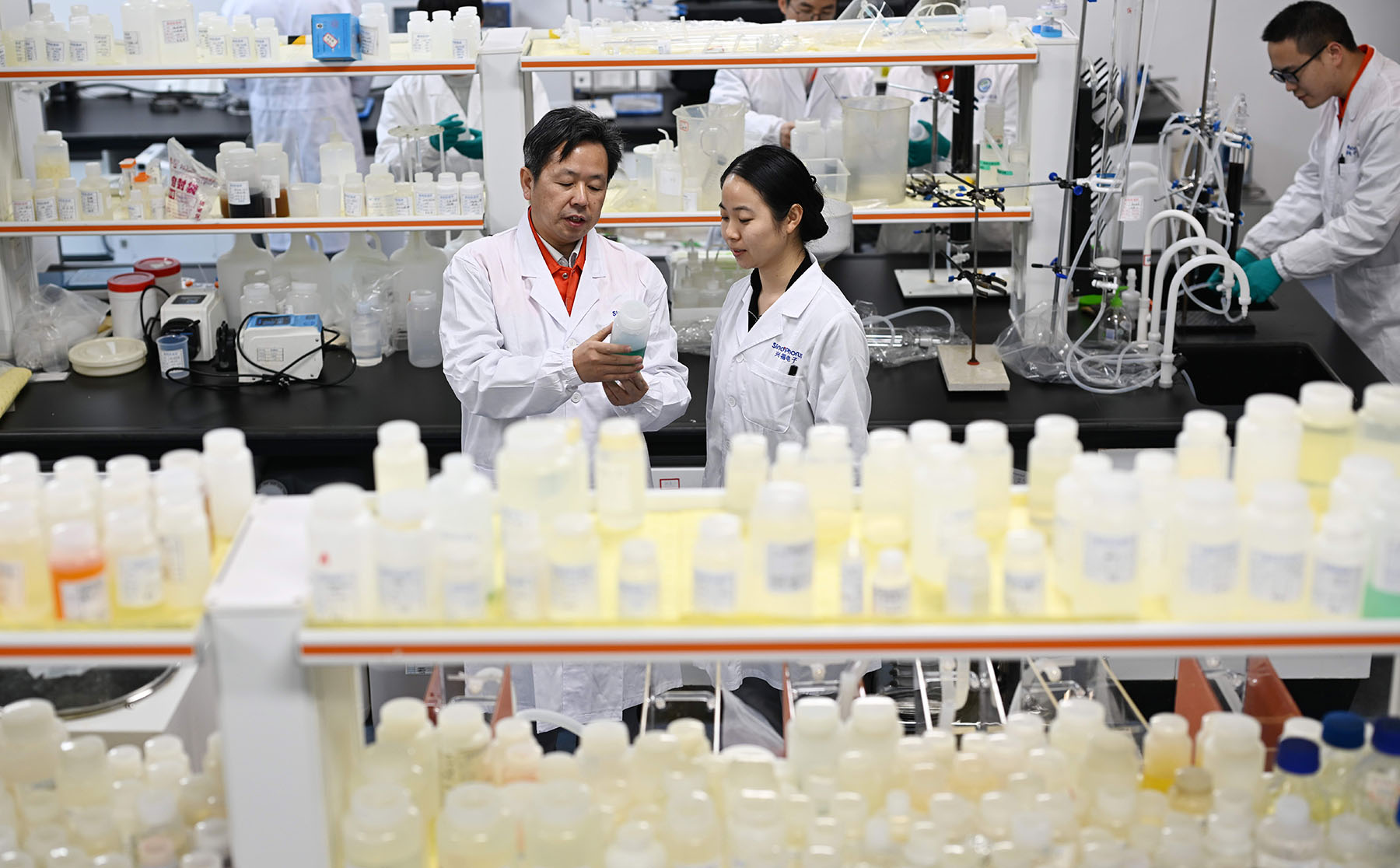
Li said that the laboratory he is in has spent three years overcoming key hurdles in synthesis and purification, eventually achieving performance levels comparable to imported products.
Late last year, the technology was transferred to Sinophorus through a transaction valued at more than 46 million yuan ($6.4 million), enabling the company to industrialize the innovation and bridge what Li described as the "last mile" from laboratory research to commercial production.
"Only when innovation moves from the lab to the production line can it truly solve real industrial problems," Li said.
Sinophorus has since tackled more than 70 supply bottlenecks in electronic chemicals, he said, adding that the company's electronic chemicals production capacity has reached 460,000 metric tons, making it the largest producer in China.
Beyond semiconductors, the company has advanced breakthroughs across the phosphorus chemical industry chain, helping push Chinese producers toward higher-value segments of the global market.
Li highlighted progress in the industrial production of black phosphorus, an emerging material with potential applications in batteries and electronics. Sinophorus has established a manufacturing process capable of producing black phosphorus at the scale of hundreds of kilograms, cutting raw material costs from about 150 yuan per kilogram to around 90 yuan.
Sinophorus has also entered the rapidly expanding new energy materials sector, where it has developed several generations of lithium iron phosphate battery materials.
"As a latecomer to the industry, we have independently developed nine products across six categories," Li said, adding that the company now maintains a pipeline of mass-produced technologies, next-generation products under development and further innovations in research.
He said the deep integration of technological innovation and industrial application is essential to fostering what Chinese policymakers describe as "new quality productive forces", referring to advanced, innovation-driven growth.
Looking ahead, Li said the company plans to increase research investment and focus on key materials used in advanced semiconductor manufacturing processes.
"Our goal is to move China's microelectronics materials into the global first tier," Li said.
The company, he added, also aims to strengthen its global leadership in high-end phosphorus chemicals and rise into the top ranks of China's new energy materials industry.
ALSO READ: ExxonMobil's landmark chemical complex enters operation in China
Li also called for stronger national support to help China's semiconductor materials industry develop more sustainably.
He urged policymakers to guide industrial planning to prevent excessive duplication and low-price competition, improve management of pilot-scale testing facilities to speed up the commercialization of research breakthroughs and strengthen recycling policies to promote greener industrial development.
He called for greater investment in basic research and deeper collaboration between government, industry, universities and research institutes.
"Key core technologies cannot be asked for or bought," Li said. "What can be purchased is often second-rate or outdated. True breakthroughs must rely on independent innovation."
Contact the writers at chengyu@chinadaily.com.cn
