

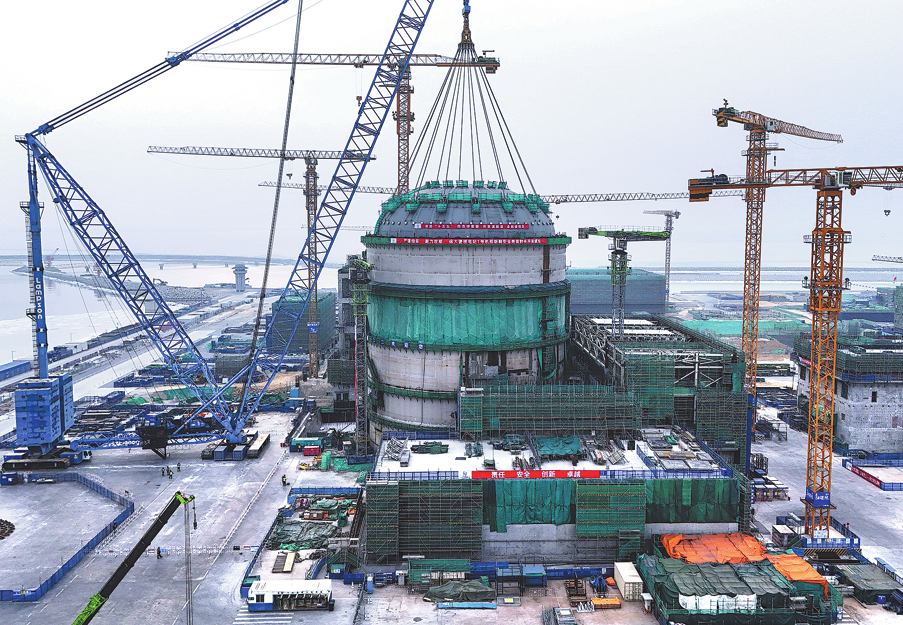
In the push for a global energy transition, much attention has been given to wind turbines and solar panels. Yet a sober look at the arithmetic of decarbonization suggests that these alone will not suffice. The second Nuclear Energy Summit, hosted by France in Paris on Tuesday, reflects a growing recognition that nuclear energy must be part of the solution.
Nuclear power provides nearly 10 percent of the world's electricity and roughly a quarter of global low-carbon electricity. Yet if the world is to achieve the goals of the United Nations' Sustainable Development framework and the climate commitments embedded in the Paris Agreement, much more will be required.
Academic studies have repeatedly shown that power systems dominated by intermittent sources become increasingly costly without a stable baseload component. Nuclear energy remains one of the few technologies capable of providing large-scale, low-carbon, around-the-clock electricity.
READ MORE: Nuclear energy sector offers safe, clean power for China’s green development
The agenda of the Paris summit reflects this reality. Three themes dominate: regional cooperation in nuclear deployment, financing models for new reactors, and technological innovation ranging from small modular reactors to advanced Generation-IV systems and, eventually, nuclear fusion.
Each theme addresses a critical constraint. The first concerns inequality in access. Many emerging economies face rapidly rising electricity demand but lack the technological and regulatory capacity to develop nuclear power. The benefits of nuclear technology remain concentrated among advanced industrial states. Without mechanisms for technology transfer and capacity-building, the gap could widen.
The financial factor is another constraint. Nuclear projects are capital-intensive and involve long construction horizons. This makes them difficult to finance through conventional market mechanisms. The cost of capital — often exceeding half the lifetime cost of a plant — depends heavily on government guarantees and stable regulatory frameworks. Innovative financing tools, including green bonds and public-private partnerships, are therefore becoming crucial to the industry's development.
Technological and institutional constraints cannot be ignored either. Nuclear supply chains remain fragile. Skilled labor shortages affect reactor construction. Meanwhile, spent fuel management and long-term waste disposal continue to raise public concerns. The legitimacy of nuclear energy expansion hinges on credible safety regulation, transparent oversight and international verification mechanisms.
These challenges underline the relevance of a summit devoted to nuclear power. The task is not merely to expand capacity but to do so in a manner that is safe, equitable and internationally coordinated. Geopolitical tensions, such as the Middle East crisis, have further exposed vulnerabilities in global energy supply chains. In such a context, the governance of nuclear energy cannot remain fragmented or politicized.
The participation of Chinese Vice-Premier Zhang Guoqing, the special representative of President Xi Jinping, in the meeting shows the importance China attaches to nuclear energy cooperation and governance.
China stands ready to work with countries on a more inclusive nuclear energy governance and development. The country now ranks among the major countries in nuclear power deployment and possesses one of the most complete industry supply chains in the sector. An atomic energy law that came into effect in the country in January emphasizes peaceful use, international cooperation and strict safeguards against proliferation and nuclear terrorism, providing a legal basis for China to strengthen the regulation of its nuclear energy sector and international cooperation.
Given its wide influence in different fields, nuclear energy development should be framed as part of a broader strategy combining energy security, climate responsibility and technological innovation. International collaboration and coordination, under an improved global governance framework capable of reconciling expansion with security, is needed to allow more countries to benefit from nuclear energy while strengthening safety and nonproliferation standards.
ALSO READ: Injecting momentum into global climate action
The Paris summit therefore is not simply a diplomatic gathering but a recognition of an uncomfortable truth: achieving emissions target without nuclear energy is not feasible with current technology and global governance system.
If the world is to decarbonize while maintaining economic stability, nuclear power must be governed not by suspicion and fragmentation but by cooperation, transparency and shared responsibility. That, ultimately, is the promise — and the test — of the Paris gathering, which should focus more on actions and results.
