

Tropical island province finds success in engine maintenance as major carriers take advantage of enhanced services
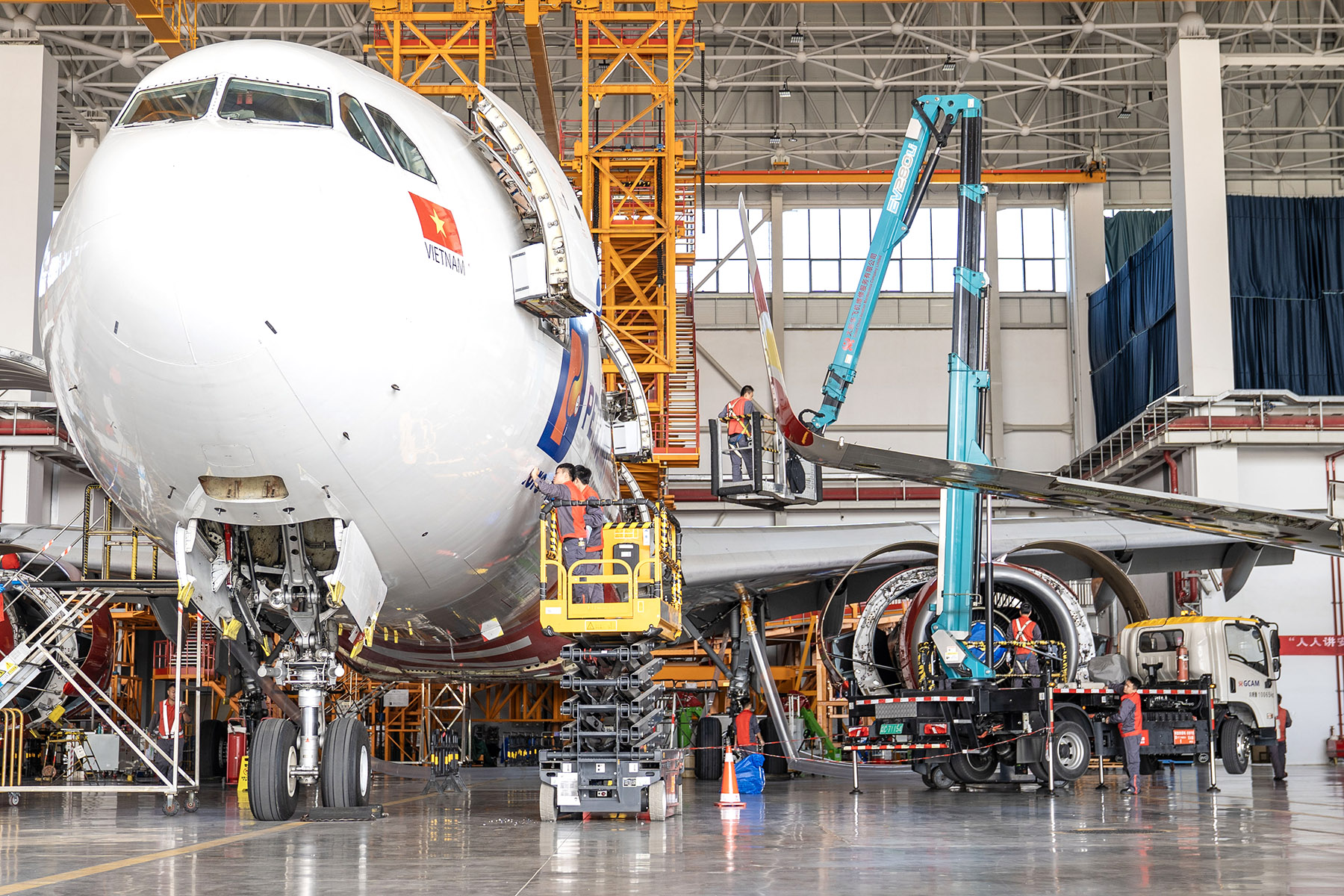
As the Boeing 787-8 Dreamliner jet, gleaming in its Royal Jordanian airline livery, slowly taxied into a hangar at Haikou Meilan International Airport, its massive engines hummed with the quiet promise of a full 66-day overhaul.
The aircraft, part of a fleet that spans continents, is far more than just a symbol of global air travel. It represents a new frontier for Hainan province's rapidly developing aerospace industry, which is poised to redefine its role in the global supply chain.
What makes this jet's journey even more significant is not its international flair, but the location where its critical maintenance is taking place: Hainan Free Trade Port, where a burgeoning ecosystem is taking shape to handle the world's aircraft overhaul needs.
READ MORE: Premier Li reaffirms commitment to Hainan Free Trade Port development
It coincides with China's pledge to safeguard and develop an open world economy. According to a draft Government Work Report submitted on Thursday to the country's top legislature for deliberation, China will improve the layout and scale of pilot free trade zones to boost their innovation-driven development capacity, as well as take solid steps to develop Hainan Free Trade Port.
This Boeing 787-8 is the latest widebody to undergo a scheduled heavy maintenance check at a state-of-the-art facility, underscoring Hainan's growing significance in the global aircraft maintenance, repair and overhaul industry.
The aircraft's seamless arrival — a mere formality under the preapproval customs system — was just the beginning.
Within hours of its arrival, it was already being prepared for an extensive overhaul by Grand China Aviation Maintenance Co, a subsidiary of HNA Technic. The facility, which opened its doors in 2022, has already begun to attract a growing number of foreign carriers, turning Hainan into a vital hub in the MRO sector.
Aboard the aircraft, engineers are preparing the jet for its comprehensive service. Over the course of the next two months, it will undergo a heavy airframe check, an overhaul of its landing gear, a cabin refurbishment, installation of in-flight connectivity systems and a full exterior repaint.
This intensive work will allow the aircraft to continue its role in an international fleet that connects countries and economies worldwide. But for Hainan, it is more than just another maintenance job; it's another step toward becoming a key player in a global aerospace network.
Aviation's new frontier
Hainan's strategic importance is now amplified by its exceptional combination of incentives, regulatory flexibility and technical expertise, which have created a perfect environment for foreign carriers seeking cost-effective, efficient maintenance services.
The two key advantages that draw airlines to Hainan are the tax exemptions on imported spare parts and the customs deposit exemptions for maintenance projects, both of which save airlines between 10 and 15 percent of total overhaul costs. In an industry where profit margins are often razor-thin, these savings are no trifling matter.
Yang Wenbo, deputy director of the maintenance base, said: "Airlines are always looking for ways to lower operational costs while keeping their fleets in peak condition. These tax breaks and the ability to clear customs swiftly are incredibly appealing."
The efficiency of the system is critical in an industry where time on the ground is time lost. Every extra day an aircraft remains grounded represents lost revenue, and the MRO base in Haikou is designed to minimize that downtime by providing a one-stop shop for heavy checks, modifications, and painting — all in one place.
The maintenance complex is a full-service facility, like a luxury auto service center where everything from deep structural checks to exterior detailing can be done in the same location.
"Just like how a car dealership provides a full range of services for vehicles, we handle every aspect of aircraft maintenance. We perform heavy airframe checks, repair components, and even repaint the aircraft, all in the same facility, cutting down the time and complexity for airlines," Yang said.
His analogy with a car service center is an apt one. Just as drivers rely on dealerships to keep their cars in top shape, airlines are increasingly turning to Hainan's MRO base to ensure their fleets remain competitive and efficient.
Since its launch, the one-stop base has serviced over 2,400 aircraft, with nearly 50 airlines from both China and abroad taking advantage of the facility's capabilities.
The business is booming. More than 400 maintenance tasks are scheduled, from routine 12-year checks to more specialized upgrades such as the installation of new cabin interiors, satellite connectivity systems and full-body repaints.
This surge in international business is a direct result of Hainan's push to develop a comprehensive aerospace ecosystem. Foreign-registered aircraft, including those from Qatar, Vietnam, Thailand and South Korea, are a regular presence at the facility, filling up hangars as the base expands its reach and capacity.
As Hainan continues to position itself as an international aerospace repair hub, the tropical island province is looking to expand into even more sophisticated services, such as engine maintenance. A joint venture in the airport's bonded zone has already established a high-thrust engine test cell capable of handling large civil turbofans.
This is a significant step, as engine maintenance is one of the most valuable and specialized aspects of aircraft repair. The new engine facility puts Haikou in an even stronger position to compete with established MRO hubs in places like Singapore, further cementing the region's role as an emerging aerospace powerhouse.
Green revolution
Just a short drive away from the bustling aviation center, another revolution is underway — a green revolution that is reshaping the future of industrial development in Hainan.
At the Haikou National High-Tech Industrial Development Zone, a cutting-edge "zero-carbon park" is under construction, representing a bold vision for how industrial hubs across China can reduce their environmental footprint while maintaining high efficiency.
The "solar tree" — a stunning piece of eco-architecture with silver-gray leaves — captures the essence of the park's mission: to integrate green energy seamlessly into everyday operations.
Beneath these trees, benches made from volcanic stone offer parkgoers the chance to rest while their phones charge wirelessly. It's a simple yet striking reminder of how technology and nature can coexist in harmony, providing clean energy while creating a space for relaxation and innovation.
This high-tech, eco-friendly vision is part of Hainan's goal to create China's first pilot zero-carbon park, blending cutting-edge technologies with smart systems to reduce carbon emissions.
The park's ambitious development plan integrates photovoltaic panels on rooftops and canopies, energy storage systems and smart energy management to ensure the maximum possible efficiency in every building.
Zheng Yuhua, general manager of Hainan Special Economic Zone Donghu High-tech Investment Co, said: "We are turning buildings into power generators. With real-time dispatch capabilities, we are reducing carbon emissions and ensuring the park remains self-sustaining."
The park also serves as a testing ground for China's broader push toward sustainable development.
In collaboration with Datang International Power Generation Co Ltd, Haikou has secured a deal to receive 100 to 400 million kilowatt-hours of offshore wind power annually, which will help drive the park's green energy needs.
This is just one example of how Haikou is integrating green power solutions at both the local and industrial levels, ensuring that the region's transition to sustainable energy is as seamless and efficient as possible.
Hainan's green transformation is part of a much larger national effort to shift toward low-carbon industrial development. In recent years, the Chinese government has committed to fostering green manufacturing through the creation of more than 6,400 national-level green factories and 491 green industrial parks.
These initiatives are helping to reduce energy consumption and carbon emissions across the country's manufacturing sector, which now accounts for over 20 percent of China's total industrial output.
China's green push also extends globally. The country is the world's largest producer of renewable energy products, from solar photovoltaic modules to wind power equipment.
From 2021 to 2024, China helped the world generate about trillion-level kWh of green electricity and reduce carbon dioxide emissions by roughly billions of tons, the Ministry of Industry and Information Technology said.
But this transformation does not come without significant investment. Since the launch of China's 14th Five-Year Plan (2021-25), the country has allocated over 300 billion yuan ($43.1 billion) to support the green upgrade of its industrial sector.
These funds are being used to finance energy-saving projects, carbon-reduction innovations, and advanced environmental technologies. With financial backing from the MIIT and China's banking sector, the government is laying the groundwork for a green industrial revolution.
Financial backbone
As China looks to scale up its green ambitions, financial support is crucial. In December, the MIIT and the People's Bank of China — the country's central bank — issued new guidelines designed to promote green financing for industrial projects.
These policies aim to incentivize banks and financial institutions to develop specialized products for green projects, such as "green factory loans" and "energy conservation loans". These products will help direct investment into projects that reduce carbon emissions, conserve energy and promote sustainable practices.
ALSO READ: China's deeper opening-up promised for steady growth
The MIIT has also established a national industry-finance cooperation platform to facilitate links between green projects and the necessary capital. This platform hosts over a hundred tailored financial products designed to support energy conservation, pollution reduction and the construction of zero-carbon factories.
The results have been promising. In the first eleven months of 2025 alone, green industrial loans grew by 22.3 percent year-on-year, reaching 73.56 billion yuan in new loans.
As the national government continues to push for green development, the financial sector is responding by offering a growing range of products and services designed to make green projects more accessible.
Yan Xinguo, head of corporate banking at China Minsheng Bank, said: "We offer online credit-based products for listed companies, helping them grow quickly while ensuring stability."
Contact the writers at chengyu@chinadaily.com.cn
