

Young people around the world are creating new forms of celebrating the Chinese New Year, passing on the spirit of it, and expanding its influence in a new area.
"Wish you a Happy Chinese New Year, with a heart full of love and festive cheer. Chase your dreams, let go of fear, with your family, friends, and loved ones near."
As these lyrics rang out across the stage of the 2026 Spring Festival Gala, hosted by China Media Group, audiences across the country witnessed a familiar celebration delivered in an unexpected voice — that of Shaun Gibson, an independent musician from the United Kingdom.
The song, titled Happy Chinese New Year, was later released on platforms including Bilibili and Xiaohongshu (Red-Note), extending its reach well beyond the television broadcast.
READ MORE: Ancient crafts dance to Spring Festival beat
Gibson's connection to the Spring Festival began more than a decade ago in his hometown of Liverpool, far from China.
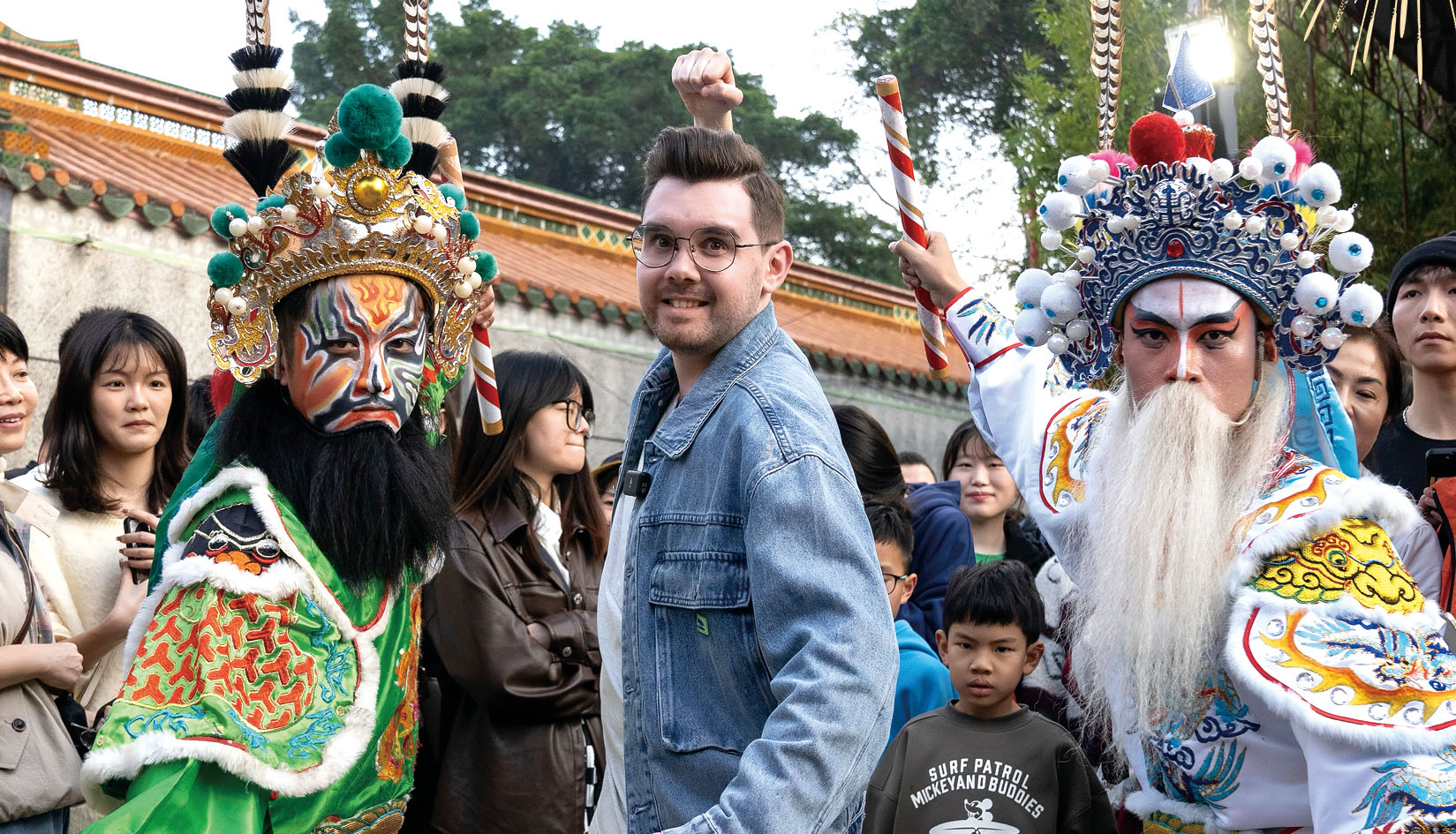
"I just happened to be walking through the city center and came across a loong dance," he recalled, referring to the traditional performance that imitates the movements of a loong. "They were setting off firecrackers, and I thought there was some kind of war going on. It was so loud and so exciting, and I was fascinated by it."
That encounter left a lasting impression. In the years that followed, Gibson celebrated six Spring Festivals across China, experiencing everything from the grand public festivities of Chaoshan in Guangdong province to intimate family gatherings in Sichuan province.
"In Chaoshan, I was lucky enough to witness so many amazing local traditions, like Yingge (a folk dance)," he said. "And in my friend's hometown in Sichuan this year, we experienced chixi — sitting together with relatives and enjoying a home-cooked feast."
For Gibson, these moments became the emotional foundation of his song. "Everything in the lyrics and the music is what I've experienced, and the music video is literally the footage of what I went through these years," he said. "If you're sensitive like I am, it's impossible not to feel the true nature of Spring Festival because it's everywhere — beyond all of the celebrations and the parties."
For example, in Chaoshan, he asked local residents why they continued to uphold traditional customs year after year."Their reason was simple and beautiful," he recalled. "They answered that it's their culture. It's what they do and love. Why wouldn't they continue? That was the moment I felt the beauty of this traditional festival. There may be no commercial value in it, but it has endless value."
For Gibson, the heart of the festival is "an expression of who we are as humans".
"We all get caught up in the daily grind — work, money, survival," he said. "Spring Festival is a reminder to come back to what really matters. It brings us back to love, to working together, to remembering that there's more to life than just getting by."
Gibson said he hopes his song can serve as a "soundtrack" for those who, for various reasons, are unable to return to their hometowns during the holiday, allowing the festival's emotional core to resonate wherever they are.
Modern togetherness
Li Zhiyue, from the Ningxia Hui autonomous region, was among those who did not return home this year due to work commitments in Beijing.
But instead of spending New Year's Eve alone, he turned to social media and invited others in a similar situation to gather at his home and celebrate together.
Though they were strangers at first, preparing dinner, chatting, and watching the Spring Festival Gala side by side helped them recreate the warmth of traditional customs.
"We made sure to tuck a coin into the dumplings, believing that whoever finds it will have good luck in the coming year," Li said. "At the same time, we added a few new touches — taking goofy group photos and exchanging mystery gifts."
In Li's view, celebrating Spring Festival with peers has its own appeal.
"It feels free and relaxed — like we're all on the same wavelength," he said. "There's no pressure from relatives asking about our jobs or whether we're getting married. There's just companionship and mutual understanding."
He hopes that his experiment can offer an alternative perspective.
"As society changes, I think young people can redefine what 'reunion' and 'festive atmosphere' mean in their own way," he said. "It takes courage to create your own warmth — to build something that feels both independent and imaginative."
In Shanghai, Peng Peng, a senior account manager at W Moment, an event planning and cultural experience agency, has taken that idea a step further by organizing Spring Festival activities for foreigners eager to experience authentic Chinese traditions.
She noticed that many foreign residents stay in big cities during the holiday, when urban neighborhoods grow unusually quiet as locals return to their hometowns.
"They see the decorations and celebrations online, but they rarely get to step into a real family setting," she said. "They don't have the chance to see how customs vary from city to city."
At the same time, Peng has heard a common refrain: that the festive spirit is fading, that the holiday no longer feels as magical as it did in childhood. For many people — especially the younger generation — long-standing traditions, such as watching the Spring Festival Gala together from beginning to end, have gradually given way to evenings spent scrolling on smartphones.
ALSO READ: A taste of home, shaped by hand
"It's true that when we were young, Spring Festival celebrations were orchestrated by our parents and grandparents. We didn't have to worry about a thing," she said. "But when international friends come and ask why we perform certain rituals, it becomes our responsibility to explain. We can't just turn to our parents anymore. We're the ones introducing the traditions and organizing the gathering. We become the hosts."
For Peng, that shift matters. As adults, she said, young people can now become active creators of the atmosphere they once passively enjoyed. Rather than lamenting the loss of tradition, she believes her generation should take ownership of it.
"We shouldn't just complain that the Chinese New Year doesn't feel the same," she said. "In the past, our families created that feeling for us. Now that we've grown up, it's our turn to create an unforgettable Spring Festival for them. That, too, is a way of giving back."
Contact the writers at guojiatong@i21st.cn
