

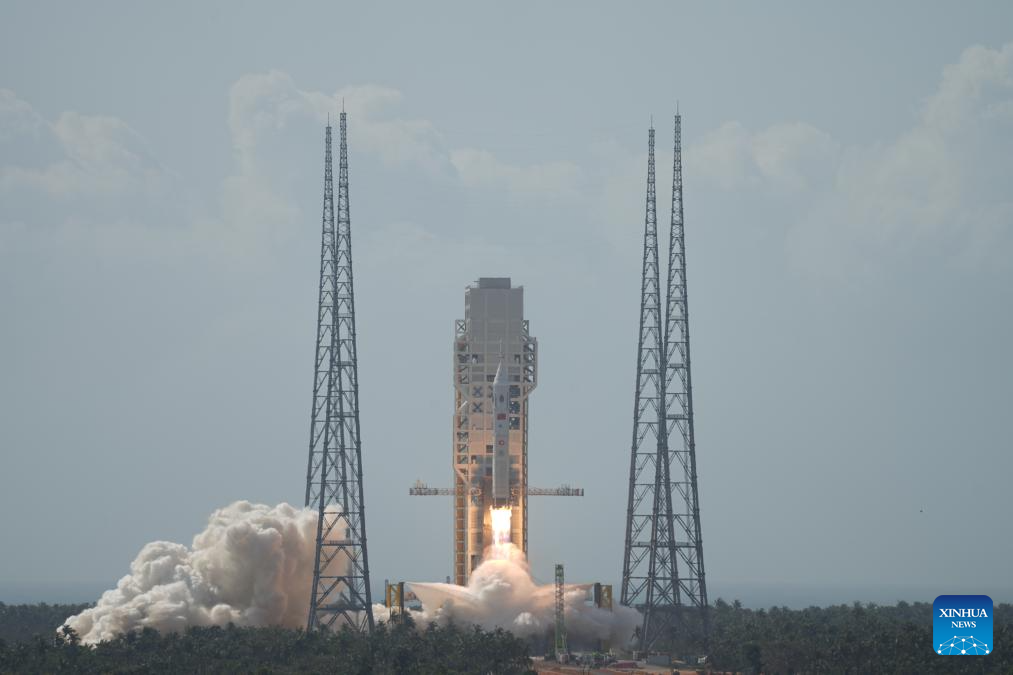
China conducted a significant flight test on Wednesday of a new rocket and spacecraft designed for the nation's manned lunar exploration missions.
A prototype of the Mengzhou spacecraft was mounted atop a prototype first-stage booster of the Long March 10 heavy-lift rocket, which blasted off at 11 am from the Wenchang Space Launch Center, a coastal spaceport in Hainan province, and soon soared into the sky.
After a brief flight, the booster reached a critical point known as Max-Q, a challenging and risky moment during a rocket's ascent when aerodynamic forces are at their strongest. At that point, the Mengzhou return capsule separated from the booster and was immediately pulled away by the escape rocket mounted on top of it.
Several seconds later, the escape rocket and the return capsule separated at a predetermined altitude. The capsule's parachutes then deployed, bringing it to a designated area in the South China Sea.
ALSO READ: China completes first landing, takeoff test of manned lunar lander
Simultaneously, the Long March 10 first-stage booster continued its upward flight. At a certain point, its engines were temporarily shut down, allowing the rocket to coast on inertia. Soon after crossing the Karman Line, the globally recognized boundary between Earth's atmosphere and outer space, the booster deployed its grid fins, and its reaction control system was activated to regulate its descent and adjust its position.
During the descent, some of its engines were restarted twice to work in coordination with the grid fins and the reaction control system to reduce its speed and maintain the desired positions.
In the final seconds of the sophisticated maneuver, all engines stopped operating, allowing the gigantic vehicle to splash down smoothly in a designated sea area, marking the successful completion of the test.
READ MORE: China unveils more details of its future manned lunar mission
Near the splashdown area, a mobile recovery platform, intended for retrieving the Long March 10 series' reusable booster, simulated the recovery process using real-time telemetry data transmitted from the rocket.
According to the China Manned Space Agency, the mission marked the first flight test of the Long March 10 prototype, the country's first Max-Q escape test for a spacecraft, the first sea splashdown of a manned spacecraft's return capsule and a rocket's first-stage booster, and also the first operation at the newly-built heavy rocket launch tower at the Wenchang spaceport.
The test successfully verified the Long March 10's first-stage ascent and recovery phases, as well as the Mengzhou's Max-Q escape and recovery capabilities, accumulating valuable data and experience for future manned lunar missions, the agency noted.
