

CAIRO/TEHERAN - Iran on Monday publicly rejected a core US demand to cease all uranium enrichment, while projecting a dual-track strategy of guarded diplomatic engagement and reinforced military preparedness.
The moves came as the indirect Teheran-Washington talks in Oman's Muscat last week yielded no breakthrough and regional tensions continued to simmer.
On Monday, Mohammad Eslami, president of the Atomic Energy Organization of Iran, said that while Iran could consider diluting its 60-percent enriched uranium, it would only do so if all international sanctions were first lifted.
"This issue depends on whether they will lift all sanctions in return," Iran's state news agency IRNA quoted Eslami as saying.
Eslami also dismissed past proposals to ship the material abroad for safekeeping.
Iranian President Masoud Pezeshkian and Foreign Minister Seyed Abbas Araghchi echoed this line on Monday, reaffirming Teheran's strategy of engaging in talks while refusing to concede on what Iran views as sovereign rights.
Pezeshkian and Araghchi have described the Muscat talks as a "good start" but warned that diplomacy must be based on "respect, not coercion."
Meanwhile, Teheran-based WANA news agency reported a closed-door session held on Sunday morning between the country's military chief and Araghchi, noting that the central message of the session was "the full coordination between 'diplomacy and the field' within the decision-making structure" of Iran.
Khamenei urges national unity
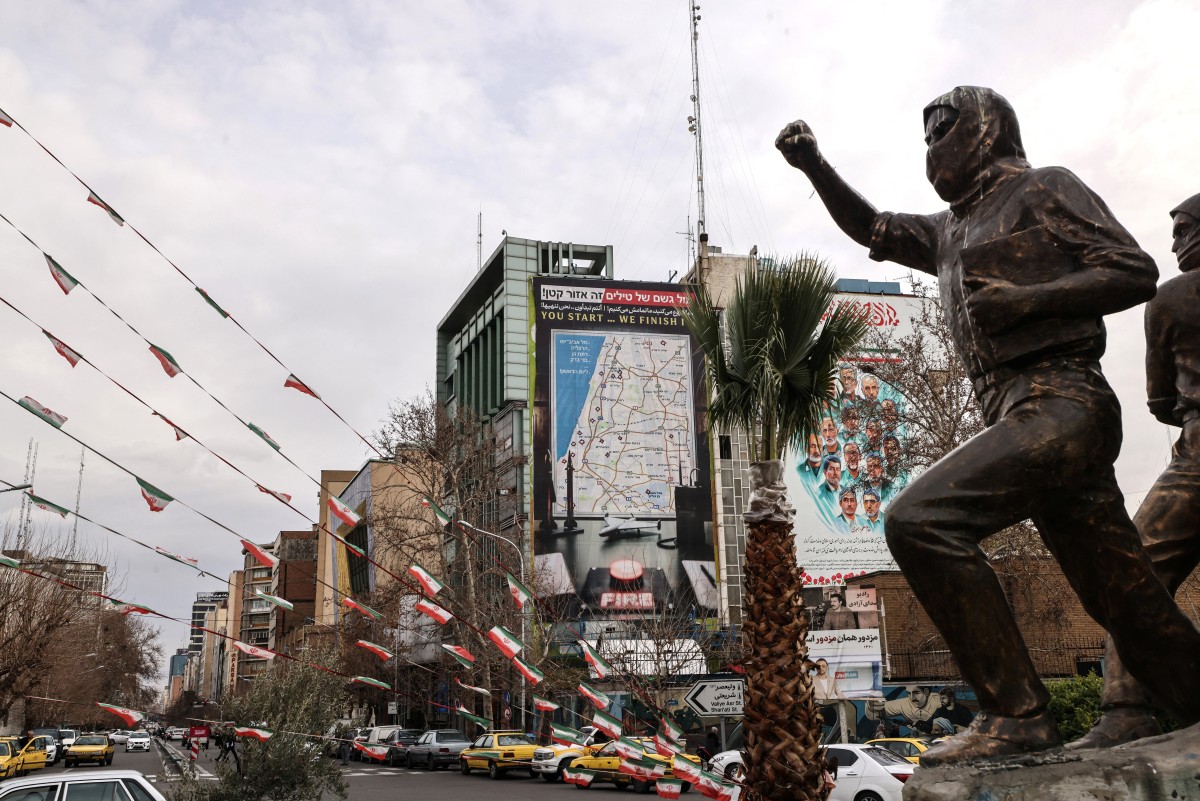
In a televised speech on Monday, Iran's Supreme Leader Ali Khamenei urged Iranians to show unity and "disappoint the enemy" ahead of the 47th anniversary of the 1979 Islamic Revolution, amid rising tensions with the United States.
His remarks come as Iran prepares for nationwide rallies on Wednesday to mark the revolution's victory."Until the enemy is disappointed, a nation is exposed to persecution," Khamenei said. "The enemy must be disappointed."
He described the annual marches as a display of dignity that forces foreign powers to "retreat" from ambitions of interfering in Iranian affairs.
Simultaneously, Iran has signaled a shift toward greater military opacity. The IRNA said in a separate report on Sunday that the Defense Ministry has halted all public displays of new weaponry "for security reasons and to safeguard the principle of surprise," a move widely interpreted as preparing for potential conflict.
The 1979 Islamic Revolution was a watershed moment that transformed Iran from a pro-Western monarchy into an Islamic republic. Led by Ayatollah Ruhollah Khomeini, a diverse coalition of clerics, students, and secular activists overthrew Shah Mohammad Reza Pahlavi, who was supported by the US.
Iran and the US severed diplomatic ties in 1980 after the Iranian people seized the US embassy in Teheran.
Top Iranian security official to visit Oman
The secretary of Iran's Supreme National Security Council (SNSC), Ali Larijani, will lead a delegation to the Omani capital of Muscat on Tuesday, according to the SNSC-affiliated Nour News.
After the Iran-US nuclear talks in Oman, the diplomatic channel seems to remain technically open.
At a news conference in Teheran on Sunday, Iranian Foreign Minister Seyed Abbas Araghchi said the date and location for the next round of nuclear negotiations would be determined through consultations with Oman.
Yet the fundamental mismatch of demands from Teheran and Washington, combined with visible military posturing, has pointed not to an imminent deal, but rather to a prolonged stalemate.
US, Israel show firm positions
Positions from the US and Israel have appeared equally firm. A report on Sunday by Israel's Channel 15 said the US had privately messaged Iran, seeking Iran's "concessions" in the next round of talks, and expecting "serious and meaningful content."
On Monday, The Jerusalem Post, citing Israeli defense officials, reported that Israel has warned Washington it "will strike alone" if Iran crosses its "red lines" on ballistic missiles.
Amid continuously simmering tensions in the Middle East, the US Department of Transportation on Monday issued a new advisory to all US-flagged commercial vessels transiting the Strait of Hormuz, asking them to stay far away from Iran's territorial sea in case Iranian forces seek to board.
The somewhat "deadlocked" situation between Teheran and Washington has been captured by several media outlets. An analysis published Monday by the Middle East Forum Observer noted the increasingly narrow path forward.
The US demand for Iran's zero enrichment is a "maximalist position" Teheran could not accept, while Iran likely views concessions on missiles or regional proxies as an "existential danger," it said, adding that this mutual perception of high risk has explained why both sides are talking while actively preparing for the talks' failure.
The Conversation has echoed this opinion, noting in an analysis published Monday that Washington's "opening demands are often maximalist by design," which are "intended to create leverage rather than define an achievable endpoint."
"The risk lies in treating these demands as simultaneously attainable," it said, adding that from Teheran's view, "the issues are not equivalent."
