

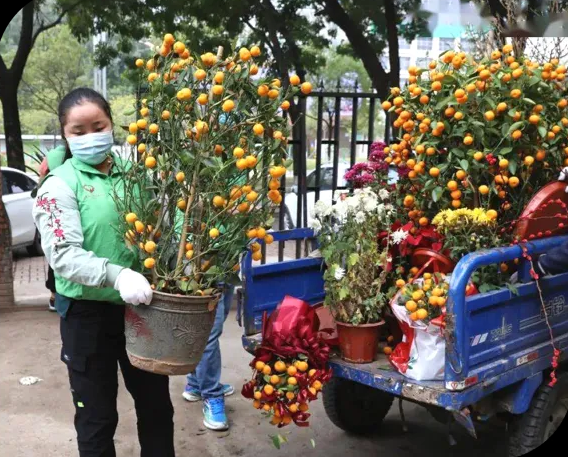
Guangzhou’s urban management department has set up 674 temporary collection points across the city to ensure the seasonal flowers and kumquat trees, which people bought to decorate homes as symbols of good fortune during the Chinese New Year (CNY) holiday period, are disposed of responsibly and sustainably.
This measure, now in its fourteenth year, aims to transform plants that would have ended up as urban waste into resources, applying a "three-step separation" method to reclaim and repurpose each component of the plants.
In Guangdong customs, decorative kumquats and flowers such as butterfly orchids and narcissus are essential for creating a festive atmosphere. However, shortly after the Lantern Festival, they often wilt, leading to a disposal challenge. These discarded plants used to end up in landfills, adding to the city's waste burden.
The city's current strategy, initiated in 2012, aims to reduce waste by separating the plants into branches, soil and pots at the collection points.
ALSO READ: Application for Guangzhou CNY fireworks viewing slots opens Sunday
Urban management told Yangcheng Daily reporters that the plants can be moved to public green spaces for replanting or processed together with soil into organic fertilizer. Intact pots are cleaned and redistributed to gardening groups for reuse, while broken ones are processed as construction waste.
This systematic approach has proven effective. In 2025 alone, Guangzhou successfully processed 2,792 metric tons of abandoned New Year plants, including 974.48 tons of plant matter, 623.32 tons of pots, and 1,194.2 tons of soil.
The 674 collection points for 2026 are strategically distributed across the city's 11 districts, with Panyu District having the most (157) and Conghua District the fewest (nine). While the number of collection points has been reduced from previous years—making it the lowest number since 2021—this reflects improved efficiency and a more targeted approach to collection, driven by enhanced public awareness and logistical planning.
The public is also encouraged to repurpose their plants in a creative manner. Kumquats, for example, can be fermented with brown sugar and water for three months to produce natural cleaning agents, or preserved to make salted kumquats, a traditional remedy for sore throats.
