

While sector showing MoM drop amid NEV policy shifts and pre-holiday weakness
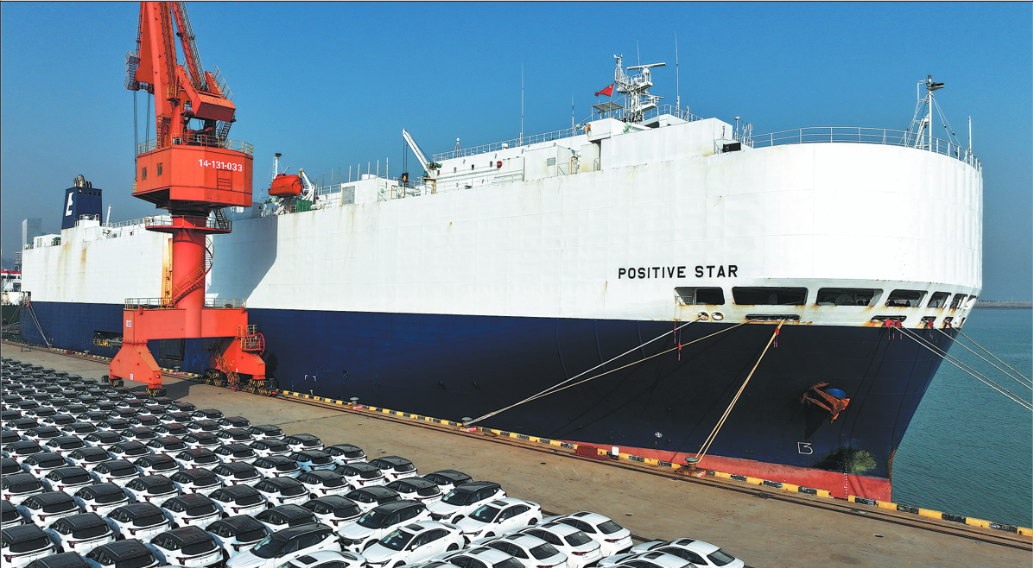
Due to factors such as policy adjustments and the traditional off-season, many automakers saw a month-on-month decline but a year-on-year increase in January sales. Expansion into overseas markets has become an important growth driver for these companies.
Passenger vehicle retail sales were around 1.8 million units, a month-on-month decline of 20.4 percent and a year-on-year increase of 0.3 percent, according to the China Passenger Car Association.
The retail volume of new energy vehicles is estimated to be around 800,000 units, accounting for 44.4 percent of total vehicle sales but 16 percentage points lower than in December.
The association noted that the main reason for this trend is the 2026 policy change, where the NEV purchase tax incentive was adjusted from a full exemption to a 50 percent exemption, alongside automakers’ year-end promotions, which led to a surge in consumer demand at the end of 2025. Additionally, consumer willingness to buy a car remained relatively weak ahead of the upcoming Spring Festival.
The China Automobile Dealers Association anticipates continued downward pressure on China’s car market in February due to a shorter selling period amid the Spring Festival holiday, which runs from Feb 15 to 23.
In terms of automakers, SAIC Motor achieved wholesale sales of 327,000 vehicles, a year-on-year increase of 23.9 percent but a month-on-month decline of 18 percent, reclaiming its position as the top seller.
Its overseas sales reached 105,000 vehicles, an increase of 51.7 percent year-on-year.
Geely sold 270,167 vehicles, up 1 percent year-on-year and 14 percent month-on-month, making it one of the few automakers to achieve a double increase in January sales.
Driven by a year-on-year increase of over 100 percent in Zeekr, Geely’s NEV sales reached 124,252 units, accounting for 46 percent of its total sales and marking a 3 percentage point year-on-year increase.
Its exports soared 121 percent year-on-year and 50 percent month-on-month, with NEVs accounting for 53 percent of these exports.
The company aims to hit a sales target of 3.45 million vehicles in 2026, including an export target of 640,000 units, a year-on-year increase of over 50 percent.
BYD reported wholesale sales of 210,051 units, a year-on-year decline of 30.1 percent and a month-on-month decrease of 50 percent. Of these, 100,482 units were exported. BYD’s overseas sales grew by 43.3 percent month-on-month, accounting for 47.6 percent of its total sales.
The overseas market is becoming an important buffer against domestic market pressure for the company. BYD plans to sell 1.3 million units overseas by 2026, a 24 percent increase from the 1.05 million units in 2025.
Since 2023, BYD has dominated monthly sales in China’s auto market thanks to its early lead and scale in NEV manufacturing. However, experts noted that as NEV market share hits a temporary saturation, electrification alone is no longer a competitive differentiator. Traditional automakers, leveraging their strength in fuel vehicle production, have found opportunities to stage a counterattack.
Chery sold 200,269 vehicles, a year-on-year decrease of about 10 percent and a month-on-month decline of 18.2 percent. Among these, 119,605 were exported, up 48.1 percent year-on-year.
Chery has maintained its position as China’s top auto exporter for nine consecutive months, with monthly exports exceeding 100,000 units.
Meanwhile, Great Wall Motor sold 90,312 vehicles, an 11.6 percent increase year-on-year but a 27.2 percent decrease month-on-month. Of these, 40,278 vehicles were sold overseas, marking a 43.77 percent year-on-year increase.
Among NEV brands, Huawei’s Harmony Intelligent Mobility Alliance delivered a total of 57,915 new vehicles, achieving a year-on-year growth of 65.6 percent despite a 35.4 percent month-on-month decline. The Aitobrand accounted for over 40,000 deliveries, making up nearly 70 percent of HIMA’s total deliveries.
Xiaomi delivered over 39,000 vehicles, a month-on-month decrease of 22 percent but nearly double the volume in the same period of 2025.
The decline was due to the halt in production of the first-generation SU7 sedan. Its new version has com-pleted testing and is to be launched in April. The company said the main model delivered in January was the YU7 SUV.
Leapmotor delivered a total of 32,059 vehicles, a year-on-year increase of 27 percent but a month-on-month decrease of 46.9 percent.
Li Auto delivered 27,668 new vehicles, a month-on-month decrease of 37.5 percent. Its deliveries also fell below those recorded in January 2025 and January 2024.
Nio’s deliveries followed closely at 27,182 units, a year-on-year increase of 96.1 percent but a 43.5 percent month-on-month decline.
Sales of the all-new ES8 SUV reached 17,646 units, becoming the core of Nio’s January sales.
XPeng’s deliveries totaled 20,011 units, a year-on-year decrease of 34.1 percent and a month-on-month decrease of 46.65 percent.
Facing downward pressure, central and local governments have rolled out various policies to boost car sales ahead of the Spring Festival holiday.
More than 20 regions, including Beijing, Shanghai and Chongqing, have introduced measures such as trade-in subsidies and purchase subsidies.
Industry experts noted that January sales figures suggest the domestic auto market, especially the NEV sector, is no longer experiencingwidespread rapid growth. For most automakers, pursuing a global strategy is essential for sustaining healthy growth in the coming year.
According to data from the China Association of Automobile Manufacturers, China’s new car exports reached 7.1 million units in 2025, marking a year-on-year increase of 21.1 percent and surpassing the 7 million mark for the first time. CAAM expects new car exports to reach 7.4 million units this year, a year-on-year growth of 4.3 percent.
Contact the writer at caoyingying@chinadaily.com.cn
