

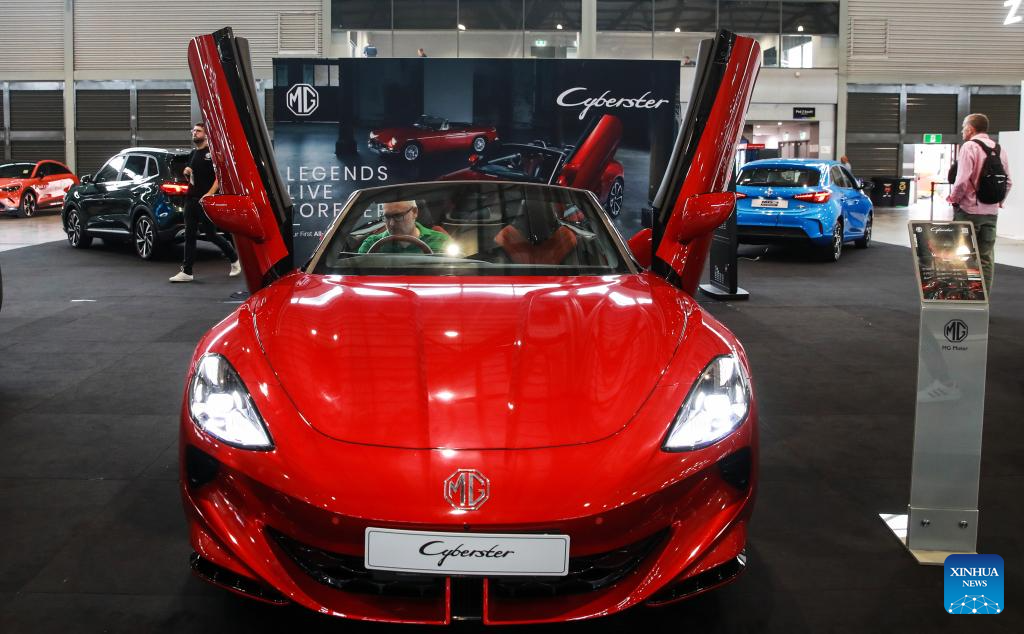
Chinese automakers consolidated their position in the Australian market in 2025, with China being the third-largest source of new vehicles amid continued growth in electric vehicle sales, industry data show.
Chinese manufacturers accounted for about 18 percent of all new vehicle sales last year, up from around 14 percent in 2024, according to figures from Australia's Federal Chamber of Automotive Industries, the sector's leading body for distributors of new passenger vehicles, light commercial vehicles, motorcycles and all-terrain vehicles.
Australia's new vehicle market recorded more than 1.21 million units in total sales last year, the FCAI said.
READ MORE: Chinese automakers move toward pole position in Australia amid green trends
Three Chinese automakers — Great Wall Motor, BYD and MG — ranked among Australia's top 10 best-selling vehicle brands last year, up from two in 2024, it said.
In addition, Chery was the fastest-growing brand last year, recording a sales growth of 176.8 percent. The FCAI said China has consolidated its position as a major vehicle source for Australia.
All new vehicles sold in Australia are now imported, as local manufacturing in the country ended in 2017.
"China's position as one of Australia's largest sources of new vehicles reflects the continued diversification of global automotive supply chains and the growing breadth of products available to Australian consumers across all engine types," Peter Griffin, director of state and territory advocacy and communications at the FCAI, told China Daily.
Griffin said it was part of a broader trend in which Asia now accounts for more than four in five new vehicles sold in Australia.
Meanwhile, Australia's vehicle market is undergoing a rapid shift, with battery and hybrid vehicles gradually reshaping the product landscape and competitive dynamics of the automotive sector.
According to FCAI data, battery EV sales totaled more than 100,000 units in Australia last year, accounting for 8.3 percent of total vehicle sales.
Plug-in hybrid vehicles recorded the strongest growth, with sales more than doubling to over 50,000 units, up 130.9 percent compared with 2024.
Hybrids also continued to gain momentum, with around 200,000 vehicles sold, representing a 15.3 percent increase year-on-year.
"Many consumers are choosing hybrid and plug-in hybrid vehicles as a practical transition toward lower emissions," said Tony Weber, chief executive of the FCAI.
"While the industry is investing heavily in battery electric technology, uptake ultimately depends on consumer readiness and the availability of reliable public recharging infrastructure," Weber added.
Australia sold around 70,000 EVs in the first half of 2025, according to the Electric Vehicle Council's State of EVs 2025 report published last year.
Best-selling models
Three BYD models ranked among the country's top five bestselling EVs during the period, with combined sales exceeding 18,500 units, the council reported.
Australia's EV fleet has now surpassed 454,000 vehicles nationwide, according to the latest annual figures released by the council.
ALSO READ: Chinese EVs make major inroads as Australian market charges ahead
Julie Delvecchio, CEO of the Electric Vehicle Council, said Australians are choosing EVs in record numbers because these are cheaper to run, cleaner and quieter.
To stay on track with Australia's 2035 emissions reduction target, EV sales would need to increase to at least 240,000 new vehicles this year, she said.
Griffin of the FCAI said: "Australians demand quality vehicles at competitive prices. Thus, we expect Chinese brands to remain an important part of the Australian market in 2026 and into the future, with further growth (in sales) and new products."
Contact the writers at xinxin@chinadaily.com.cn
