

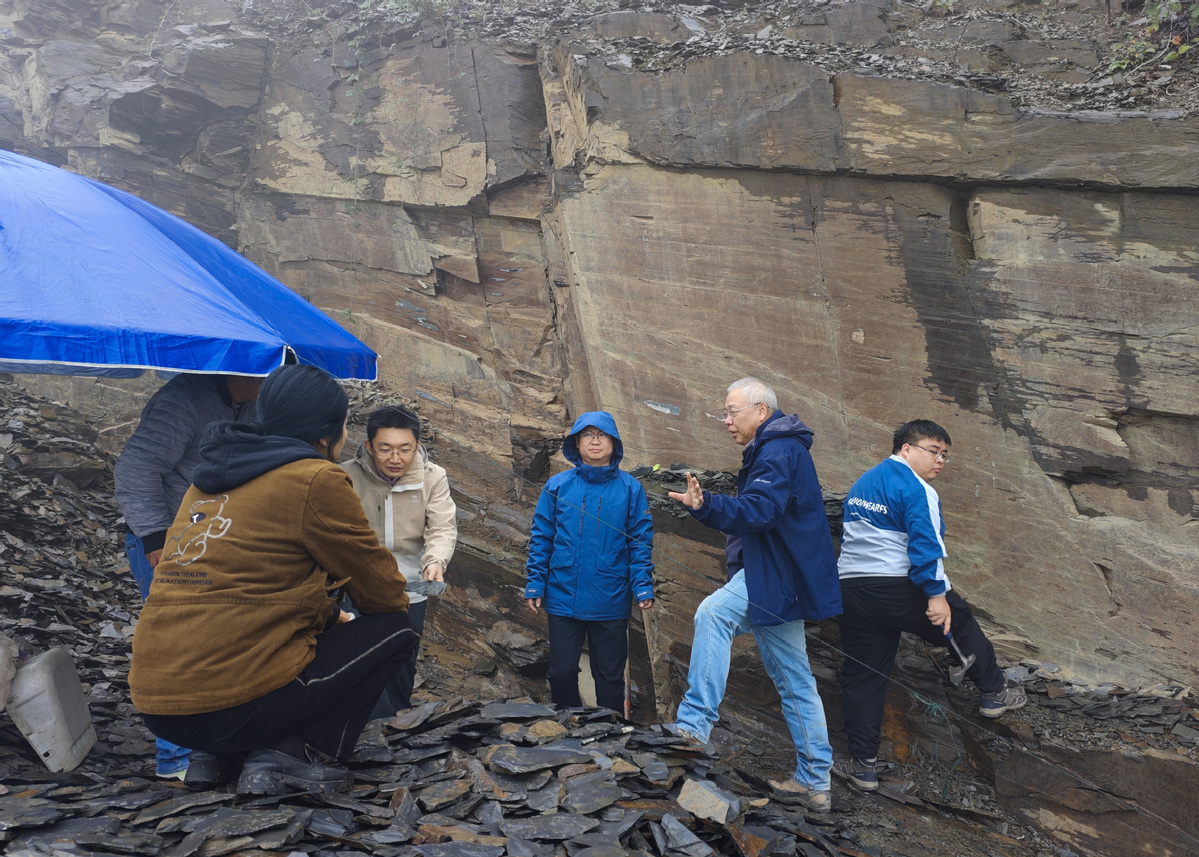
Around 539 million years ago, Earth witnessed the Cambrian explosion — a pivotal event when nearly all major animal groups suddenly emerged in the fossil record, reshaping the planet's biodiversity. However, this biological boom was interrupted by the Sinsk event around 513 million years ago. While scientists know this first mass extinction of the Phanerozoic — the starting age of visible life — caused widespread species loss, its full impact remained unclear due to a lack of soft-bodied fossils from the period immediately after the event.
Now, a breakthrough by Chinese researchers has filled this gap by discovering a top-tier soft-bodied fossil deposit in Hunan province's Huayuan county — dating shortly after the Sinsk event. This discovery, which sheds light on the first mass extinction event's influence on the Earth system, was published in the journal Nature on Thursday.
READ MORE: Chinese fossil find illuminates Earth's earliest mass extinction
Over the past five years, the research team, led by scientists from the Nanjing Institute of Geology and Palaeontology of the Chinese Academy of Sciences, has collected and analyzed 50,000 fossil specimens from the Huayuan deposit. They identified 153 animal species, nearly 60 percent of which were new to science.
Zhu Maoyan, a CAS academician who led the study, highlighted the uniqueness of the Huayuan fossils, noting that unlike previous fossils, which mostly preserve hard shells or bones, these fossils are extraordinarily well-preserved and diverse. They include soft tissues such as digestive systems, gills, and even nervous systems, offering an unprecedented glimpse into early animal anatomy.
"The presence of diverse active predators and abundant far-ocean-living tunicate forms reveals a deep-water faunal community with a complex food web and mechanisms for moving carbon from the ocean surface to the deep sea through biological processes,"Zhu said.
Scientists found that the biota thrived in the outer deep-water environment far from shore. By comparing it to other Cambrian fossil sites — such as the famous Chengjiang biota in Yunnan province and the Burgess Shale biota in Canada's Yoho National Park — they found that shallow-water ecosystems suffered catastrophic losses, with many species vanishing after the extinction. Meanwhile, deep-sea communities like Huayuan retained key species that survived the crisis and later repopulated other regions.
ALSO ERAD: Million-year-old skull from central China rewrites human evolution timeline
"These findings support that the Sinsk event was likely driven by environmental disasters in shallow waters, such as widespread anoxia," said Zeng Han, an associate researcher at the Nanjing Institute of Geology and Palaeontology.
"The deep-water environment served as a biotic refugium, where life could endure during mass extinctions," he said, adding that these environments not only preserved ancient lineages but also likely fueled evolutionary innovation, as surviving species adapted to new niches.
Robert Gaines, a professor of geology at Pomona College in the United States, spoke highly of the discovery, praising it as "a world-class fossil site" that fills a critical gap in Earth's history. Its high diversity and preservation quality rival those of the Chengjiang and Burgess Shale sites, offering a new benchmark for studying Cambrian ecosystems.
Contact the writers at limenghan@chinadaily.com.cn
