

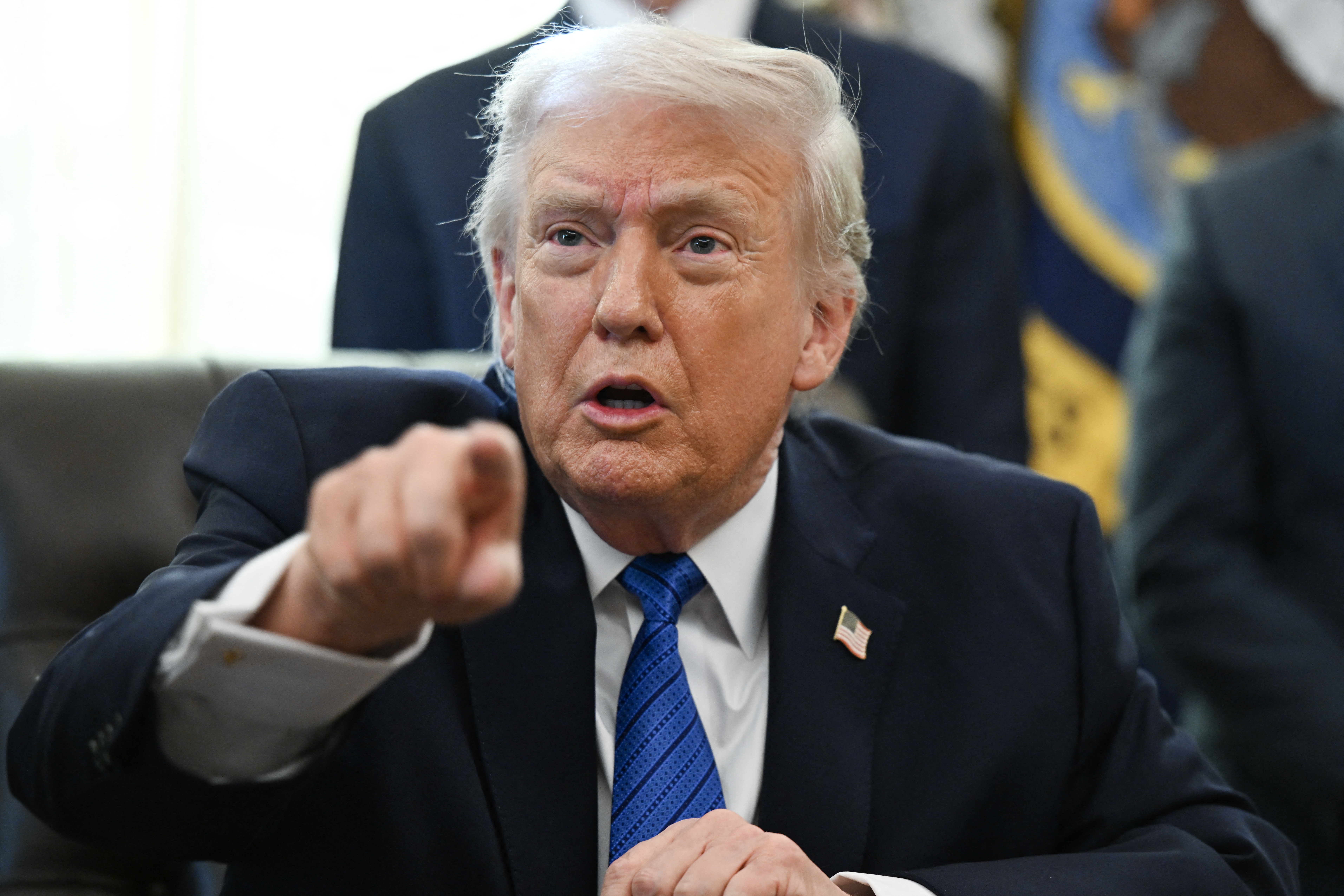
WASHINGTON/CAIRO - US President Donald Trump said on Saturday that Iran was "seriously talking" with the United States.
Asked by reporters aboard Air Force One whether he had made a final decision on Iran, Trump said, "Certainly, I can't tell you that, but we do have very big, powerful ships heading in that direction."
"I hope they negotiate something that's acceptable," Trump said, adding, "We could make a negotiated deal that would be satisfactory, with no nuclear weapons, and they should do that, but I don't know if they will."
The president also told Fox News that the United States could not share its military plans with Gulf allies while negotiating with Iran.
"We can't tell them the plan. If I told them the plan, it would be almost as bad as telling you the plan -- it could be worse, actually," Trump said.
ALSON READ: Trump says he has held conversations with Iranian leaders
Iranian President Masoud Pezeshkian said Friday that Teheran has consistently pursued engagement and dialogue to resolve disputes and is not seeking war.
He said that Iran's approach is based on "dignity-based diplomacy," engagement within the framework of international law, mutual respect, and refraining from threats or coercion.
The United States has said a deal with Iran must include a ban on uranium enrichment, the removal of already-enriched uranium, a cap on long-range missiles, and a rollback of support for regional proxies -- all conditions Teheran has rejected.
Explosions in Iran
A senior Iranian security official said Saturday that a structure for talks with the United States is being established, following two explosions in Iran earlier in the day that Israeli officials have denied any involvement in.
The developments unfold amid heightened regional tensions and US military movements.
At least four people were killed in a gas explosion at a residential building in Iran's southwestern province of Khuzestan on Saturday, Iran's official IRNA news agency reported, noting that the incident was caused by a gas leak at the four-unit building located in the provincial capital Ahvaz.
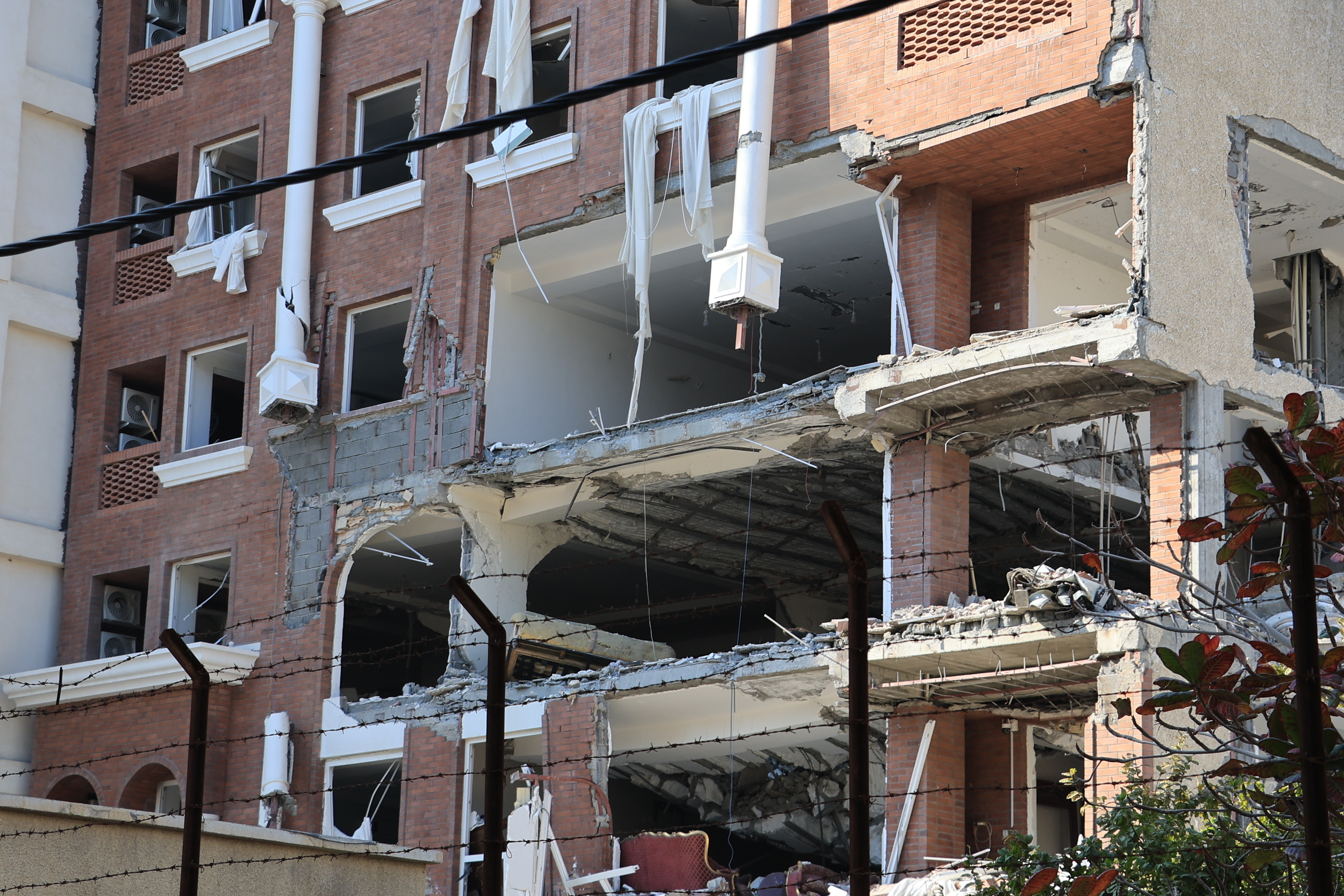
Separately, an explosion at an eight-story building in Bandar Abbas, a port city in Iran's southern Hormozgan province, killed at least one person and injured 14 others, according to the semi-official Tasnim news agency, with the cause under investigation.
Following the explosion, Iran's Islamic Revolution Guards Corps (IRGC) Navy, whose headquarters are in Hormozgan, said no drone attack has been carried out against any of its headquarters in the province, and no building affiliated with the force has been destroyed. The IRGC also roundly rejected rumors of the assassination of its Navy Commander Alireza Tangsiri.
Meanwhile, senior Israeli officials, quoted by major Israeli media, denied any Israeli role in the two incidents. A security official told state-owned Kan TV News that "we are monitoring, it is not ours or from us." Channel 12 News reported the Israeli security establishment's assessment that the two explosions were likely caused by an "internal incident."
These developments came amid rising regional tensions, especially between Iran and the United States, with the latter bolstering its military presence in the Middle East.
ALSO READ: Trump says another 'armada' sailing towards Iran
Trump has announced that a "massive armada" is heading toward Iran and indicated he has given Teheran a deadline. Meanwhile, a US guided-missile destroyer, USS Delbert D. Black, recently made a port call in Eilat at the northern tip of the Red Sea.
On the Iranian side, Army Chief Amir Hatami warned Saturday that if the United States makes any mistake, it will definitely jeopardize its own security and that of Israel and the entire West Asia region, whereas Secretary of Iran's Supreme National Security Council Ali Larijani wrote later on X that the formation of a structure for negotiations with the United States is "progressing," without elaborating.
Additionally, Iran's Foreign Minister Seyed Abbas Araghchi was quoted on Saturday by RIA Novosti as saying that Teheran and Washington may cooperate on energy if they manage to resolve existing disagreements and conclude a new nuclear deal based on the US recognition of the peaceful nature of Iran's nuclear program.
READ MORE: Iran to consider any US military action as 'act of war'
The evolving situation has alarmed regional leaders and sparked urgent calls from the international community for renewed diplomacy.
Egyptian Foreign Minister Badr Abdelatty, who held separate phone calls with his counterparts from Iran, Qatar, Türkiye and Oman, as well as with Trump's special envoy Steve Witkoff, on Saturday urged the United States and Iran to resume negotiations and "reach a peaceful, consensual settlement" to the nuclear issue.
