

In the summer, more than 200 UK students will participate in tailor-made courses across the country

Through collaboration among 16 universities from China and the United Kingdom, more than 200 British students will come to China in May and June to participate in 13 tailor-made courses, as announced at the Study Tour Pioneering Scheme Launch Ceremony: China-UK Youth Mobility event.
The launch ceremony, sponsored by the Chinese Service Center for Scholarly Exchange under the Ministry of Education, was held at the University of International Business and Economics in Beijing on Jan 14.
As highlighted in a speech by Chen Dali, deputy director-general of the Department of International Cooperation and Exchanges of the Ministry of Education, the event is to promote credit recognition between Chinese and British universities through innovative approaches and to facilitate two-way exchanges between young people of the two countries. It marks a new and crucial step forward in China-UK educational cooperation, evolving from traditional study-abroad programs and short-term exchanges to a stage of more targeted alignment and in-depth interaction.
READ MORE: Ice dragon boat race aims to bolster Sino-UK bond
Chen added that hopefully, through this program, young students from China and the UK will personally experience the dynamism of scientific and technological innovation and the cultural heritage of each other's countries. They should shape a true, multidimensional and comprehensive image of studying in China, promote the brand of studying in the UK, and encourage more outstanding young people to regard both China and the UK as important global destinations for learning.
Through personal experiences and face-to-face exchanges, they can break stereotypes, build mutual understanding based on respect and appreciation, foster long-term friendship and mutual trust, consolidate the foundation of friendly public opinion between the two nations, and sow more seeds of friendship for the future of China-UK relations, Chen said.
Wang Daquan, director of the Chinese Service Center for Scholarly Exchange, noted in his address that the new round of industrial and technological revolution has posed fundamental challenges to education. The goals of strengthening international educational cooperation, promoting mutual exchanges and learning among the younger generation, enhancing cross-cultural communication and understanding abilities, and boosting practical and innovative capabilities have become important in education.
Wang introduced the World Study Tour Alliance initiative, launched by the Chinese Service Center for Scholarly Exchange, noting that it has received enthusiastic responses from universities around the world. Up to now, it has supported 40 Chinese universities in developing 74 courses under the framework. In 2025, the first batch of 25 courses offered by 17 universities hosted nearly 1,000 young students from multiple countries.
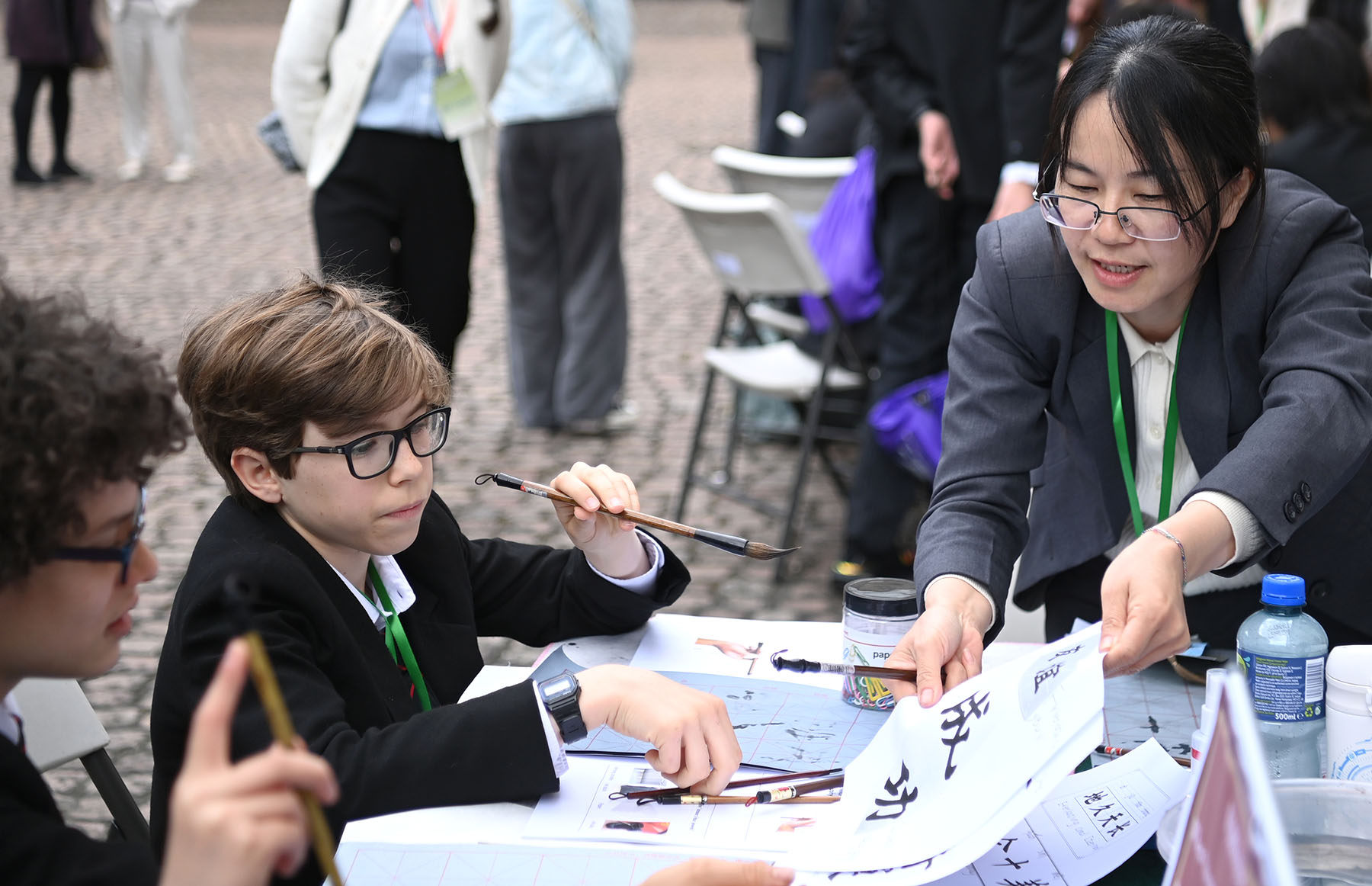
Huang Baoyin, Party secretary of the University of International Business and Economics, said in his speech that long-term immersive exchanges and short-term visits differ significantly in terms of how participants understand a country. This China-UK study tour pioneering program has innovated the pathways for international exchange and cooperation as well as youth interactions, enabling young people from the two countries to conduct in-depth study and exchanges in each other's countries.
According to the release, six British universities — the University of York, the University of Exeter, the University of East Anglia, the University of Birmingham, the University of Greenwich, and the University of Kent — will bring 200 British students to China for study tours.
Thirteen tailored tour courses, designed by 10 high-level Chinese universities, including Shandong University, the University of International Business and Economics, Beijing Institute of Technology, Beijing University of Posts and Telecommunications, and Fudan University, will host the first group of British students for immersive learning in China.
As the flagship program focusing on two-way study tours for young people between China and the UK under the World Study Tour Alliance, this represents a major innovation in exchanges and mutual learning between Chinese and British youth. It also marks a crucial step in China-UK higher education cooperation, advancing from traditional one-way study-abroad programs and short-term visits to a new phase of systematic development, credit recognition, and two-way in-depth interaction, according to the organizers.
In addition to this study tour pioneering program, the Mandarin Excellence Programme, funded and established by the UK Department for Education, is another China-UK education exchange program with the aim of nurturing Chinese language talents.
Launched in 2016, MEP is run by the Institute of Education of University College London and the British Council. It conducts local Chinese language teaching as well as immersive Chinese study tours in China with the support of the Center for Language Education and Cooperation of the Ministry of Education.
In 2025, nearly 1,200 students from the UK participated in the program. They arrived at 18 Chinese universities and colleges in Beijing, Shanghai, Tianjin, Shenyang, Dalian, Xi'an, Wuhan, Hangzhou, Guangzhou, Chengdu and Kunming, to take part in immersive Chinese language learning and cultural experience activities.
ALSO READ: More in UK keen to learn Chinese language
With the assistance of Chinese language teachers and language partners, the students learned Chinese, applied the language in real-life scenarios, improved their Chinese communication skills, and deepened their understanding of traditional Chinese culture and modern Chinese society.
In October 2025, at a MEP exchange conference held in London, Zhao Fei, a minister of the Chinese Embassy in the UK, said that the study and exchange trips of British students to China are of profound significance. The students are not only learners pursuing knowledge in China, but also important bridges connecting China and the UK. He hoped that all participants would deepen mutual understanding, act as envoys of China-UK friendship, become a key force driving practical cooperation between the two countries, and contribute their wisdom and strength to building a better world.
Neil Lawson, director of the MEP at the UK Department for Education, said that this educational initiative has provided valuable exchange opportunities for students and teachers from diverse countries and regions. The enthusiasm demonstrated by the participants has filled the program with vitality and meaning, embodying the extensiveness and far-reaching effect of international cooperation. Through such activities, participants have not only enhanced their professional skills, but also deepened their understanding of diverse cultures and educational approaches. He expressed the hope that future cooperation would continue to deliver higher-quality learning and development opportunities for students and teachers, and that the outcomes of educational exchanges would be continuously expanded and consolidated.
