

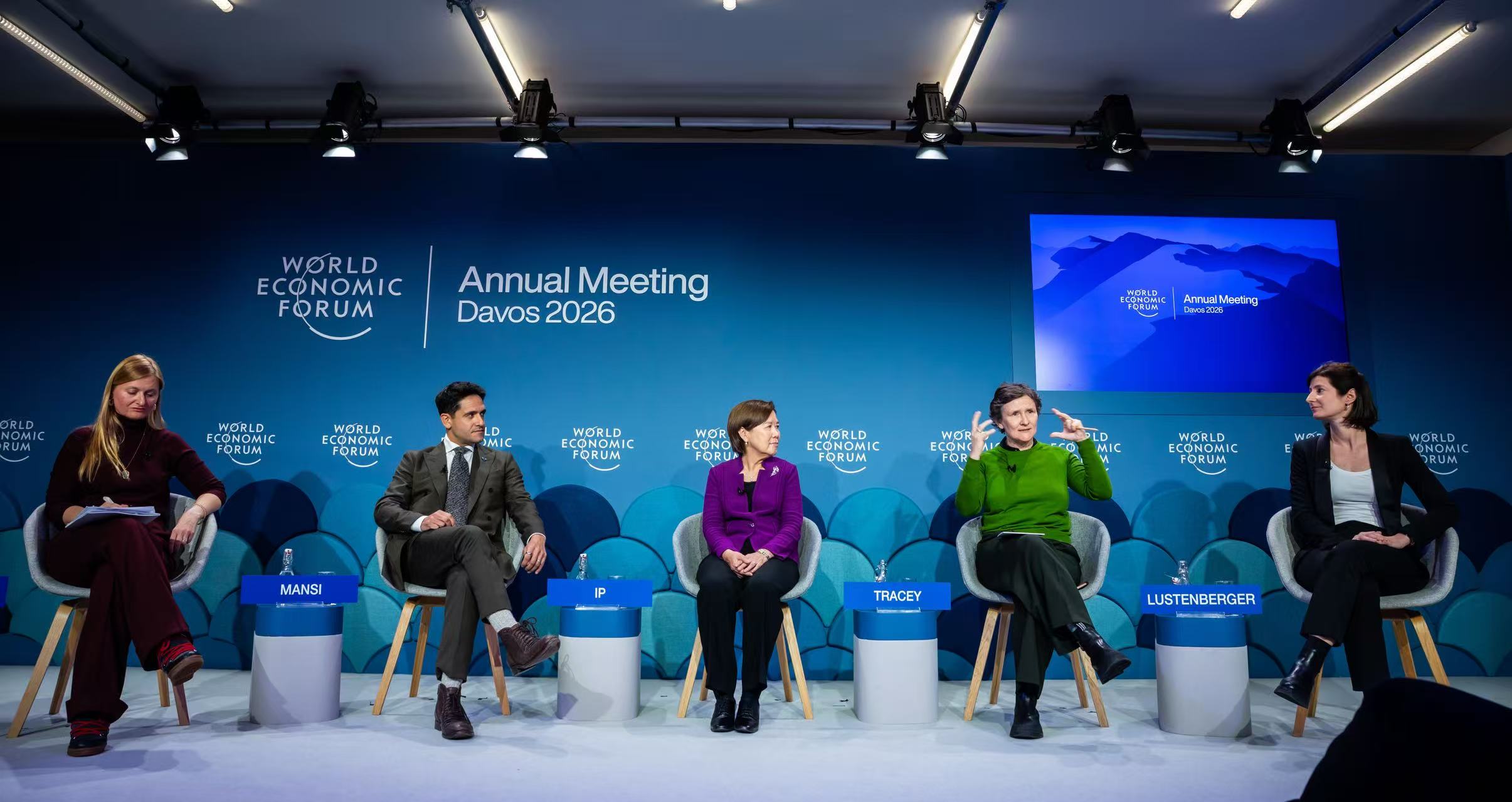
The Hong Kong University of Science and Technology (HKUST) participated in the World Economic Forum (WEF) Annual Meeting 2026 in Davos-Klosters, Switzerland, contributing key perspectives to high-level dialogues on neuroscience, the evolving role of universities, the future of global research, and health innovation—critical topics addressing global challenges.
HKUST President Nancy Ip, the sole university president representing the Hong Kong Special Administrative Region, led the university’s participation in the high-level discussions. This year's WEF Annual Meeting, themed "A Spirit of Dialogue", brought together over 3,000 distinguished leaders from government, business, civil society, and academia across more than 130 countries and regions.
As an internationally renowned neuroscientist, Ip emphasized the transformative potential of converging neuroscience with technology during the staged panel "Latest Discoveries about the Brain" — where she joined leading scientists and innovators from the University of Oxford, ETH Zurich, and health-tech firm Viz.ai. She pointed out that “molecular biology, imaging, and AI are enabling a true multiscale understanding of the brain, from molecules to networks to clinical outcomes”, highlighting how this integration drives a paradigm shift in brain care.
Ip further elaborated on practical applications of this integration, sharing HKUST’s research on blood protein profiling. She noted, “Our work on the profiling of multiple proteins in the blood enables us to predict Alzheimer's risk more than a decade before symptoms appear, monitor treatment response, and tailor interventions to individual's biology.”
She stressed that this shift from reactive to proactive care—powered by blood tests, AI, and lifestyle insights—can reshape how brain circuits are preserved and restored, laying the groundwork for precision medicine that leverages the brain's inherent ability to heal, adapt, and learn.
At the Global University Leaders Forum (GULF), where Ip was the only representative from the HKSAR, she focused on academia’s institutional role. Speaking at the roundtable lunch “Leadership in Transition: Universities and the World Ahead”, she stressed that universities must act as public-good institutions, fostering dialogue, trust, and impartial exchange of ideas.
“Our mission must align with societal needs—from cultivating student diversity to preparing graduates as global citizens,” Ip said. “Diversity enriches intellectual engagement and equips students to address complex challenges. Universities should prioritize social good over profit to remain anchors of integrity in a divided world.”
She also highlighted the importance of knowledge diplomacy and cross-sector collaboration, noting, “Partnering with governments, industries, and philanthropies helps translate research into public value. By co-creating solutions with diverse stakeholders, universities can tackle real-world problems while maintaining academic independence—a balance key to sustaining trust and relevance.”
