

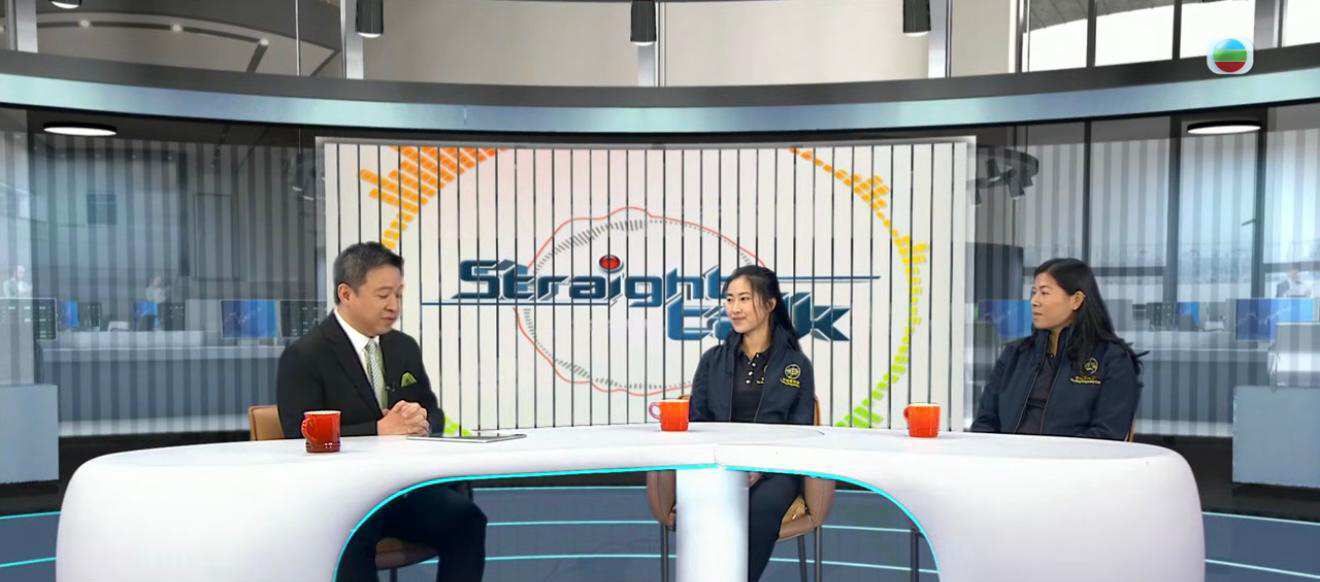
On Straight Talk this week, we take a look at equestrian sport in Hong Kong, with performance coach for the HKJC Youth Squad Raena Leung, a top show jumper and FEI Asian Championships medalist, and Samantha Chan, a rising star in dressage and member of the Hong Kong Jockey Club Elite Squad 2026, sharing their experiences and expertise and what it takes to represent Hong Kong at the highest level of equestrian sport.
Check out the full transcript of TVB’s Straight Talk host Dr Eugene Chan’s interview with Raena Leung and Samantha Chan:
Chan: Welcome to Straight Talk! I'm Eugene Chan. Joining us this evening, to take a closer look at equestrian sport in Hong Kong, are two of our top equestrian athletes. Raena Leung, a top show jumper and FEI Asian championship medalist. She is a member of the Hong Kong Jockey Club Elite Squad 2025 and has ridden internationally for over 30 years. She now serves as performing coach for the Hong Kong Jockey Club Youth Squad on the Chinese mainland, sharing her expertise with the next generation of riders. Also with us is Samantha Chan, a rising star in dressage, a member of the Hong Kong Jockey Club Elite Squad 2026. At just 23, she helped Hong Kong win its first ever Asian Games team bronze in dressage and continues to compete in the National League while training in Germany. We hear about their journeys, their training, and what it takes to represent Hong Kong at the highest level of equestrian sport. Welcome, Raena and Samantha!
Raena: Thank you.
Intro and Early personal journey
Chan: Let's start with the obvious question by the viewers. What exactly is equestrian sport, and how different is it to horse racing?
Raena: Equestrian sport, we work with an animal. We work with horses, and we compete together. So, in my particular discipline, show jumping, we jump over fences, we try to keep them up, and we complete it, hopefully, in the quickest time possible.
Chan: Right. Samantha?
Samantha: And in dressage, it's a bit different. You don't go as quick, or it's not as adrenaline-causing as show jumping, but people have explained it as ballet for horses, and the point of the rider is to try to keep as still as possible and make it look as easy as possible.
Chan: Right. And I understand there are three forms of equestrian, yours is dressage, yours is show jumping. There is also one more called eventing, isn't it? So, what exactly is eventing?
Raena: It's like a combination of ours. So, they have to do a dressage element, but not quite as high level as pure dressage. Then they also have to do a show jumping element, again, not quite as high as pure show jumping. And their third element is cross country. So, they have to jump all these fences, you know, going uphill, downhill, into the water. So it's like the triathlon, basically, of equestrian.
Chan: Right, so before we get further into the sport, maybe we'll start with asking both of you why were you involved in this sport? I mean, it’s not like table tennis, or swimming, or basketball. They're so popular amongst other people. So, maybe start with Raena? I know you have been riding since age 6. And can you tell us how you got sort of interested in this, and what sort of makes you want to go onto show jumping?
Raena: I've always liked animals since I was young. I was told by my mom, I think, we saw some sort of fun fair across from our place, where people were riding these ponies, and I was just like, and I just started to ask her, I said, “I want to learn how to ride horses.” And so, she enrolled me into the Lei Yu Mun Public Riding School. But you can't start until the age of 6. And the waiting list was extremely long but finally, when I got my turn, I started to ride. Actually I had a horrible experience the first time, because the pony kept trying to bite my boot, was pulling his head down, and I was ready to cry. But my mom was like, okay, you know, we've waited this long, and if you're just going to cry, then, you know, maybe this isn't for you. But somehow, I just kind of gritted my teeth, and I was like, no, no, this is something I want to do, and been doing it ever since.
Chan: Sami, you also started at a very young age, at 8, right? And what sort of drew you to the horses and make you this passion, more than just a hobby now?
Samantha: Well, I also started in a way similar to Raena. I really liked animals and my parents, well, they said it was kind of a surprise that they signed me up for lessons, and I guess I just kept going, and, of course, it always starts off as a hobby. Don't go in as an 8-year-old, saying I'm going to do this professionally. I'm going to this, this, this competition, and I'm going to get this percent, and this specialization. But I think it's similar the way you go through life, it just all falls into place, and I knew this was something I was really passionate about, and I also had, luckily, the skills to keep going. So, then it kind of turned into my full-time profession.
Chan: Right, so you would be a professional athlete from now on. That's your dream. Wow! So, I'm going to ask both of you. People, when you look at horses, equestrian, it looks very glamorous, and it looks very expensive. So, maybe I ask a more senior person, Raena, if I say that it is perceived as sort of an exclusive, expensive sport, would you agree?
Raena: I think, in some ways, for sure. When you go up to a professional level, but I think in all professional sports, when you engage with professionals, there are definitely expenses that are involved. However, in order to start, you know, the Jockey Club has made it very accessible to the public. They've got three public riding schools in Pok Fu Lam, in Tuen mun, and in Lei Yu Mun. So, it is very much open to the public, where you can start to not just be riding the horses, but to interact with the horses. And then, eventually, if you like working with these animals, then you can start having the riding lessons. And you start off with, like, once a week, then if you really like it twice a week. It's kind of just depending on how much you decide to engage with it, and then if you decide to pursue it as a sport, for sure the expenses are going to rack up, but I think it's still very accessible to the public.
Chan: Right, Sammy, for the viewers who may have never ridden a horse, what does a typical training week as an elite equestrian training actually look like? I mean, how many hours do you do? How many times you could practice? And even, I'm sure you do some off-saddle of training as well. Can you share with us?
Samantha: Yes, so it definitely depends person to person. But I personally like to take a really hands-on approach to my training with my horse, because having a horse it’s not like having a tennis racket, you kind of have to take care of it, like a child. And when you have many horses, you don't have the time. And you just have to ride them, but for me, because I don't have so many horses to ride in a day, so I like to, I mean, we'll have to start at maybe 5 or 6 in the morning sometimes, to start to take care of them, and cleaning them, and cleaning their stable, and getting everything ready, plus the riding, and then when I'm kind of have some time off from the horses, and I try to go to the gym to better myself, just so, I mean, I have to be fit, not just them. And it sometimes ends at even at competitions, like 9 or 10 o'clock, you have to check on them before they go to bed, before you go to bed, and then start again the next day.
Chan: Wow! It's a full time job, isn't it?
Samantha: Yes.
Chan: Raena, I mean, how long you mentioned about this is one of the very few sport, if not only sports that you work with a live animal. You've been there quite some time. So, how long does it take you to build trust and communication with a horse that you're working with?
Raena: I think it depends. Actually, because if you're really lucky and you come across a horse that really fits your own style, sometimes you get on a horse, and you just think, wow, I click with them right away. However, some that are a bit more sensitive or complicated, maybe, then it needs a bit of time for them to get to know you and to build that trust. But in general, I would say, you know, the longer you have the partnership, then, I think, the more bond you have with the horse.
Chan: Right.
Raena: So, you kind of know how they're feeling that day, what you need to do to prepare them for a competition, what they like, what they don't like, and you just try to maintain everything you possibly can to peak at the right times.
Chan: Right. Sammy, what happens if the horse isn't doing his or her best on that day? What would you do?
Samantha: Well, depends where you kind of feel the disagreement is coming from. So, perhaps if they just don't really feel like doing it. Sometimes you don't really feel like going out of bed, but it's good if someone makes you get up and start working or start studying, then you kind of have to motivate the horse, but if you feel like there's really something wrong, or something not normal, or they're feeling pain somewhere, the best is always to just leave it for another day, maybe in a competition, you might even say, I retire, and I don't compete today, because in the end, if you don't feel well, if the horse doesn't feel well, it's not going to be a good result. So. there's not really point in pushing it.
Chan: Right, so, in a way, quite unpredictable, isn't it?
Samantha: Yes.
Personal development
Chan: Raena, let's talk about your personal development. I mean, I've read up about what you have done, you have quite a remarkable achievement. You’re the first Hong Kong show jumper to compete in the FEI World Cup Final, and the FEI World Equestrian Games. And since then, you won a few medals, including the team gold and individual bronze at the 2019 Asian championships. So, how did you progress from local competitions to the international scene and how did all these shape your career as of today?
Raena: I got lucky. I mean, I already knew, sort of, in school. I did a lot of other sports, but it got to a point where I had to choose one. And in the end, it was show jumping. And it got to a point where, if I really wanted to pursue this, I had to move overseas, and I ended up living in Germany for over 10 years, actually, just for the sake of training, and to be able to access the circuit. You know, and I got really lucky. I found a coach that I worked really well with, and we found horses that really suited me, so I had a great team behind me. And to qualify for the World Games was actually kind of unexpected. We were just like, there's a qualifier. You're in really good shape. I think this is maybe a good time to attempt this, and we got the qualification. And for the World Cup Final, it was also great timing because China is sort of just coming up with the World Cup shows and the World Cup League. And at the time, maybe they weren't quite as established, but because we've been in Europe quite a while already. So, when we went to China, then I managed to win the league and qualify for the World Cup Final. And then it just kind of went on from there, and that's also when the Jockey Club decided to step in and become a sponsor for me. And because of that, I was really able to … instead of just doing it as a hobby, it became really, like, this really can be my profession. And that's basically where it went from.
Chan: Right, let's take a short break now, and we'll be back with more Straight Talk.
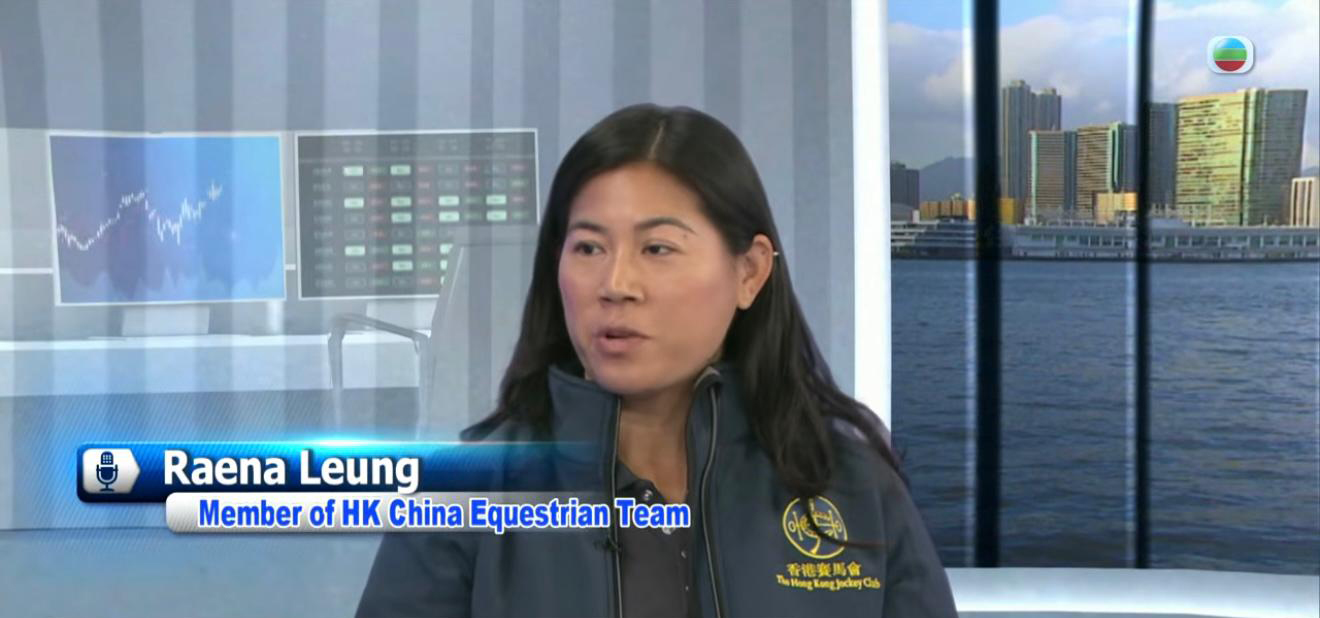
Chan: We are back on Straight Talk, and continuing our look at equestrian sport in Hong Kong with Raena and Samantha, both part of the Hong Kong Jockey Club Elite Squad. So, in the first half, you gave us a sort of a bird's eye view of what equestrian is and you have shared with us some of your personal achievements. Sammy, it is your turn. I have seen that you have progressed from the youth squad now to the elite squad. If I am going to ask you, what were the pivotal moments that sort of helped you to sort of jump from one to the other, especially from a young rider? And how important have been your parents' support?
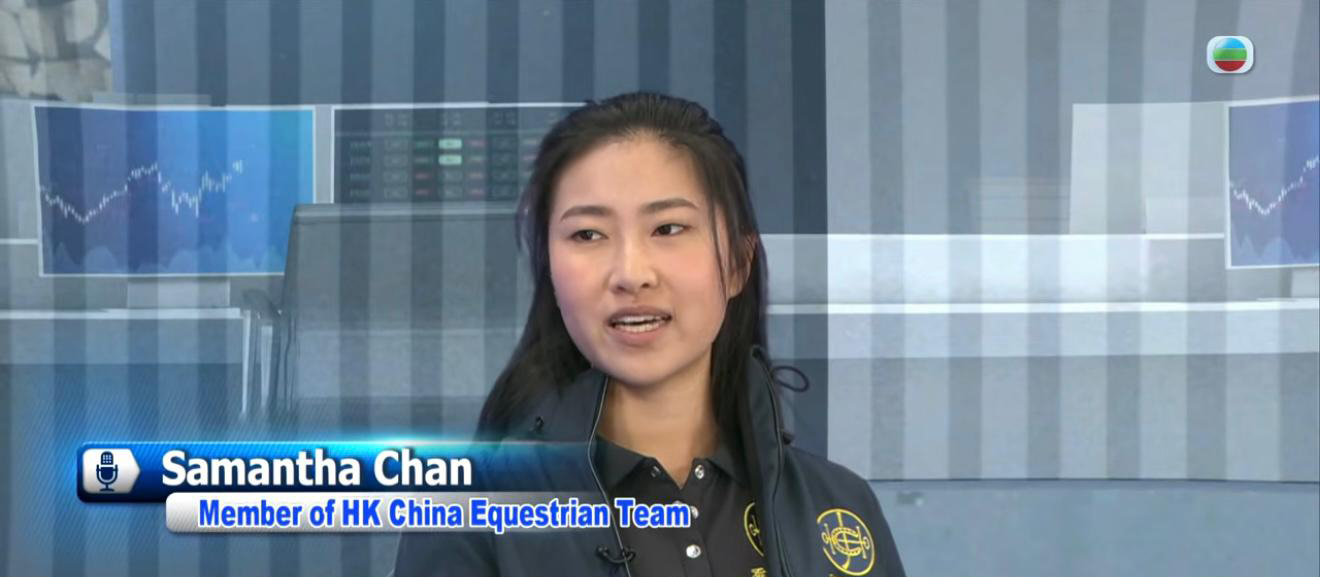
Samantha: I started in Hong Kong riding in Pok Fu Lam and in Beas River in Fanling, and it felt like kind of unachievable, having to even being able to be on the youth squad because there weren't so many dressage riders at the time. But I was lucky to have the right combination of support, my coach and the horse, and I was able to make it on the youth squad. That was a really good goal. But then the jump from the youth squad to the elite squad was quite a big gap. So, I was really, really lucky that my parents said “Okay, I know you should be going to university. But if you want to do the Asian Games, we will support you as best as we can.” And we found a good horse and we made it to the Asian Games. And the beauty of the program from the Jockey Club, it makes a good thing to aim for and it makes a good goal. But once you are there, it is just designed to support you. So, it is not like “Oh, I have made the squad, now I can relax.” You always have to keep going and it kind of helps push you on the way, and it wasn't so easy. But the Asian Games was definitely the thing that really drove me and that was the main goal. And being on the elite squad really helped to push me along the way.
Chan: Actually, I have been observing both of you in this interview. I feel that both of you are very calm, I mean, calm looking at least. I am sure you had that from your training from your sort of horse work. So, it must be mentally demanding. Sam, how do you deal with it? When you are under pressure, must be, make sure your horse is working how you want it. How do you handle the stress so well?
Samantha: I personally am quite a low-stress person in general. But something I have really learned is that it doesn't help anybody if you are stressed out or if you are anxious, and the horse can feel it. And sometimes if they feel you are stressed out, they also get more anxious. And it is kind of nice being a rider from Hong Kong because you feel a bit like the underdog. So, you don't have so many expectations, especially when you are competing in Europe where there are not so many other Hong Kong or Asian riders with you. So, then your own competitor, your biggest competitor is really yourself rather than other people. And I think that really helps.
Chan: Is that why you have done so well in the recent Asian Games?
Samantha: Let's say so.
Chan: Right. Raena, we saw that you are transitioning from an athlete now to a coach as well. So, how does your role as the Hong Kong Jockey Club Youth Development Programme and Performance Coach sort of contribute to the development of Hong Kong riders? How do you do that?
Raena: I think we have a great crop of talent. And because the sport is developing so fast in the mainland, we have a lot of riders who live there and can represent Hong Kong. So, I think once the Jockey Club realized that we have such a crop of talent there, and because most of the senior team is in Europe, some of them are in Hong Kong, they needed somebody to also look after the kids over in the mainland. I actually took a small break from competitions from 2022 until this year actually. I picked it up again this year. During the last three years, I was able to work quite closely with the riders who are based in the mainland. And so, I have been going in and out to sort of check on them in some ways, to kind of mentor them, and share my own experiences because now that they have all these junior and young rider championships. I have been to the senior ones, and it is just a good way to kind of translate and help them on this path. And knowing that we have such a good crop of talent, it is important to grow them into, like what Sammy has done from the youth squad, and to transition onto the senior squad.
Chan: Right. Sammy, I know that you are sort of doing training in Germany. I am sure at a young age, you look at different things sort of with a long-term view of whether you want to be a professional athlete, although you have already just decided. So, what will be the major challenges you think you are facing? Would the funding be one thing? Would you be able to have exposure to different competitions or even the coaching? I mean do we have, apart from Raena, do you find other coaches more readily available in other countries?
Samantha: Yes. It is much easier or kind of the only way to expand into international sport is being in, based in Europe, or sometimes in America, but mostly in Europe because there is just so many more horses and coaches abroad. But it is really tough living in Europe because you are away from your family and your friends, and the systems you know, and you have to, kind of, set those up yourself. And my equestrian career up to this point has been quite structured. I was with a big stable and they have the coaches available, the horses available. They tell you which competitions to go to. But starting this year, kind of starting self-funding and deciding what stable to go to, and having to pick a coach because even though all coaches might or many coaches might be good, not all of them might suit you and you might not communicate well. So, that is always tough and having to maybe move around or change coaches. Those are some challenges that I found.
Equestrian sport in HK
Chan: Right. So, Raena, let's look at the equestrian sport in Hong Kong. I mean you are the more senior person, I am going to ask you more direct questions since Sammy is just getting into the game. If you look at the last 30 years, how equestrian sport has developed in Hong Kong? We both agree that the Hong Kong Jockey Club has played a very major role since the Olympics in 2008. Then the club established the equestrian team and the junior squad. So, how do you see this further develop in years to come, especially now we have such a close connection with the GBA as in all other areas? How do you see that?
Raena: It is definitely growing, I mean, and it is great to see that it is growing. When I started, you know, there was no youth program. And at that time, show jumping was probably the more focused on discipline. And I feel like the riders from my generation, when we wanted to pursue this, it was kind of us finding our own paths. But then once they did see, you know, we had riders who could ride at the Olympic level, especially at the 2008 Olympics, and then eventually us qualifying for the World Games in 2014, World Cup Final, and we had another rider at the 2018 World Equestrian Games. They could see that we are scratching the highest level within our sport. And then, of course, with that kind of exposure, then comes the funding and the support, not just from the Jockey Club but also from the public because I think being exposed to the sport and realizing what you can do with horses, since it is more established, racing is more established in Hong Kong, I feel like the public is quite familiar with this concept, but not quite with equestrian. So, exposure for sure is the first thing, I think, to garner that kind of interest.
And then also now, every year we have a show run by Longines that also is going to help with the exposure. And with the mainland also really catching up now, with the national games and with national championships, they are also slowly every year just having more and more competitions. I think every weekend there is a show either in Beijing or Shanghai or Chengdu, and the number of kids riding can go up to 200 in a single competition. So, just the sheer numbers and people enjoying the fact that you can work with horses and compete with them, I think it is been a great way to see people, understanding and wanting to be part of the sport.
Chan: Right. Sammy, I quite like you said earlier when you go to Europe, you feel like you are an underdog meaning that Hong Kong isn't seen to be the major force, like fencing recently. So, how do we rank internationally, in your view, especially amongst other Asian countries, like Japan and Korea?
Samantha: Historically I would say in dressage at least, Japan and Korea have been more up there, but right now we are really climbing up. If you see our recent results in the Asian Games two years ago and the Asian Championships just now, we were team medalists, so we are definitely getting up there. And we don't have the population numbers, for example, that many of these other countries have. So, perhaps we are not quite at the level of European countries because it is kind of a newer sport in our Hong Kong’s history, but I would say we’re really competitive at the Asian level for sure.
Chan: Right. Sam, the last question for you is what advice would you give to younger riders who aspire to do as well as you do, progress from the beginning level to compete at the elite level? What would you say to them today?
Samantha: I would say you can't just rely on other people to tell you what to do. If you really want to succeed, you have to study yourself and explore opportunities, and take every opportunity you can to learn and to train and get better. And it doesn't just come from showing up. Attendance doesn't really mean anything, there is no one taking your attendance. You really have to try yourself and make yourself better and think of ways to make your horse better, your system better. And if something is not working, then you have to change it.
Way forward
Chan: Raena, what would you like to see improve in Hong Kong sort of the equestrian scene, if you have your wish?
Raena: It is pretty good at the moment. But of course, it will always help if you have more stables or more people because I mean obviously, space wise we will always be somewhat limited. And at the moment, so all the major competitions is generally held in one venue, which is at the Beas River Country Club. So, maybe to help the sport and to help the riders get a bit more experience, if we are able to hold more competitions in different venues, I think you will give them maybe a better taste of what it is like competing on an international circuit.
Chan: Right. Thank you, Raena and Sammy, for sharing your personal journey, so that all the viewers will be sort of inspired by your achievements and they get more interested in this sport.
As we have seen Hong Kong's equestrian scene is more than medals and competitions. It is a winning formula where passion, talent, and determination make our riders true trailblazers on the international stage. Have a good evening and see you next week.
