

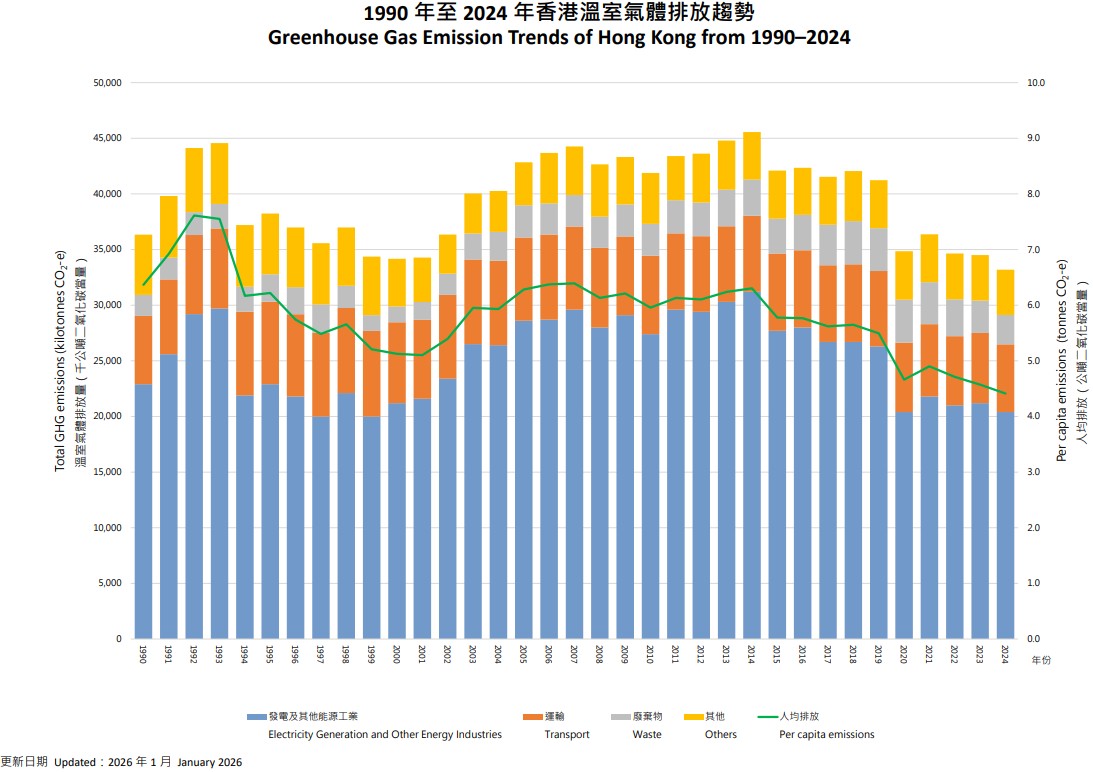
Hong Kong's greenhouse gas (GHG) emissions in 2024 amounted to approximately 33.2 million tonnes of carbon dioxide equivalent (CO2-e), representing a 3.6 percent decrease from 2023 emissions and about a 27 percent drop from the 2014 peak figures, official data showed on Thursday.
The city's three main emission sources remain to be electricity generation (61 percent), transport (18 percent) and waste management (8 percent), according to the latest GHG emission inventory released by the Environment and Ecology Bureau.
Per capita GHG emissions continued their downward trend, reaching a new low of 4.41 tonnes CO2-e.
“It is 3.5 percent lower than that in 2023 and is about a quarter of that of the United States and 60 percent of that of the European Union,” the bureau said in a statement.
During 2024, the carbon intensity was 0.011 kilograms of CO2-e per Hong Kong dollar of gross domestic product, or GDP, representing about 6-percent decrease compared to the previous year.
RELATED ARTICLES
- Tse: Carbon emissions in HK down by a quarter since 2014 peak
- Hong Kong launches carbon neutrality drive
- Survey: HK biz has greater carbon awareness, resources, costs loom large
- HK’s milestone $10m carbon trading deal showcases unique strength
- HK unveils world’s first spaceborne payload for monitoring emissions
Compared with 2014, when Hong Kong's GHG emissions peaked, the total emissions, per capita GHG emissions and carbon intensity in 2024 have been reduced by about 27 percent, 30 percent and 35 percent, respectively, according to the data.
“With the gradual replacement of coal with natural gas and zero-carbon energy for electricity generation, popularization of electric vehicles, reduction in municipal solid waste and increase in landfill gas recovery for energy production, Hong Kong's GHG emissions from electricity generation, transport and waste management declined by 3.5 percent, 3.7 percent and 9 percent respectively, compared to 2023,” reads the bureau statement.
Particularly significant was the reduction in GHG emissions from waste management, mainly attributed to the 3.4 percent reduction in the quantity of municipal solid waste disposed of at landfills, and a nearly 12 percent increase in landfill gas recovery for energy production.
The special administrative region's government said it was working to align with the country's "dual carbon" target to achieve the peak of carbon emissions before 2030 and carbon neutrality before 2060.
To achieve its goal of reducing Hong Kong's carbon emissions by half from the 2005 levels before 2035 and reaching carbon neutrality before 2050, the SAR government said it will continue to implement its four decarbonization strategies – net-zero electricity generation, energy saving and green buildings, green transport and waste reduction, as outlined in Hong Kong's Climate Action Plan 2050.
