

Celebrated global clinical geneticist Kym Boycott has painted a rosy picture of medical development in the Guangdong-Hong Kong-Macao Greater Bay Area, praising China’s strengths in getting clinical trials off the ground in a fast and affordable manner to address rare diseases.
She spoke in a recent interview with China Daily on the sidelines of the International Genomic Medicine Symposium at Hong Kong’s Science Park.
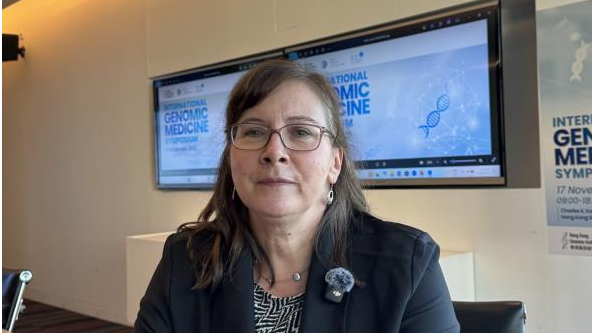
Boycott was among a legion of heavyweights from more than 20 countries and regions attending the conference. The Canadian medical veteran, who co-chairs the Rare Diseases International-Lancet Commission on Rare Diseases, was also in the special administrative region for the commission’s first-ever annual meeting held in Asia.
Heaping praise on China’s rapid development in the medical field, she noted that the country’s large population, advanced technology, and skilled doctors, have added up to a healthcare system that could practically run on its own.
“They don’t need me as much as I need them,” she said in jest, as Canada has a notable number of Chinese descendants living there.
Boycott spoke highly of how clinical trials are happening faster and at a lower cost in China — something she said would be slower and costlier in Canada or the United States due to excessive red tape.
ALSO READ: HK, SZ open clinical trial institute, center to push biomedical development
The quick response of clinical trials reflects the fact that China has a large population, with a well-established infrastructure that could transport patients speedily and efficiently.
“From an international perspective, China is doing some really amazing things concerning rare disease clinical trials,” Boycott said.
A rising region
Boycott said she sees great potential in the Greater Bay Area for medical innovation.
Having visited a sequencing facility in Shenzhen in 2012, she said she was impressed by the technology-driven boomtown’s achievements. She has high hopes for integrating Shenzhen’s strong technology powerhouse with the Greater Bay Area’s well-established supply chain, saying it will be “greater than the sum of its parts” and the “impact will be tremendous”.
“I’m very excited about what I’m hearing about the Greater Bay Area and its potential for significant medical innovation that’ll have an impact not only on the region but also on the world. I see it as bringing together a unique combination of expertise and resources, plus technology that, to my knowledge, really isn’t found anywhere else in the world,” she said.
“And, I think, it’s going to enable faster discoveries to help more patients and families living with rare diseases,” she added.
As a clinical geneticist, Boycott meets patients of Chinese origin monthly. She said genome sequencing projects like the one undertaken by the Hong Kong Genome Institute are, indeed, very helpful globally, particularly for those whose ancestors are from southern China and now living elsewhere.
“We’ve about 20,000 genes. We know that about 400 to 500 or so of those, when they change, can cause a very significant condition called a rare genetic disease,” Boycott said.
That’s what a clinical geneticist does: provide diagnosis and precision management for patients with rare genetic diseases. Although the concept is not common in Hong Kong, the city has been making efforts in this area. Since launching its first large-scale genome sequencing project in 2021, Hong Kong had recruited 52,000 patients by mid-October, surpassing its initial goal of 40,000 to 50,000 patients by 2025.
Besides setting up a DNA database for the local population, Boycott said such a project has contributed to mankind and patients globally.
She said at least several of the genetic discoveries have been made in Hong Kong.
READ MORE: Global scientists develop SE Asian population genome dataset
In a notable case, a new disease came to light as genome sequencing helped identify a missense variant in the PSMF1 gene in a 16-year-old patient, causing motor delays, progressive deterioration in walking, and cognitive decline.
Over a three-year investigation into the root causes of the patient’s condition, the commission, via the global nongovernmental Matchmaker Exchange program, found 24 patients from 17 families who had similar symptoms without knowing the cause.
The Matchmaker Exchange program, which was created in 2013, has a database of 140,000 patients with rare diseases from 115 countries and regions, according to Boycott.
She applauded the Hong Kong SAR government’s ambitious plan to establish its own medical regulatory body for registering drugs and medical devices. The Hong Kong Centre for the Medical Products Regulation is expected to be set up this year.
She said that such top-down government support makes medical development like “rolling the rock down the hill”, rather than “up the hill” as often seen elsewhere.
Contact the writers at stushadow@chinadailyhk.com
