

As Chinese startups go abroad, they are reshaping how artificial intelligence is built and deployed in multiple domains
In a soundproof recording studio in New York City in the United States, an independent audio producer leans toward a microphone, replaying the same 30-second script again and again. The voice coming through the speakers sounds unmistakably like his own — same timbre, same cadence — but it is not him speaking.
Minutes earlier, he uploaded a short voice sample into an AI tool called MiniMax Audio, developed by a Chinese startup thousands of kilometers away in Shanghai. Within seconds, the system cloned his voice and generated a polished advertising read, ready for delivery.
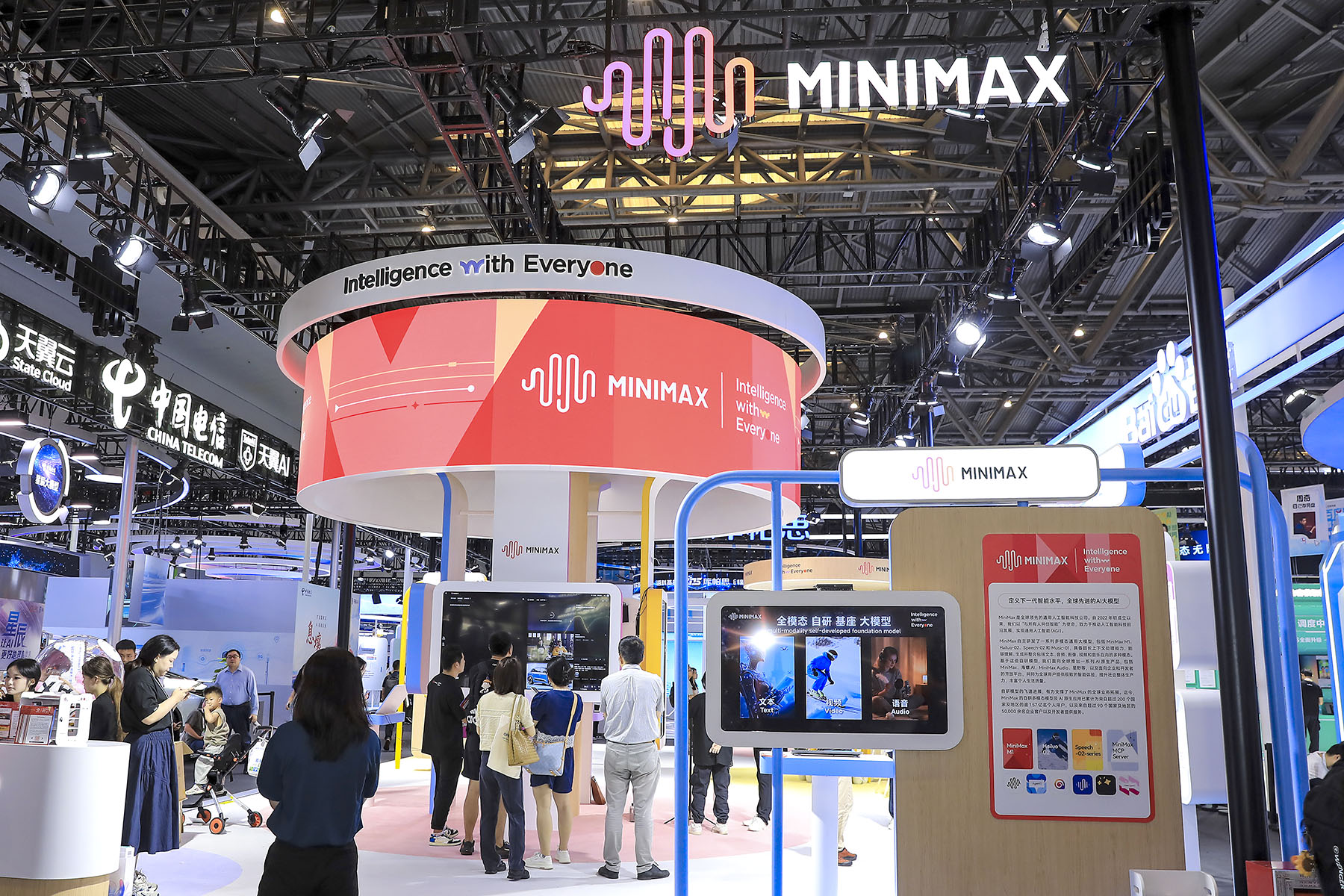
Half a world away, in Shanghai's Xuhui district, engineers at Mini-Max's research center are watching dashboards light up with real-time feedback from users like him. They are fine-tuning multilingual pronunciation rules, stress patterns and emotional intonation, optimizing a model that now serves users in more than 200 countries and regions.
READ MORE: China aims for secure, reliable supply of AI core tech by 2027
This quiet, transpacific loop — a US creator using Chinese AI software refined by engineers responding to global demand — captures a broader shift underway in the global technology landscape.
China's artificial intelligence companies are no longer content to compete at home. They are exporting models, platforms and increasingly, entire industrial solutions, reshaping how AI is built, deployed and governed worldwide.
Founded in early 2022, MiniMax spent just over three years turning a self-developed multimodal foundation model from a Shanghai lab project into a global product suite spanning text, audio and video generation. Its trajectory mirrors a broader wave of Chinese AI startups that, after years of intense domestic competition, are now pushing outward.
By late 2025, that wave reached a symbolic milestone. From Manus — acquired by Meta for billions of dollars — to Beijing-based Zhipu AI and MiniMax, which both passed Hong Kong stock exchange listing hearings, China's latest generation of AI entrepreneurs had begun to "come ashore" financially.
Their prospectuses also revealed a strategic divergence. One route, exemplified by Zhipu AI, focuses on building foundational models and selling infrastructure-level capabilities to enterprises and governments. The other, taken by MiniMax, leans toward consumer-facing applications, from voice and video generation to creative tools.
Zhipu's overseas expansion remains in its early stages. As of the first half of 2025, overseas revenue accounted for 11.6 percent of its total, with Southeast Asia contributing the bulk — around 17.9 million yuan ($2.5 million). MiniMax, by contrast, has prioritized global user acquisition from the outset, embedding itself in creative, media and customer-service workflows across continents.
Yet both paths reflect a common reality: China's AI firms are no longer peripheral players in global innovation. They are becoming structural contributors.
One of the clearest signals of that shift lies in open-source AI. According to a joint report by Massachusetts Institute of Technology and Hugging Face, Chinese-developed open-source large language models accounted for 17.1 percent of global downloads over the past year, surpassing the United States' 15.8 percent for the first time.
Models such as DeepSeek's V3 and Moonshot AI's Kimi K2 have driven a surge in adoption, together representing nearly 30 percent of global usage of open-source large language models last year, the report said.
Wei Kai, head of the artificial intelligence research institute at the China Academy of Information and Communications Technology, said the data reflected "a systemic upgrade in China's overall AI capabilities".
"This is not a single breakthrough," Wei said. "It is the result of sustained investment, open ecosystems and the ability to integrate models with real-world scenarios at scale."
China's emphasis on open source is not accidental. More than 30 million open-source projects have been incubated nationwide, spanning chips, frameworks and applications. The country now counts over 9.4 million software developers, with open-source contributors ranking second globally.
PwC estimates that AI could add up to $7 trillion to China's GDP by 2030. Market consultancy CCID projects China's AI industry will grow from 398.5 billion yuan in 2025 to more than 1.7 trillion yuan by 2035.
If software is one pillar of China's AI export push, robotics is rapidly becoming another. At the Consumer Electronics Show in Las Vegas in 2026, the presence of Chinese companies is set to undergo a structural shift.
Alongside established names such as Lenovo, Hisense and TCL, a new cohort of embodied intelligence firms — many attending for the first time — arrived with commercial-ready products, firm order pipelines and clearly defined deployment scenarios.
Chinese humanoid companies including AgiBot, Noetix Robotics, and the Beijing Embodied Artificial Intelligence Robotics Innovation Center made their CES debut. Others, including Unitree Robotics, Galaxea, Deep Robotics and Fourier, formed what organizers describe as an unprecedented "Chinese robot matrix".
Unitree Robotics, which drew crowds at CES 2025 with its robot dogs and humanoid prototypes that sold out on the spot, will return with its H1 humanoid robot.
Equipped with 360-degree environmental perception and a payload capacity of up to 15 kilograms, the system is now targeting industrial inspection and logistics scenarios. More significantly, Unitree is moving toward a "robot-as-a-service" model, exporting turnkey automation solutions rather than standalone machines.
AgiBot showcased its full product line in the US for the first time, including upgraded dexterous hands and core components. Its Expedition A1 robot has already been deployed in 3C electronics manufacturing and automotive assembly lines in China.
The company said that it combines open hardware interfaces with deep integration into domestic manufacturing giants, allowing it to accumulate large volumes of real-world industrial data, an asset it sees as critical to global expansion.
In fact, China's AI momentum is inseparable from policy design. As early as 2017, Beijing released a national AI development plan outlining strategic goals through 2030. The recent Central Economic Work Conference also elevated AI related initiatives to one of top priorities for 2026.
The results are measurable. China now hosts more than 9 million standard racks in active data centers, ranking second globally in total computing capacity. According to official data, the number of AI-focused computing centers built, under construction or planned exceeds 100 across 30 cities.
IDC estimated China's intelligent computing power would reach 1,037 exaflops in 2025, nearly tripling by 2028. The compound annual growth rate for intelligent computing between 2023 and 2028 is projected at 46.2 percent.
The World Intellectual Property Organization reported that between 2014 and 2023, China filed more than 38,000 generative AI patents — six times the number filed by the US.
ALSO READ: China's open-source AI model launches consumer chatbot to claim mass market
As Chinese AI spreads, so does Beijing's engagement in global governance. China has advocated principles such as people-centered development, inclusive access and collaborative governance in international forums.
Looking ahead, experts argue that emerging markets will be central to the next phase of expansion.
Wang Peng, a researcher at the Beijing Academy of Social Sciences, said: "Companies should not limit themselves to Europe and the US. Southeast Asia needs affordable, durable factory robots. The Middle East needs heat-resistant inspection systems. Africa needs robots for basic medical support."
"Localization and partnerships would be key, and urged firms to develop differentiated models suited to high temperatures or low costs, establish joint ventures and R&D centers, and participate actively in international standards-setting," he added.
Contact the writers at chengyu@chinadaily.com.cn
