

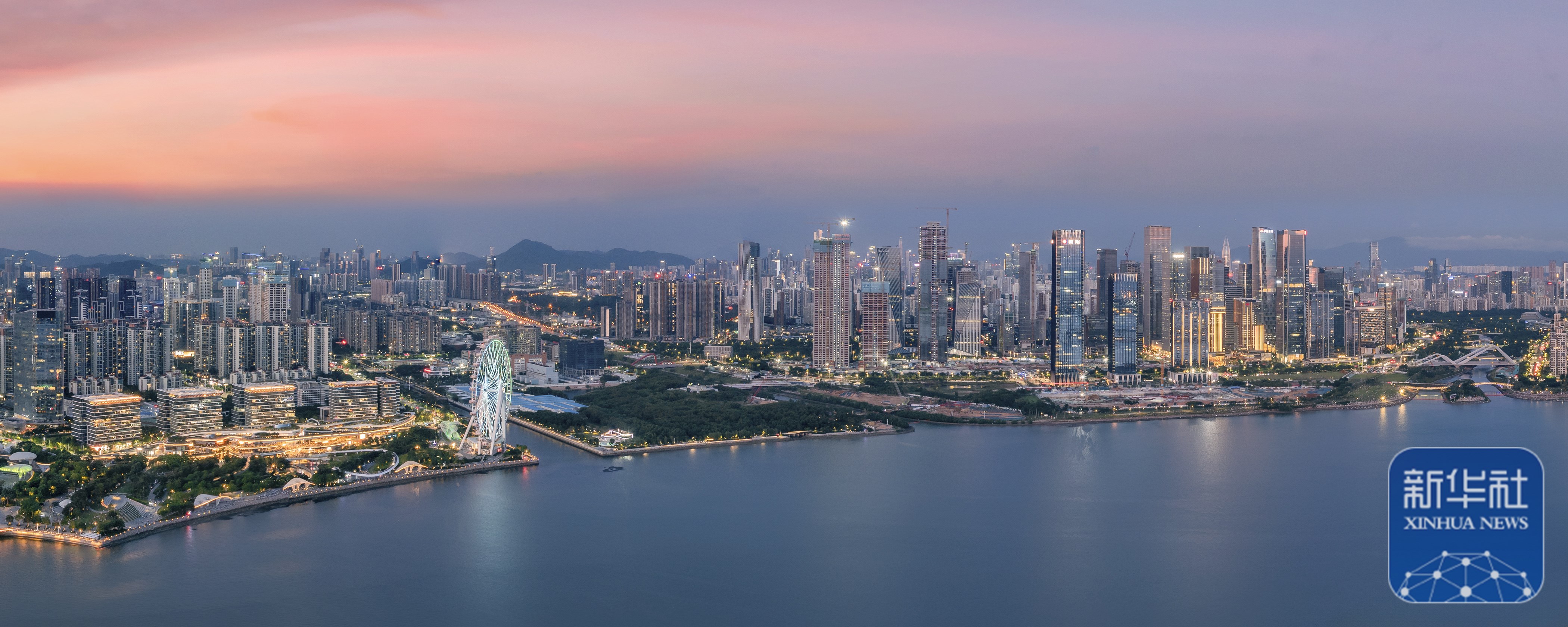
The Qianhai cooperation zone in Shenzhen has achieved remarkable progress in integrating with Hong Kong two years after the launch of its development plan, with growing clusters of Hong Kong enterprises and smoother cross-border collaboration, experts said.
The National Development and Reform Commission officially launched the Overall Development Plan for the Qianhai Shenzhen-Hong Kong Modern Service Industry Cooperation Zone (Qianhai Plan) on Dec 21, 2023, with a range of policies and measures to deepen bonds between Shenzhen and Hong Kong by leveraging Qianhai’s role as a leading area for deep integration between the two cities.
Wang Da, visiting professor of the Institute for International Affairs of the Chinese University of Hong Kong, Shenzhen, said that the implementation of the Qianhai Plan has catalyzed milestone breakthroughs in cross-border integration over the past two years, forging a robust ecosystem underpinned by three pillars: rule alignment, market integration, and life integration.
ALSO READ: Experts: GBA services trade integration to fuel global competitiveness
“The core progress lies in institutional opening-up entering a new phase of joint rule-making,” he said, citing the joint formulation of green building environmental assessment standards by Shenzhen and Hong Kong, and the innovative “one-screen dual-certificate” model that realizes the integration of professional rules.
“In terms of market integration, a notable shift is that Hong Kong capital is no longer flowing into Qianhai in the form of scattered individual enterprise investments, but rather through clustered industrial layouts,” Wang said.
Official data paints a vivid picture of such growth momentum. So far, a total of 10,577 Hong Kong-funded enterprises have set up operations in Qianhai, with their combined registered capital reaching 846.14 billion yuan ($120.14 billion). The Qianhai Shenzhen-Hong Kong International Financial City has emerged as a magnet for financial institutions, hosting more than 370 Hong Kong and foreign-funded players. Meanwhile, startups incubated at the Qianhai Shenzhen-Hong Kong Youth Innovation and Entrepreneur Hub have secured over 6.8 billion yuan in funding, fueling the zone’s innovation engine.
READ MORE: Hetao: Zone of talent
“Notably, the scope of integration has expanded beyond the economic field to cover daily lives of residents on both sides. The implementation of the Qianhai Plan has translated integration from a concept into tangible benefits that enhance people’s livelihoods in multiple dimensions,” Wang said.
For instance, more than 1,000 professionals from Hong Kong and Macao have completed occupational registration in Qianhai, gaining access to expanded career opportunities on the mainland. The zone has also built a familiar living environment tailored to Hong Kong residents, featuring Hong Kong-style schools, hospitals and retail facilities.
Shi Kun, director of the department of regional development and planning at Shenzhen-based think tank China Development Institute, said that Qianhai has met its development goals over the past two years, as evidenced by the influx of over 10,000 Hong Kong-funded enterprises and more than 10,000 Hong Kong people.
READ MORE: Officials: National Games boosts connectivity across GBA
“Hong Kong residents, universities and businesses now have a stronger recognition of Qianhai and are actively tapping its pioneering experience,” he said.
He further highlighted a structural shift in Hong Kong’s investment focus in Qianhai. Capital is increasingly flowing into knowledge-intensive sectors such as technology and information services, overtaking traditional pillars like finance and logistics. This trend reflects Qianhai’s evolving role as a hub for high-end, innovation-driven cooperation, Shi said.
Yu Haichun, director of the institute of international trade rules at the University of International Business and Economics, emphasized Qianhai’s strategic role as a national pilot zone for institutional opening-up and a bridgehead for Shenzhen-Hong Kong collaboration.
“Through systematic rule alignment with Hong Kong and international standards, the zone has played a critical role in consolidating Hong Kong’s status as a global financial hub while facilitating the special administrative region’s deeper integration into the nation’s overall development strategy,” he said.
Contact the writer at sally@chinadailyhk.com
