

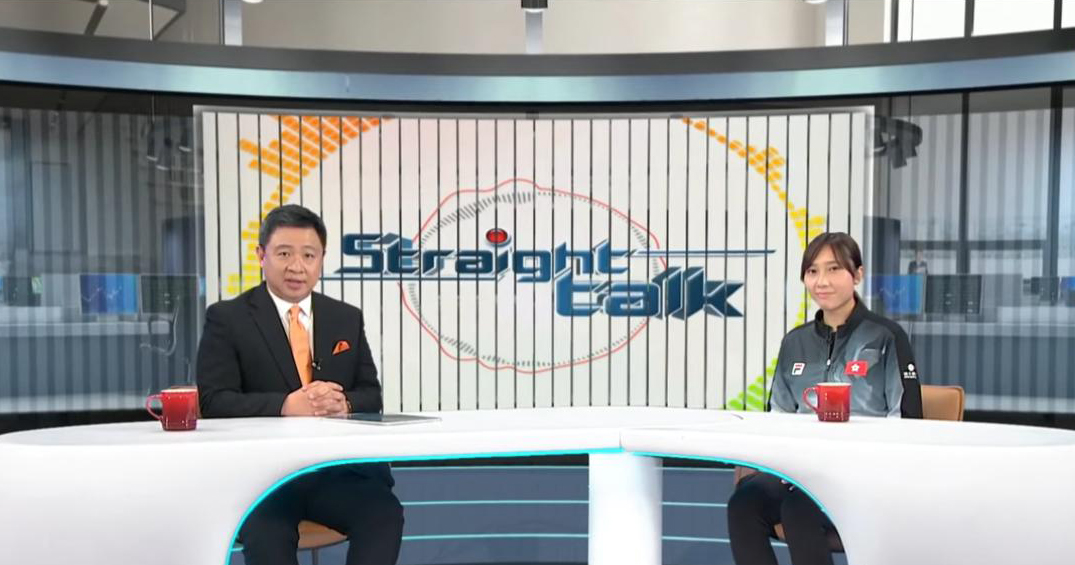
Olympic bronze medalist Hong Kong table tennis star Minnie Soo is on the show this week.
Minnie talks about how going for gold is not just about the medal and how her career in sports is helping her grow as a person despite numerous setbacks and obstacles.
Check out the full transcript of TVB’s Straight Talk host Dr Eugene Chan’s interview with Minnie Soo:
Chan: Good evening! I'm Eugene Chan and welcome to Straight Talk. Our guest this evening is Olympic bronze medalist, Minnie Soo. Soo has been a Hong Kong table tennis team member since 2013. She was ranked 25th in the world and has previously held the top spot as the world's number one U21 table tennis player. She went on to win a bronze medal in the women's team event at the 2020 Summer Olympics in Tokyo in the year of 2022. She was also awarded the Ten Outstanding Young Persons in Hong Kong. Welcome, Minnie!
Soo: Hello!
Chan: Minnie, last week we had Brian Stevenson, the chef de mission of the Paris Olympic team, here, sharing with us his insights about the team's preparation and expectation about the performance at the Paris Olympics.
READ MORE: Leading HK athletes are doing remarkably well, says Stevenson
So, this week, although we share your disappointment not being able to be in Paris with the team, we'd like to take this opportunity to ask you to share with us your perspective on the Olympics as an athlete. Maybe we can start off with your own journey. How did you become sort of a full-time athlete in table tennis?
Soo: I started playing table tennis when I was four years old. My dad is a coach, so it's kind of natural for me to interact with table tennis. And actually, at first, it's my sister who started playing table tennis first and I wasn't tall enough at that time. I was just by her side picking up the balls, but I was already captivated by the sound of the ping pong balls hitting the table. So, I really liked the rhythm. And once I was tall enough, I tried and immediately fell in love with it. So, when I was four years old, my dad asked me what I wanted to be when I grew up, and I told him that I wanted to be a table tennis world champion.
Chan: Wow!
Soo: Yeah. So, I guess that's how my table tennis journey started.
Chan: Right, and do you still play table tennis nowadays with your sister?
Soo: Not as much as before. But sometimes we still play. I think I like table tennis more than my sister.
Chan: We saw that you were only 15 when you decided to go full-time and actually how difficult it was because you had to give up your studies at the Diosecan Girls School and to focus on table tennis. Was it an easy decision?
Soo: Actually, I struggled a lot at that time, because I was 15 years old at that time and like Form-3 is kind of a critical year for secondary school students here in Hong Kong, because you have to, you know, choose your electives and decide what to study for the DSE (Diploma of Secondary Education). And actually, I was so close to choose to still be a full-time student. And I already have all these electives in mind. But I actually talked a lot with my parents and also with Ms Lau, the headmistress of Diosecan Girls School. And I love table tennis, but just giving up school life is too much for me. I mean, I enjoyed studying and I have a lot of friends and I also have some other dreams other than table tennis, although table tennis is still my biggest dream. So, at that time, I communicated with my parents and they said, I have this talent in table tennis and, most importantly, I was given this opportunity at that time. And if I really like table tennis, I have the passion and the talent and the opportunity. Like, why don't I go for it? And also becoming an athlete has a lifespan whereas studying I can study at the age of 15, I can still study at the age of 50. So, I thought, “Okay, maybe I should give it a shot and try playing professionally for two years”. And after I started my professional career, I never looked back.
Chan: So, when you look at right now, say for today, would you be happy that you made that decision?
Soo: Yes.
Chan: No regrets?
Soo: No, totally no regrets. I think most importantly, it really wasn't about what I achieved today. But I think that this journey has given me a lot of insights and nurtured a very tough mentality for me to face different kinds of things in life. And recently, I've gone back to university and I feel like okay, I was right before, that I can study at any age.
Chan: So, what you're saying is that your family's support is very important. Especially when you have to make such a big decision at age 15. Maybe you can share with the viewers: what does a typical training day would be like as a full time athlete? I mean, our students know what we do. We go to school, when we have lunch, and then we go to extracurricular activities. What do you do as a full-time athlete?
Soo: For me, I usually get up at 7 am and sometimes I go for a morning run, and I go to breakfast. During breakfast sometimes I prepare a little bit for my training. I sometimes watch some videotapes, you know, to get myself motivated. And then at 8:30 am, I would start training and we would finish at 11:30 am. So, sometimes we would finish at 12, depending on if we wanted to practice more. And then we would go for a massage or physiotherapy and then go to lunch, then we'd have a power nap, for me it’s like 20 minutes. And then we start training. We start training at 2:30 pm and end at 6 pm. Then we go to fitness for about an hour and then we go to dinner. And at night, it's usually free so we can choose either to go for physiotherapy massage, or usually I also write some training diary and to you know, review my training and also to prepare for the training the next day.
Chan: Do you still see your family on Sunday?
Soo: Yes, but I feel like when I was younger, my family often complained that they didn't get to see me enough.
Chan: Right, so what you're saying it’s a lot of determination, a lot of hard work. And from what you're saying, during the day you have other supporting activities like physiotherapy, even I'm sure there's sports psychology that comes into it as well.
Soo: Yes.
Chan: And now, I'm sure people would like to know how you mentally prepare for such a big competition. I mean not just the Olympics, it could be a local competition, could be a regional competition. How do you do that?
Soo: I think I usually start preparing like a month before any larger scale competitions like world championships, and you know the games, Asian Games. And usually, I will have a training plan for myself. Like how I want to improve myself because usually the competitions, the tournaments, they just never stop. Like we have two tournaments in one month. So, we're always in this mental state where we are ready to compete. So, usually we already have in mind what skills we want to improve and then I will write a brief overview on the skills and the mentality that I feel like I could have done better. And then during the training, I would just keep marking my progress and see if I'm actually making any improvements.
Chan: Right, so also a very strong mental side of things as well. You have to prepare yourself. So, do you think you have missed out anything that normal teenagers would enjoy by being a full-time athlete?
Soo: I think when I look back I feel like I kind of missed a chance of, you know, growing up with people of my same age, because, like in table tennis, I mean, the age range is kind of like wide. But when I was playing at that time, I didn't really feel like I missed out a lot because I really enjoy table tennis and I always have a very specific goal in mind, and I feel like what I was doing every day was already like, very enjoyable.
Chan: So, Minnie, the title of the show tonight is "Olympics: is it all about medals?" And we had Brian here last week, and I asked him what his answer was that every single athlete in the Olympic team will be aiming to win a medal. But at the same time, they want to know that they're doing the best performances all the time, and this is what we should be looking for. Do you agree with that statement?
Soo: Yeah, I totally agree. Because as an athlete, I mean, we always have this goal of achieving the medal in the back of our minds, but for me, my goal is always like, I don't really think about the medal when I play. I only tried to, you know, think about how to perform well. And I don't actually like "cherish", "cherish" that medal as much as people think. I actually cherish the great points I played during the match. So, for example, people ask me, like: “Do you often look at your medal after your Olympics, or you know, just to get that feeling again?” And then I say, no, but I actually cut some highlights from my Olympic Games and keep watching the good points that I played. And I would feel very proud and happy.
Chan: So, really, are the points or the actual journey more important than actual medals?
Soo: Yeah.
Chan: In Hong Kong recently, because we used to be just participating in the Olympics, but in recent years, it'd be a better success even four years ago in Tokyo, there was a fantastic turnout, in terms of result. Do you think people in Hong Kong now we're putting too much emphasis on the medals? What do you think?
Soo: I think it is okay to put some emphasis on the medals because, I mean, a gold is always a motivation, but I think it is also very important for people to know that ... I mean, it's great to have medalists here in Hong Kong, but there are so many other athletes who are like fighting very hard, and even have the same skill level and mentality as those medalists. But because I do believe that luck also plays a role in sports and also, yeah, sometimes they are … you get a better draw and you're more likely to you know, get a medal. So, I would say that these medalists are kind of representative of an icon of all our athletes, but it is very important to acknowledge that you know, sports is like kind of a community, a profession and not only about those, those people at the top.
Chan: Minnie, let's take a break now but viewers stay tuned. We will be right back.
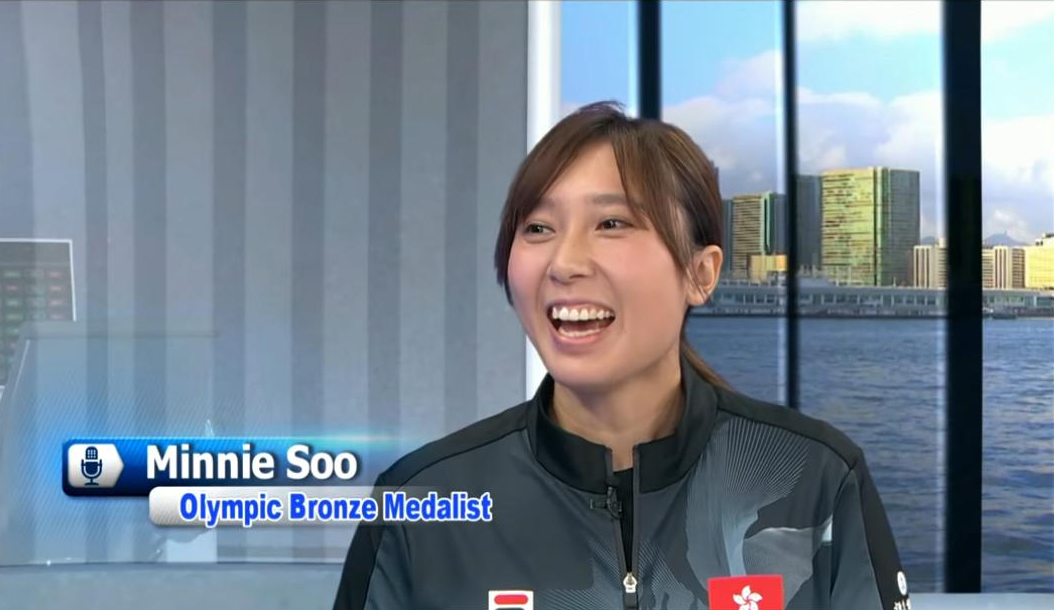
Chan: Thank you for staying with us on Straight Talk. Olympic bronze medalist Minnie Soo is with us, sharing with us her journey, her perspectives on the Olympics as an athlete. So, Minnie, in the first part of the show, you have clearly said that medals are a goal for athletes, but then the journey is more important, as you said you've always played back those important points that you have in table tennis. So, can I say that winning the Olympics in Tokyo would be the highlight of your career? And how has that changed your life since?
Soo: Looking back, I feel like the Olympic medal has a huge impact on my life. I mean like I got a lot of opportunities in both my sports career and also outside my sports career. But if you ask like as an athlete, I mean to me, every tournament is equally important. I prepare very hard for both the Olympics and Asian Games, or any other tournaments. I mean every match is equally important because I always feel like I don't compete for the medals or for the recognition, I compete for my own dignity, you know.
Chan: Okay.
Soo: Yeah, so, I would say that the Olympics is definitely the highest stage, but for me, table tennis is just important in all sort of ways, not only like about the level of the tournament.
Chan: Right. Minnie, at the beginning of your introduction, I said that although you are disappointed you won’t be at this Paris Olympics because of your injury. Do you mind sharing with the viewers what happened? And I mean you being so optimistic and being so happy, how can you handle that disappointment? I am sure people would be wondering.
Soo: So, actually, I had this injury for quite a few years already. In fact, it started more than half a year before the Olympics. So, one day when I was training, I suddenly felt like there’s some rigidity in my arm. At first I thought it was fatigue, and I tried to push myself harder to execute these perfect movements. But day after day, it worsened. And one day, I just realized that I couldn't control my arm anymore. So, when my arm was supposed to open up like this, my wrist bent in a very awkward angle, and my arm would move the other direction instead. And I eventually had to see a neurologist, and I was diagnosed with focal dystonia. So, it is a psycho-neurological disorder that involves involuntary spasms in my arm when I try to execute some movements. So, the doctor told me that there wasn't any cure at that time, and I was actually really devastated.
Chan: Yeah, it would be.
Soo: It was the first time in my career that I thought that I might have to quit. But I just … I still went to training and try to, you know, persist. And my parents also encouraged me, like, I have fought for table tennis for so long already, and it is really a waste if I quit now just right before the Olympics. So, I tried really hard in training. And one day, in training, I was so devastated that I had to see a sports therapist. I had to talk to him and I complained to him that it was too difficult for me because my arm wasn't listening to me, and how could I even improve if I couldn't control my own body. And it was very important that he told me to accept this injury as a part of myself, and to embrace focal dystonia. So, at that time, I was thinking how can I embrace focal dystonia because this is totally hurting my career. But one day in training, I had this chance to play against a player from the Chinese mainland team. And on that day, my arm was especially bad, but somehow I just won that match. And I thought it was pure luck, but after that match, my friend told me that my opponent said that because of my uncontrollable movements, they found my serve really difficult to read, they don’t know when I am going to serve. And this is the first time I feel like there is actually a bright side to my injury. So, I thought okay, if I couldn’t control my arm, then be it because it might actually distract the opponent as well.
Chan: So, Minnie, thank you for sharing your innermost feelings. I can actually feel your frustrations, or even I can even feel your emotions when you were talking to us just now. Are you planning to try for the next Olympics? Let me be very direct.
Soo: For the next Olympics … of course. As an athlete, I would always want to play again in the Olympics. I mean like I hope that one day my injury would recover, and then I'd be back on the stage again.
Chan: Right. I am sure we are going to get a lot of calls from the viewers, I am sure a lot of help is going to come because they hear what you are having. But anyway, let’s see how we go. How do you stay motivated? Even, say you have done well in the Olympics coming back. I am sure the injury is still there, you still have your frustrations, and this time you can’t play, and you are still connected with your teammates. I know that you are very good friends with your Hong Kong women’s table tennis team, and you guys are good friends.
Soo: Yeah.
Chan: How are you going to support them this time?
Soo: I would talk to them, I would message them, and ask them like how they are doing. And you know, I always say that I have a lot of confidence in them, and I really look forward to seeing them play on TV.
Chan: Right, okay. Let's move on to the future of Hong Kong sports. I mean you have been a … I would say, a beneficiary of the Hong Kong Sports Institute, if I may say. Being a full time athlete, you were trained, you have done well in the Olympics, and now you are a great ambassador for the sports. I mean we had Brian here last week, and he said winning medals in the Olympics would contribute to the sense of national pride and unity in Hong Kong. How do you see things from the angle? How does sports going to help Hong Kong in terms of unity and the pride?
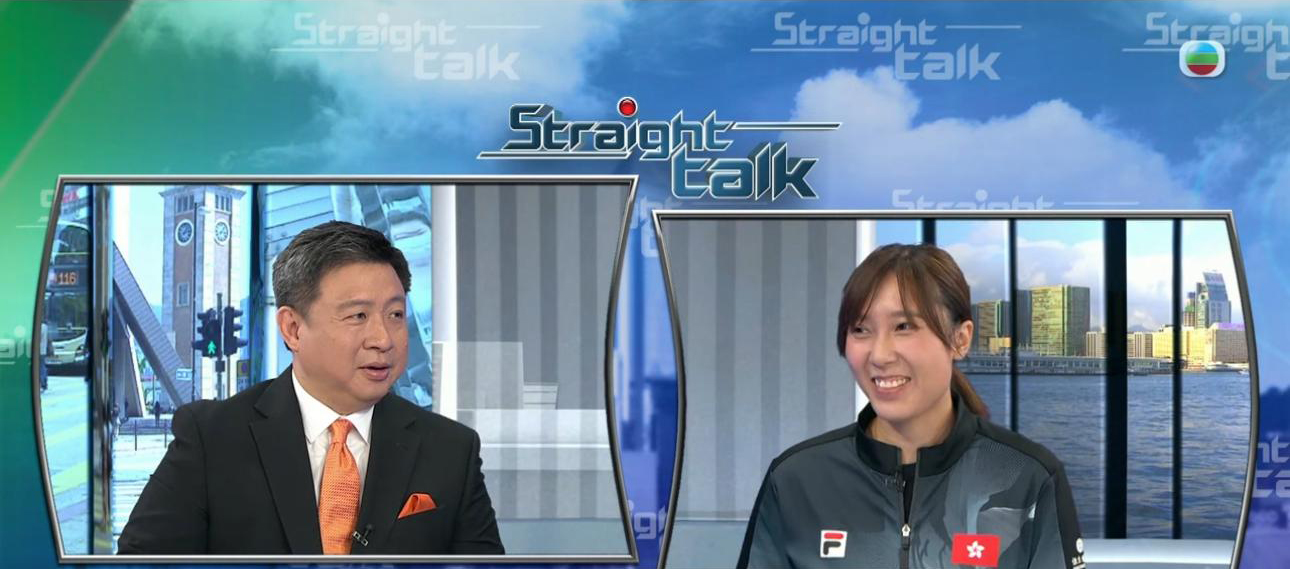
Soo: I actually do think that sports play a very important role in the society because like I myself learn a lot from sports. Apart from, you know, the passion you have when doing sports, I also learn a lot of communication. I made a lot of very precious bonds with people, made some connections. And it is also very important in building a very tough mentality because when I go back to university, I realized like, okay, there might be a lot of difficulties that the students are facing nowadays, but I realized like because I was so used to failure in sports, in fact 90 percent of the time I feel like I am always disappointed in my results. Well, I am so used to not getting what I want despite working so hard for it, so I think it really builds a tough mentality for myself to face different difficulties in life. And I really think that this mindset should be spread among everyone in the society because it’s not … because like we need this tough mentality, but because when I have this mentality, I feel much happier and I don't feel too negatively affected by my losses.
Chan: Right. Minnie, you know Olympics only comes every 4 years, and there are other competitions, like the Asian Games, as you said earlier, and other world class competitions in table tennis. But I heard a comment recently from my friend saying that the Olympics’ sort of wave or of the heat in the society hasn't really picked up. From an athlete, is there any difference in the Olympics as compared to other sporting events? Is it so much more special?
Soo: Like from my observation, I do think that the Olympics definitely has a larger impact on the community, like people are more excited about the Olympics than the Asian Games. But I think it's also like affected by how these events are broadcast in Hong Kong. For example, like when I see, like, the Olympic Games are being broadcast on these televisions in shopping malls, I feel like it really bonded Hong Kong people together to root for Hong Kong athletes. And yeah, I think this actually really promoted sports a lot in Hong Kong.
Chan: So, now you are kind of like a role model for the young people in Hong Kong because you have been in the Olympics, you are very positive, and now you are back into full-time education as well, as I believe. What will you say to the younger athletes who are thinking of turning full-time right now? What will you say to them?
Soo: I think the most important thing is to follow your heart. I mean like I always think that you might not get a medal in the end, but you shouldn't just be thinking about the medal because the journey is very important. And I really think that if you try very hard, then you always get something out of it. So, don’t be afraid of failures and go for what you want.
Chan: Right. So, thank you, Minnie. And I'm afraid that we have to leave it there for now. Thank you, Minnie. Your dedication, resilience, and achievements are truly inspiring. Indeed the Olympics is not just about medals, but the spirit of perseverance and sportsmanship. As renowned track and field athlete Carl Lewis said, “It is all about the journey, not the outcome.”
Have a good evening and see you next week!
