

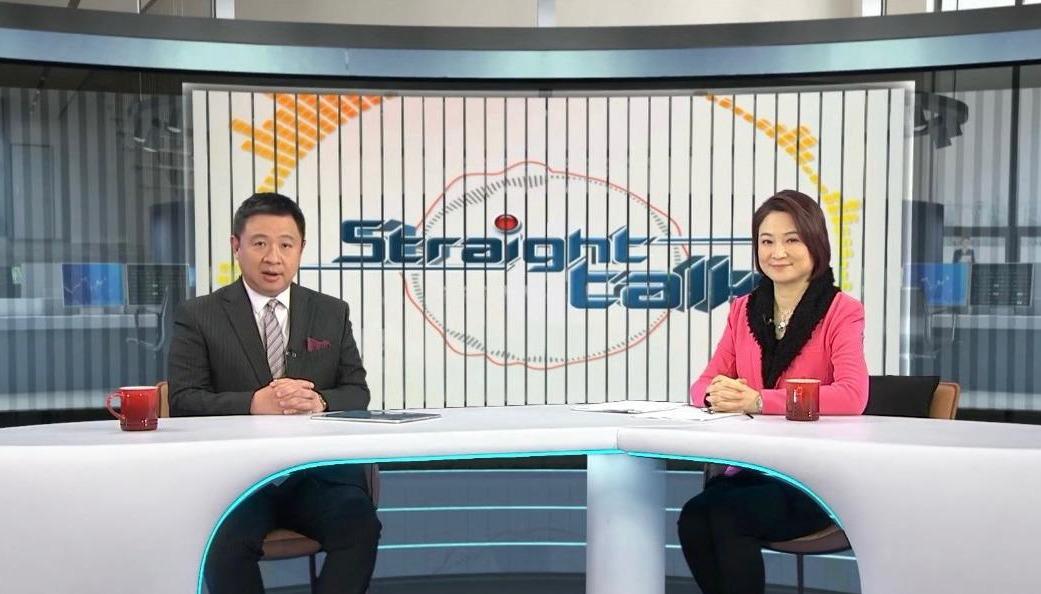
 Starry Lee (right), a member of the National People's Congress Standing Committee, speaks on TVB’s Straight Talk program on March 19, 2024. (PROVIDED TO CHINA DAILY)
National People's Congress Standing Committee delegate Starry Lee is on the show this week. Lee described in details how delegates went through their meetings during the Two Sessions, and gave us an inside look at how business went about among Hong Kong delegates and the responses they received from our nation's leaders.
Check out the full transcript of TVB’s Straight Talk host Dr Eugene Chan’s interview with Starry Lee:
Chan: Good evening. I'm Eugene Chan and welcome to Straight Talk. This evening, our spotlight is on the recent Two Sessions in Beijing. Joining us is Starry Lee, a member of the Standing Committee of the National People's Congress, to give us her insights into how the latest national policies will impact Hong Kong. Lee is also the former chairperson and current advisor of the Democratic Alliance for the Betterment and Progress of Hong Kong and a legislative councilor for the Kowloon Central geographic constituency. Welcome, Starry!
Lee: Hi!
Chan: Starry, it has been quite some time since we have had you on the show. And this time, we want to invite you because you went to the Two Sessions, which ended on Monday. So, what was your experience like this year, compared to previous years that you have been? Are there any differences?
Lee: Well, I can experience the progress and advance of the Two Sessions. Like this year, I feel very glad to be able to join personally. It was a very fruitful Two Sessions and if you compare the previous Two Sessions. The time is short and I will describe it as high quality and high efficiency. We have completed seven tasks. We have seven agenda. Apart from most published government work reports, actually we have deliberated on the budget and also the fund allocation between the central government and also different provinces, and we have two reports from the High Court and we have two reports from the prosecution. Of course as a lawmaking body, we also deliberated on a law related to the government structure.
Chan: Right. Sounds very fruitful seven days when you were in Beijing.
Lee: Yes, seven days.
Chan: So, I'm sure that a lot of the viewers will want you to share with them what will be a typical day during the Two Sessions, because on the television, we see you guys in front of the Great Hall taking pictures or during the actual meeting. But we have no idea what actually happens either before or during or after the meeting. What actually happened?
Lee: Yes, thank you for asking this question. I always share my experience as an NPC member and also my experience as a Standing Committee member, because I would like to make use of my experience so that more people understand what the actual situation and deliberation that we have carried out at the NPC.
Chan: Before you start, what exactly is meant by the Standing Committee?
Lee: Oh, Standing Committee, you know, we have the National People's Congress system and this is the top authority in our country. Basically, it is governed by the Constitution. If we have the constitutional amendment, we have to go through the NPC. And, you know, every year, these Two Sessions attract a lot of attention because it is the most important political event in our country. All the important reports and deliberations have to be carried out during the Two Sessions. You can think about this in the Hong Kong scenario, right? We have two important events in Hong Kong, I would say. The Policy Address and the Budget. And just like what we have in Hong Kong. But you know, we as a country, we have to, you know, make use of these Two Sessions. Therefore, apart from the government work report, just like our Policy Address in Hong Kong, we have our government report, apart from that we have to deliberate our Budget, and how we do that actually, just like what you said. Now national leader will usually deliver a very brief summary of what had been achieved and what are the plan forward, like Premier Li, here deliver around 15 minutes speech about the government report, and then this session ends before television, what we do as a member of the National People's Congress, like Hong Kong delegate, we live in the same hotel. Then in the afternoon, we will have a session for deliberation. You can think about that. It is actually a Congress of our country, just like the Legislative Council. But the way it’s conducted is similar to Legislative Council. We have government officials to listen to our views. As members of the People's Congress, we have to ... after studying the report presented by our leaders and then we give views, we give suggestions. Before attending the Two Sessions, we have to have a good preparation like what we did. We, as a team, put forward over 30 suggestions to the central government. Of course we, as Hong Kong delegates, most of the suggestions are related to the Hong Kong community and different sectors of the Hong Kong society. We collect views before we go to the Two Sessions. And this year, we're glad that we have reached a consensus for a suggestion made by the whole 36 Hong Kong delegates.
Chan: Right, since you have given us the detail of what you actually do there. But when you come back to Hong Kong, I mean, the Legislative Council actually meets weekly except in the summer, but for the NPC members, they only mainly meet once a year in Beijing. So, how can the views be fully communicated? I know you're in the Standing Committee, you go there every two months, you go there more often. So, how can we ensure that our views can be effectively communicated and being addressed at the Congress?
Lee: We have to understand the difference between a city and a country. You know, we have around 3,000 NPC members in total. You can imagine, right? People from different parts of our country coming together to meet for a week is already a very, you know, a very huge exercise.
Chan: Exactly.
Lee: Therefore, we can only afford to have a full council meeting every year. That is, as I've mentioned, most of the important things have to be designed and deliberated within these Two Sessions. When these sessions close, then it is the Standing Committee, which is composed of around 200 people, representatives from different provinces and different sectors. And then, we'll continue some deliberations, like for example, we will go through a lot of bill scrutinization and it is actually a lawmaking body.
Chan: Right, Starry, you mentioned earlier that you have to be prepared to go into the Two Sessions. So, you've been there a few times. How do you prepare yourself both mentally and physically? Because you're actually in Beijing this summer, at least you're not locked in the hotel. Are you still being confined to one hotel?
Lee: Not really.
Chan: So, you can go outside this time?
Lee: Well but of course, they would like you to concentrate on the meeting. Therefore, most of the time we will be in the hotel except for some of the things that we need to do, like for example, meet the media, to promote Hong Kong and also do some important things. Otherwise we have to stay in a hotel.
Chan: So, mentally and physically it is quite demanding. Can I say that?
Lee: Oh, yes. Because it is quite condensed. We run from Monday to Sunday, every day and night, I will say, because it is actually quite condensed. You can imagine seven agenda in the morning. Usually, the leader gives a brief report and then you receive a lot of documents including the government report. And also apart from this government report, we have Budget, we have a lot of supporting documents and then we have to scrutinize it in a timely manner. We will conduct a small group discussion like, for example, what we did to discuss the government report. And then listen to people from different backgrounds. And then we write up our speeches and suggestions. And throughout that deliberation, you know, representatives from different bureaus will come to Hong Kong delegates to listen and collect views and they are quite responsive. For example, during the discussion of the government report, we made some suggestions, like, we advocate to increase the custom from 5,000 to 30,000 for the mainland tourists per day. And then we respond immediately from the finance bureau. And then we exchange views, I will follow it up when I'm back in Hong Kong.
Chan: Right, Starry before you share with the viewers what are the national policies that you sort of picked up, you just mentioned there are 3,000 members of the NPC and also over 2,000 odd members for the CPPCC. So, there's a lot of people, a lot of comments. So, how seriously does the central government take Hong Kong's views? Because Hong Kong used to be a major, a very important city for our nation, recently with the other major cities like Beijing and Shanghai, Shenzhen doing better and better and Hong Kong having some trouble as we all know. We are not ... relatively we are not as important. To many viewers, we are no longer the favorites. So, does the central government still view Hong Kong as very important?
Lee: My feeling is that, you know, the central government through discussion with various national leaders, do treasure Hong Kong very, very much. You know, we can have a lot of things that we can tell. Like for example, our President Xi does visit Hong Kong during important days and deliver important speeches. He again re-emphasizes that "one country, two systems" is a good system and that the country will continue and Hong Kong should you know make use of "one country, two systems", that is we have full backing from our motherland. On the other hand, we have to continue to be the international city of our country. Apart from President Xi, you know this year different national leaders do come to visit the NPC delegates and also members from the political consultative body and we have Vice-Premier Ding Xuexiang to visit us. Like for example, during the meeting with Mr Ding, we exchanged view, there are … this meeting is around two hours, and he listened carefully to what NPC members said and do make a very, detail sharing and during his speech he emphasized that he, on behalf of the central government, treasures Hong Kong very much and more and more policies will come to support Hong Kong's in the future.
Chan: Right Starry. Let's take a break now. But viewers, stay tuned. We will be right back for more discussion on the 2024 Two Sessions.
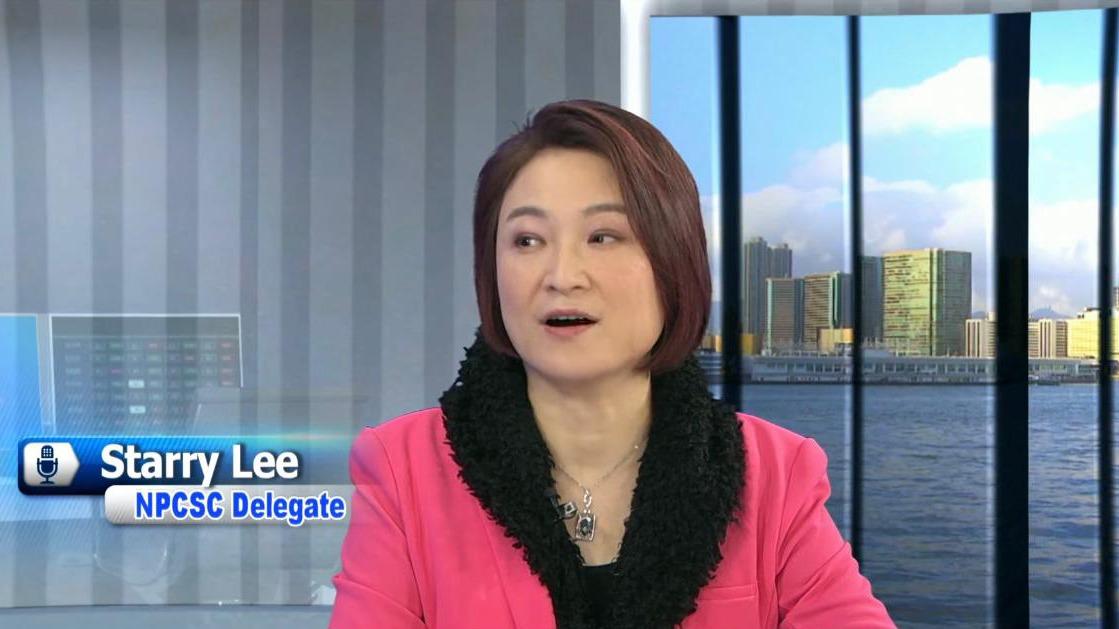 National People's Congress Standing Committee delegate Starry Lee speaks on TVB’s Straight Talk program on March 19, 2024. (PROVIDED TO CHINA DAILY)
Chan: Welcome back. Thank you, Starry, for giving us the main national policies arising from the Two Sessions, and your insight into the impact on Hong Kong. In the first half, we were mainly discussing the ins and outs of what are the Two Sessions, and you have categorically mentioned that Hong Kong is still very important and being respected by our national leaders. Let's move on, as I said just now, a bit more on the national policies. I understand you had a few interviews with CGTN, and you said that you will take the spirit of the Two Sessions meeting back to our local community. So, let this program be the first time you share that words with the viewers. So, what were the key takeaways from the Two Sessions when you've been there? What are the main things that you remember and want us to remember?
Lee: I think to understand and learn about the message from the Two Sessions, very important things. First of all, we have to understand the message delivered by our leader, President Xi, during his visit to various delegates. This can be searched from the internet. And apart from the message delivered by President Xi, we have to understand the most important work report presented by Premier Li, and this is usually the focus. You know, from this report, we clearly understand what have been achieved in the past year, that is last year, we have achieved a 5.2 percent GDP growth. Our GDP is at a very, you know, high base, and we can still, in this difficult situation, both internally and externally, achieved a 5.2 percent growth. That growth achievement is, you know, not easy to achieve. And apart from that, we have created not less than 12 million employment opportunities; we keep our inflation low at around 3 percent; the consumer price index is about 0.3 percent, something like that, that is the price level, it is at a stable level, so that people do not need to experience high inflation and high price rise. And all this achievement is managed through our central government, a combined effort. Apart from understanding the past performance, I think another important thing that we have to learn and fully understand is what is the way forward, especially what are the key national policy initiatives. One of the very hot keys, after the Two Sessions, is we have to produce or develop high quality, new quality productive force, in order to enhance further high-quality development. I repeat, new quality productive force. This is a new term mentioned by our President Xi during his visit to Heilongjiang, and then he re-emphasized that we have to look into the local situation to develop that new quality productive force. To me, what is meant by a new quality protective force? We all understand that we are in a very challenging situation. In a lot of areas, we face bottleneck, we have to have a breakthrough. How can we achieve that breakthrough? We have to have that breakthrough through innovation, technology, high quality education, we have to have sufficient talent to move, so that our economy, our industries can grow continuously. And also we have some breakthroughs in products, productivity, and also supply chain, etc.
Chan: Yes. Since you mentioned all those terms, I am sure people hearing words like high quality development, all those terms ... How should we interpret those high quality terms? It sounds very good, but what is it actually?
Lee: Well, to me, you know, our country continues the high quality development for over the past years. And we can see we have achieved a lot, like I think one of the most common products that are welcome by the world is our electric cars.
Chan: Right.
Lee: Now you know the electric cars produced by our country share 60 percent of the world market.
Chan: Yes.
Lee: And this is such an advanced and innovative product, and we are all proud of it. And we have the C19 aircraft just produced. And we have a lot of breakthroughs.
Chan: Right.
Lee: And we are moving towards our digital economy. And in terms of green economy, we have also achieved a lot. You know when we look back over the past 10 years, our country did spend a lot of resources, a lot of combined effort, to tackle pollution, pollutants. And when we now go to attend Two Sessions in Beijing, I feel the achievement that we have achieved. You know when we go to, like for example, Beijing, in the past, I mean 10 years ago, you can feel the air quality.
Chan: Right.
Lee: A different air quality.
Chan: So, things have improved?
Lee: Yeah. But now very significant improvement.
Chan: One quick question: how about in terms of … you know we all know that our mainland doing very well with all the digital transformation. Anything you have spotted this time when you were in Beijing? Are things getting more modernized?
Lee: Yes, I think we every 2-3 months when we go to different cities in our country, we can find new things.
Chan: Right.
Lee: That is how we work, like infrastructure, we are amazed to see that we have a lot of good infrastructure. Our high-speed train is our very … another infrastructure that we should be proud of. Electric cars and digital economy. And if you have a chance to look at the digitalization, and also the technology used for governance, everywhere now a lot of cities, they use technology in governance. All these, we can see we have achieved a lot of breakthroughs.
Chan: Right. Starry, I am sure a lot of the viewers are going to start wanting me to ask you this direct question. In Hong Kong, after the pandemic, we are expecting things to get back to normal. But quite the contrary, we are facing huge challenges in the actual economy because of the interest rates, because of the geopolitics, because of our mainland counterparts they’re not … I mean we are not having the rich mainland visitors anymore. So, Hong Kong, we are all suffering, we are all wanting a new breakthrough. We had the Budget, we had the financial secretary here a couple weeks ago. So, I am sure people are looking for what is our national government going to do, in terms of policy, against the ailing economy in mainland? As you said, it was much higher based at 5.2 percent, so we have still got 5.2 percent growth. So, can you see some light at the end of the tunnel that the economy is going to be turning around with the policy? And how about the geopolitics, I mean that is definitely affecting us. I mean I know a lot of funds are not going to mainland because of that. A lot of visitors are not to go. What do you say to that?
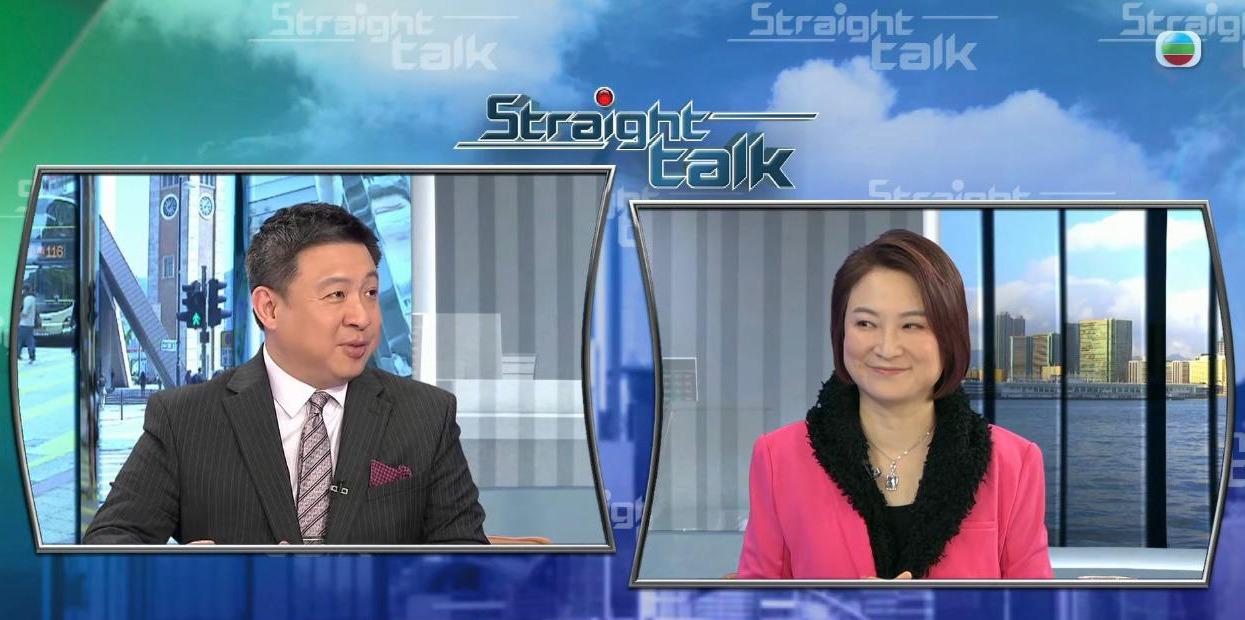 Straight Talk presenter Eugene Chan (left) interviews National People's Congress Standing Committee delegate Starry Lee on TVB on March 19, 2024. (PROVIDED TO CHINA DAILY)
Lee: Well, we have to admit that we are facing great challenges externally, the geopolitics. I would say this part we cannot change, especially from the Hong Kong’s perspective, we are such a small economy. Of course, we have to understand our national policy, and we have to integrate into our country further. We are part of our country, therefore, we are inevitably faced with the challenges from geopolitics. But I feel strongly that, after attending this Two Sessions, I have full confidence towards the development of our country. You know even facing all these challenges, we continue and persist in working towards the high quality development, we can see continued breakthrough. And Hong Kong is part of China, and you know, national leaders, whenever they come to visit us, they give us full confident that Hong Kong’s issue is not Hong Kong alone, it is the whole country’s … (they) also treasure and care about Hong Kong. Therefore, we have problems, of course, in this moment maybe. Like for example the financial center, our country does want Hong Kong to continue to be the international financial center because, like for example, when we met with Mr Ding, we have one delegate, we have one deputy, who also suggested some measures to boost Hong Kong’s financial centers. And he clearly mentioned that more measures will come. And therefore, we should have full confidence from our country, our country will support Hong Kong's development. But of course, from the Hong Kong perspective, we of course can rely on our country's full support. But we have to perform our role, maintain our international city, we have to attract talent, attract funds, and also attract technology, in order to help our country to further development.
Chan: Thank you for very concise summary of what Hong Kong should do. I am going to ask you the last question. Financial Secretary Paul Chan has said that we will aim to get a growth of 2.5-3.5 percent this year. However, getting more talents for Hong Kong is very important because we are running lower in numbers. However, I am sure the viewers are going to ask you, looks like we are attracting more people with the mainland background coming to Hong Kong, making Hong Kong not as much as an international city. What is your perspective on that? A quick answer.
Lee: Well, I think we have to continue to maintain Hong Kong as an international city. That is very important. Apart from attracting people from our motherland, we have to attract people from different parts of the world. But now, maybe the international cities, or attract people from different parts of the world we have to extend further, like ASEAN countries, like Middle East. We have to have our wider spectrum. That is my remark.
Chan: All right. Thank you, Starry, for enlightening us on this impact of the recent Two Sessions in Beijing on Hong Kong’s trajectory. As we forge ahead, it is clear that collaboration and strategic planning are essential for harnessing Hong Kong’s strength, amidst the evolving economic dynamics.
International solicitor, Susheela Rivers, said, “Disparity is not a policy issue, it is an open education issue; to have the best positive impact, the Hong Kong people need to have a good understanding of the why and the purpose of important policies”. Have a good evening and see you next week!
