

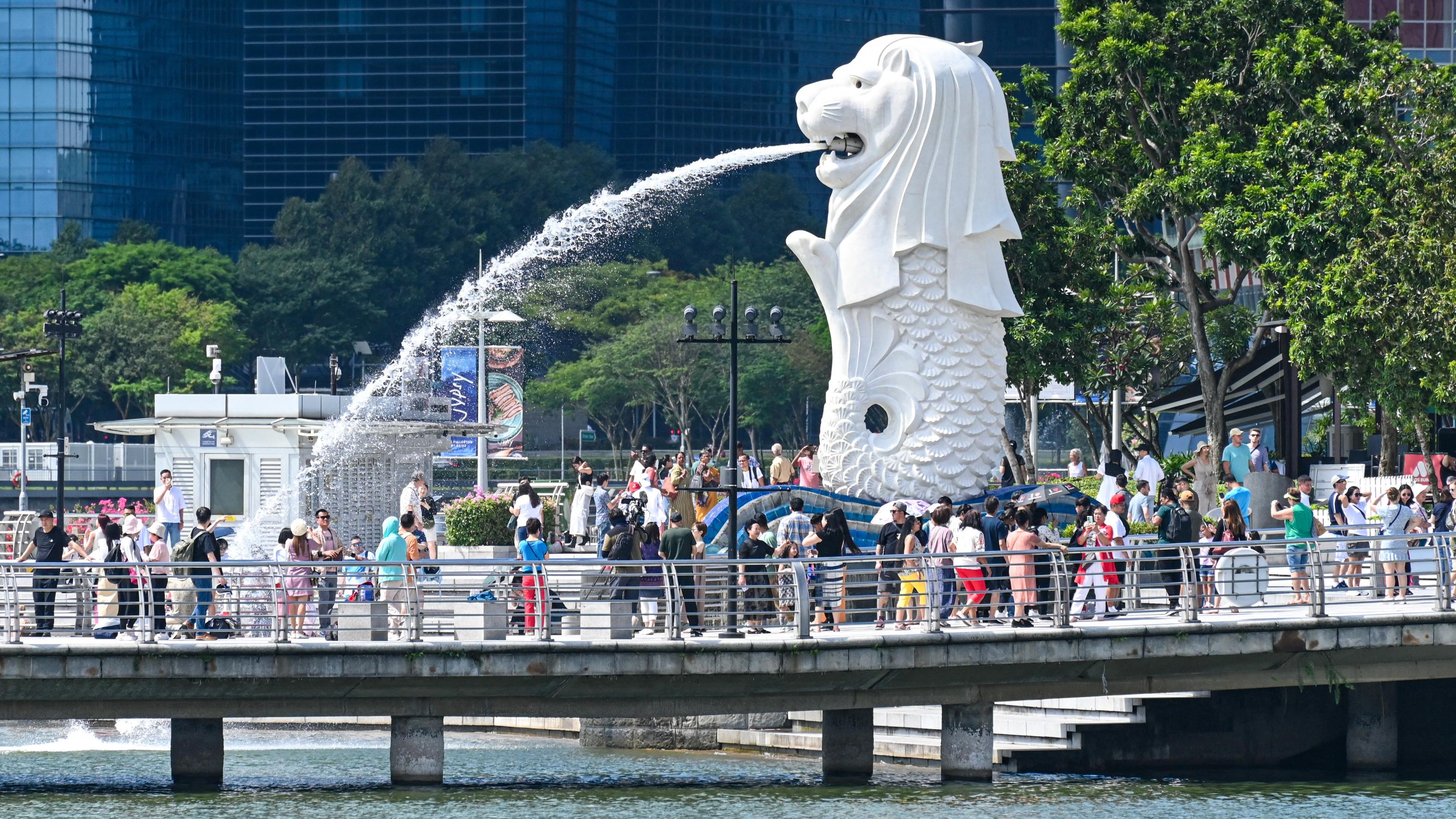
 People gather for photograph next to the Merlion statue at Marina bay waterfront in Singapore on March 18, 2024. (PHOTO / AFP)
An influx of Chinese travelers in the past few months has enabled the tourism industry in Southeast Asia to recover from the pandemic-induced slump, analysts said.
While China has long been one of the key travel markets for the member countries of the Association of Southeast Asian Nations (ASEAN), decisions by Singapore, Malaysia and Thailand in late 2023 to waive entry requirements for Chinese tourists have bolstered tourism receipts in the first two months of this year.
Visa-free access for Chinese tourists is a “facilitating factor” in boosting ASEAN tourism industry receipts, according to John Paolo Rivera, associate director at the Manila-based Dr Andrew Tan Center for Tourism, Asian Institute of Management.
Rivera said Chinese tourists are the “biggest spenders” among travelers in Southeast Asia. “Alongside the volume of Chinese tourists, the Chinese spending habit has driven consumption spending and the tourism contribution to GDP” in the region, he said, noting that tourist expenditures have helped the ASEAN travel industry to recover from the losses posted during the pandemic.
Chinese tourists’ spending has perhaps created the biggest impact on Singapore. Official data showed international visitor arrivals in the city-state reached 13.6 million in 2023, with China among the top three source markets. Tourism receipts reached S$20.1 billion ($14.95 billion) between January to September 2023 and Chinese tourists were the biggest spenders, with receipts hitting over S$2.3 billion, according to the Singapore Tourism Board (STB).
STB expects the tourism sector’s recovery to continue this year thanks to improved global flight connectivity and the implementation of the mutual 30-day visa-free travel between China and Singapore that started on Feb 9.
Yu Hong, senior research fellow at the East Asian Institute of the National University of Singapore, said the mutual visa-free agreement has boosted the number of Chinese visitors to Singapore, especially during Spring Festival. But Yu noted that Singapore has always been a popular destination among Chinese tourists owing to its geographical proximity, cultural similarities and the presence of many direct flights to and from Chinese cities.
In Malaysia, officials welcomed on March 16 the passengers aboard China Eastern Airlines’ inaugural flight from Kunming in Southwest China's Yunnan province to the Malaysian capital city of Kuala Lumpur.
Manoharan Periasamy, director general of Malaysia Tourism Promotion Board (Tourism Malaysia), said in a statement that this new route provides a “great opportunity” to bring in more Chinese tourists, especially after the visa-free policy took effect on Dec 1.
For 2024, Malaysia is eyeing 27.3 million international tourist arrivals, with 5 million arrivals expected to come from China.
As for Thailand, a government spokesperson said 3.96 million foreign tourists arrived in Thailand from Jan 1 to Feb 8. Tourists from China topped the list with 730,747 visitors, media reports quoted the spokesperson, Chai Wacharonke, as saying.
Online travel agency Trip.com said that on March 1, the number of Chinese tourists to Thailand was up more than 30 percent compared to the same period a year earlier, according to a report filed by Xinhua News Agency.
Qin Jing, vice-president of Trip.com Group, said the implementation of the mutual visa exemption, which was implemented in March, holds significantly positive implications for the growth of the tourism sectors in both countries.
Contact the writer at prime@chinadailyapac.com
