

 Straight Talk presenter Eugene Chan (left) interviews Legislative Council member for the Technology and Innovation Constituency Duncan Chiu on TVB, Oct 24, 2023. (PROVIDED TO CHINA DAILY)
Legislative Council member for the Technology and Innovation Constituency, Duncan Chiu is on Straight Talk this week.
Duncan Chiu talked to us about Web3 and digital finance on the show.
He says the recent JPEX scandal exposes the current weakness which is that Hong Kong doesn't have sufficient legislation to govern operators. But he says Hong Kong should not stop the whole development of the industry just because a bad operator misused the technology to commit crimes. Duncan is of the opinion that the authorities should speed up legislation and clarify the financial products class to ensure the retail investors are protected.
Check out the full transcript of TVB’s Straight Talk host Dr Eugene Chan’s interview with Duncan Chiu:
Chan: Good evening! I'm Eugene Chan and a warm welcome to Straight Talk. Our guest this evening is Legislative Council member for the Technology and Innovation Constituency, the Honourable Mr Duncan Chiu. A tech entrepreneur, and a veteran investor, Chiu is a leading figure in Hong Kong's T&I sector with over 20 years of experience. Serving as LegCo member since 2022, he has a significant influence on local T&I policies, both chairing and being a member of a range of advisory committees. Duncan has participated and invested in over 100 technology companies and is an experienced professional investor. This evening, we have invited Chiu to talk to us about Web3 and digital finance and its relevance to ordinary Hong Kong people like you and me. Welcome, Duncan!
Chiu: Hello, Eugene, happy to be here.
Chan: Maybe, let's start the show by telling people what actually, the term Web3 is. We hear this all the time and it must be a very popular term right now.
Chiu: Yeah, I think there are actually a few clarifications or explanations of what Web3 is. For me. I think it's actually anything related to blockchain technology, leveraged by blockchain technology which is a distributed ledger system. And with that, you can store data, data of transaction, data of value, data of personal data or some digital creations. So, anything that is actually created or under the blockchain system that stores value, I would call it part of the Web3.
Chan: So, in other words, it offers more than the traditional web1 and web2, so-called …
Chiu: There's actually two ways of defining it. Web1, we have people that's called Web3 and also Web3.0. Web3.0 is the natural extension of the internet of leveraging blockchain technology that provides extension of internet offerings. That is what we call Web 3.0. And then they are people that define Web3 as thing related to digital finance, digital assets, virtual assets, what we call in Hong Kong, that is actually leveraging blockchain and store value, which things you can invest like fractionize a building, cryptocurrency, using blockchain to store let's say, an art piece that we would define as Web3. So, there's still you know, people trying to define between Web3 and Web3.0. But I would say to me, I mean, Web3 is anything related to digital assets,
Chan: Right. For the viewers' interest, what is Web1 and Web3 in contrast?
Chiu: I think Web1, a natural extension, is where, when internet ... the early stage of internet where there's only a few posts, you can access online, and it's more one-way traffic, and then web 2.0, you see companies like social medias, some trading e-commerce platform, where you have a centralized offerer or company or entity that actually they store a lot of customer data and there's more interaction between the users and the centralized platform. And then web 3.0, what we define is with the technology of blockchain, where data can be stored in a distributed network, people try to ... we give up the ownership of the data to the people using it. So, you know from 2.0, where all the data was centralized and owned by several big platforms, when you go to Web 3.0, that will be actually.... Most of the data was owned by the users themselves.
Chan: Right. So, when you talk about Web3.0, I'm sure the viewers will understand now, this is a new era. So, who are the key industry participants?
Chiu: Well, there's a lot I think most of the people who are leveraging new technology by blockchain, to think about any options, they can extend business, you know, stakeholders in Web 2.0, they are or extending their business into the new era, let's say Facebook, they changed the name to Meta and, you know what the process of that, you know, they're providing services of not a centralized platform, but trying to empower the user to own and contribute and innovate. So, that's the power of blockchain. And in terms of the finance area, you know, we have digital finance, virtual assets in Hong Kong. And you know, there are different products that people think about and the right will not be just as bank issuing financial products. We will be empowering, you know, different entities, startups to issue their own financial products but with governance and legislation in place.

Police present pieces of evidence confiscated in the investigation into the unlicensed virtual asset trading platform JPEX at Hong Kong Police Headquarters in Wan Chai on Sept 19, 2023. (CALVIN NG / CHINA DAILY)
Chan: So, with this new Web3, is it closely related ... I'm sure with the cryptocurrency, I'm sure, but how about with the traditional businesses like financial services, banking and asset management? Does Web3 have a role to play in that?
Chiu: Yeah, definitely. I think what we call web3 is a basket of things. They are like tokenization, they are cryptocurrency and they are also the use of blockchain to extend their financial services into different products. So, one easy example is that the government launched a tokenized green bond earlier this year, amounting to 100 million Hong Kong dollars and with the process, you know, they use blockchain technology to record all the bonds being issued, being traded and the ownership of the bonds. And the good thing is, you know, the efficiency of trading. It went from T+5 to T+1, and transparency of the trading record and low fee. You can reduce a lot of fees and it's more sustainable because it's environmentally friendly, you save a lot of paper. So, that's how we use blockchain ... put it into use for existing financial products. That's actually a big usage we can think about in Hong Kong because we issue hundreds of billions of financial products in Hong Kong every year. So, if we tokenize the whole process, it improves the efficiency, transparency, and user-friendliness.
Chan: So far, you've been talking about many financial products. Is Web3 also applicable to other sectors?
Chiu: Yeah, there are many options people and thinking about like fractionizing art work, you can actually tokenize future services that you can provide to your clients. Let's say I provide a token where a record you paid for let's say future services for let's say an artist, you can come to my concert in the future, it is like a digital signature, where I recoup the the price of my future concerts for the moment or you know it can easily be transferred ... this record and things like that. But, you know, we have to prevent the bad actors, because you have to confirm whether the people selling the token has the right to give the service or the product over time in future.
Chan: Right. Since you mentioned that. I think all systems must also come with challenges or what we call disadvantages. So, what are the so-called weaknesses of Web3?
Chiu: I think weakness for now is we don't have enough legislation to govern. You know, this happens to all kinds of technology when it first started people think about all options you can … that can be created with the technology. And then some people, bad actors will come to misuse the technology itself. And then it comes to a place where you should think about legislation. Like I have mentioned, there are many options about tokenization, about leveraging Web3 technology, leveraging blockchain technology into financial products, but then there are also people thinking about bad ways of, you know, illegally raising money, etc. And maybe they will also provide some product or services they promise where they cannot deliver, right. So, how do we govern people not doing this? So, this is the legislation part which will be coming in place.
Chan: Sure, this is a kind of challenges coming here. In July this year, our Hong Kong SAR government has created a task force trying to promote this Web3 development. How has that been going on so far in Hong Kong?
Chiu: I think we had ... there's a few meetings with the Web3 committee and government has actually come up with different committee within the Hong Kong Monetary Authority, and also in SFC, also police looking into the financial product issues, and there are experts joining committees ideas, giving directions, suggestions to government on what we should embrace, and how we should do in terms of the legislation side. I think this has been very helpful. It’s only a short time. The government actually announced their attitude towards Web3 by the end of 2022. So, it's only less than a year. And we get a lot of attention. A lot of good teams from the world, all over the world in web3 development, blockchains. I think they all came to Hong Kong, I met a lot of those. They're very interested in moving their business and their R&D, and their innovations to Hong Kong. So, I think a lot of people validate the value of Hong Kong of doing this.
Chan: Do you think Hong Kong people are very involved with the Web3 at the moment or you think it is the thing to come?
Chiu: I think it's a thing to come, definitely, it takes time. Over time, maybe it’s still years away from really materialising the whole industry.
Chan: Alright, so before the break, I'm gonna ask a very sensitive question right now to the public. So in June, I mean, the Securities and Futures Commission released its guidelines on, for cryptocurrency companies and actually three months later. I mean, in September, we had the JPEX scandal with like 2,400 reported victims and 1.5 billion in losses, huge numbers in terms of numbers and money. Do you think the SFC has done enough to protect our investors or have they failed?
Chiu: I think the point is, before June, before the legislation is in place. There is a limitation in SFC doing their work in limiting people in this area. That's why we need the legislation, we need to push this forward otherwise we haven't defined. We haven't a clear definition of who should take charge, who's actually the governing body in this area of development. And that makes the governing body difficult.
Chan: Duncan, let's take a break now, but viewers do stay with us. We will be right back.
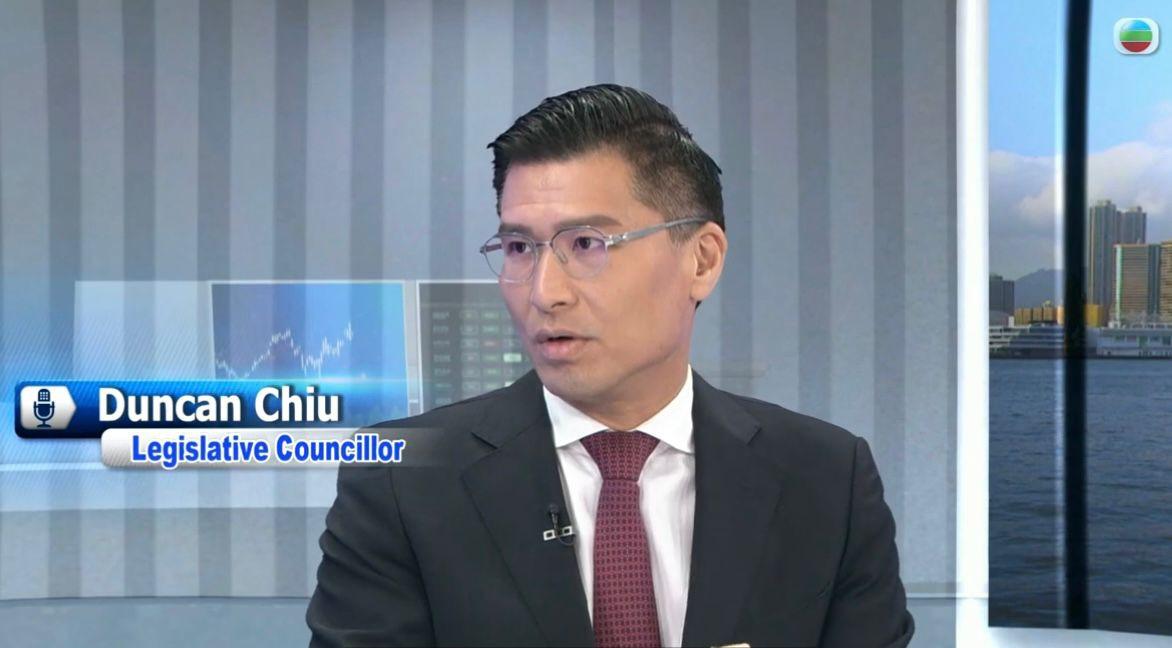 Duncan Chiu, Legislative Council member for the Technology and Innovation Constituency, attends the Straight Talk show on TVB, Oct 24, 2023. (PROVIDED TO CHINA DAILY)
Thank you for staying with us. And we have been talking with LegCo rep for the Technology and Innovation Constituency, Duncan Chiu about Web3 and digital finance and its relevance to us. So, Duncan, before the break, we have just touched on the need for regulations.
Chiu: Yep.
Chan: I mean you said before June, I mean they only released the guidelines, and then suddenly we had this JPEX happening in September. Before we go into further, there's also a term that you have mentioned today, it is blockchain. And I've read it up and it says blockchain promises greatest transparency, which is a good thing.
Chiu: Yep.
Chan: Can you explain briefly what blockchain is to the viewers, and also tell us how it helps in finance, and also anti-money laundering exercises.
Chiu: I think blockchain, we would call it a distribute ledger system, it is actually a decentralized group of computers that actually records all transactions, all data being created. So, it is a transparent and traceable system originally. And you know, of course, a lot of products being created, financial products or technology products being created under blockchain. You can store gaming events, gaming weapons, right? You can also store value products, you can also store things like, by creating NFT, you can put a mark on, let’s say, art pieces, etc. So, the way of doing blockchain is unlimited, there's a lot of high frequency transactions, like let’s say, shipping, they have been using blockchain to record a lot of their transactions. So, it is a data storing system in blockchain, where it provides transparency. And of course, you know, cryptocurrency is also one by-product of blockchain. And I think people have misconception of cryptocurrency because some kind of cryptocurrency, by the way they record the transaction of the currency itself, but then since the trading of it, you know, the buyer and seller can remain anonymous, so that becomes the things that a lot of people think there is AML (anti-money laundering) problem, there is transparency problem with Bitcoin, which is against its original propositions. So, things have developed. I think the technology will still innovate, and there's a lot of people working on traceability, what we call zero knowledge of transactions, where you can also govern, by doing anonymous transaction, but still you have some way to relate to the seller and buyer of the product.
Chan: So, Duncan, Financial Secretary, Paul Chan, has called for a proper regulatory framework for the next generation of the internet and blockchain technology. He said balanced regulations are needed to protect investors and prevent money laundering, while and still encouraging responsible and sustainable development of the sector. So, with that statement, does that mean that the regulations are not balanced, at least not sufficiently? What is your view on that?
Chiu: I totally agree what you said. One, I think the government make the stance that this, whether it is what we would call digital finance or virtual assets, this asset class is here to stay, that is one statement the government made, which I agree. This is gonna be a future development of this market, it might go even further, bigger in size. And in terms of you know, digital finance I mentioned is a basket of products, and within that, you know, what we mentioned, cryptocurrency is only a small part of that. But even that small part of that, cryptocurrency today value at about $1 trillion. And if you look at the stock market of Hong Kong, the total market capitalization of Hong Kong stock market today is $4 trillion. So, if crypto market is already $1 trillion, like 25 percent of Hong Kong market capitalization of the stock market. So, that is a huge market, and you see a lot of people participating in that. But the guideline is still not there.
Chan: Right.
Chiu: There is a global discussion of what asset class this should fall into. The US also took some legal actions against bad actors and operators platforms. There's a big dispute in the US between the two parties, how to define this asset class, whether it is a commodity, it is a product, or it is a currency. So, it is still evolving, the whole thing is evolving. But the thing is for Hong Kong, if you want to remain as a financial center, we should maybe join the debate, and look at how things evolve. And maybe it could be a huge market in the future, then we should actually be the first to legislate it and let people know, okay, how to do it legally, healthily, and let the technology and the digital asset market grow.
Chan: Right. So, as a LegCo rep for the T&I constituency, your view is very strong to say that you think the government or even the SFC should regulate this as soon as possible.
Chiu: Yes.
Chan: So, to put us in a very favorable position amongst the rest of the world.
Chiu: Right. I think that also put us in the international stage that, okay, Hong Kong is leveraging our financial technology. And with Hong Kong’s legal trustworthiness and our legal system, I think it makes sense for us to come out and say okay, we are legislating it, we look at the products, we vet the products, and we make sure everything that come out from Hong Kong is safe.
Chan: Right. Just now you mentioned it’s worth about $1 trillion, nearly one quarter of the market.
Chiu: Yep.
Chan: I mean so there must be some security challenges. How would you suggest this to be mitigated?
Chiu: I, as a venture investor for 20 years, one thing I believe is technology is always improving, you know we cannot use technology today to judge what is going to happen tomorrow. Look at AI, right? ChatGPT come out and things come into a different landscape. Same for blockchain technology, it is ever improving. Look at people … you know a few years back, people looked at the cyber security problem, where there was a lot of hacking, that happened in the cryptocurrency area, and then things improved a bit. And you know, we have people working in cybersecurity, and how to keep the assets safe, you know, put it into a wallet, you know, cold wallet, hot wallet. I think technologies have improved, and I believe if the younger generation, the future generation thinks this is a major asset class, there would be a lot of work put into it, technology will improve, and the product will only get safer. And together with legislation, that is the work we have to do to govern, or maybe bring all the good talents into this place in Hong Kong.
Chan: Right. Duncan, while you are very passionate about pushing this technology for Hong Kong, I must say that since the JPEX scandal, the HKUST has run some surveys. They have found that 12 percent and more of Hong Kong people prefer not to hold virtual assets, and only 20 percent, previously 25 percent, said they would like to hold virtual assets in the future. So, is this a case like, I will use a description like, throwing the baby out with the bath water?
Chiu: I think people misuse technology or leverage technology to do crimes all the time. We see scams everywhere, and people are now misusing, let’s say, A-share stocks or other stocks. And few years back, you look at the co-investment scheme, where we say crowdfunding. A lot of people also misused that to do illegal activities. So, I think we cannot say when we see one bad actor, we should actually stop the whole development of the industry. But like the study you just had, the researches you had, it shows that the public knowledge of technology, of innovation, and especially of blockchain and digital assets, is quite limited.
Chan: Right.
Chiu: And public education is definitely one thing we have to put more effort into, to let people understand what they are buying into.
Chan: Right. Duncan, I think what you said is very true, but having said, someone said that this JPEX scandal is a major challenge to Hong Kong on going into initiatives to deal with virtual assets. So, what can the authorities, including yourself, to regain the trust of the public?
Chiu: I think we should speed up legislation, one thing. And public education, we definitely have to do more on that. And clarify the product class, clarify what financial products should be included in Hong Kong, who can buy what, you know, some are open for retail investors, some are open for professional investors, we have to speed up the work of that. And maybe in the case of JPEX, the only lesson we learnt is before we legislate all these, we let people publicly advertise about what they were doing.
Chan: Right.
Chiu: Before government vetting it. So, I think that's one thing we have to speed up.
Chan: And one thing I have to bring up the case of JPEX again because many local retail investors were attracted through mass media advertisements, and were also influenced by social media. So, how can the authorities regulate this? This is more than just, you said, the financial world now. How can you regulate all these promotion activities?
Chiu: I think now we have the legislation in place, we should actually only let the licensed platforms to be able to provide any advertising. We now have 2 companies licensed under the virtual assets service provider, VASP or VATP, virtual assets trading platform. So, these are the licensed people, and the product that they can advertise or the product that they can provide on their platform are under discussions, and that will further clarify soon, in the months to come. And so these are the product where we should all treat as other financial products, complex products, bonds, all other ETF, etc., that we sell to citizens in Hong Kong. So, with that clarification that actually we can edge out the bad actors and products that are not legal in Hong Kong from being advertised.
Chan: Right. Duncan, I am going to ask you the last question – you know the policy address is coming out and you know we try to attract talents, and as you said, technology is something that we want. Does Hong Kong have enough talents right now to sort of compete with other major players like the Middle East, for example?
Chiu: Talent is definitely one thing I think is a big challenge to Hong Kong, we can have another episode to discuss that.
Chan: All right, sure.
Chiu: We definitely have to increase the number of talents we have in the pool in Hong Kong. We have to attract people from outside.
Chan: So, how can (John) Lee do that?
Chiu: Attract, education, and all ways of getting incentives to get talent into Hong Kong is needed.
Chan: All right, okay. Thank you, Duncan, for that eye-opening discussion on Web3 and digital finance. It is clear that this digital finance offers huge potential, but also comes with its fair share of challenges and risks. The importance of government regulation and greater public awareness is essential for responsible investing in this rapidly evolving landscape.
This week's quote I like to share with you is from Mark Zuckerberg, who said, “The biggest risk is not taking any risk..,In a world that is changing really quickly, the only strategy that is guaranteed to fail is not taking risks.” Have a good evening and see you next week!
