

Putin arrest warrant sees experts urge court to be wary of being controlled
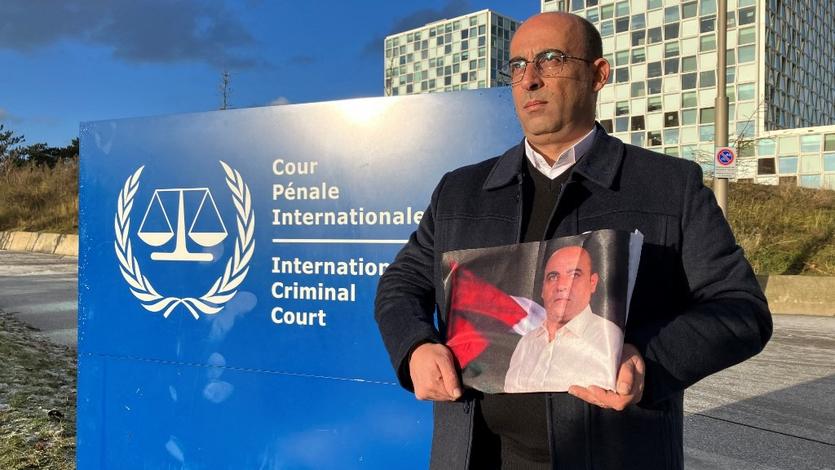 In this undated photo, Ghassan Banat, brother of late Palestinian activist Nizar Banat, holds a picture of his passed brother outside the International Criminal court (ICC). (PHOTO / AFP)
The International Criminal Court (ICC) should ensure equal treatment in holding alleged perpetrators of war crimes to account and avoid being controlled by powerful states, which may undermine the rule of law and the fight against impunity, said legal experts.
They pointed to the apparent “slow and selective investigations” into such crimes that have been widely documented in countries like Iraq, Afghanistan, and recently, in the occupied Palestinian territories.
On March 17 — three days before the 20th anniversary of the United States-led invasion of Iraq — the ICC issued arrest warrants for Russian President Vladimir Putin and Maria Lvova-Belova, the Russian Commissioner for Children’s Rights, for their alleged involvement in the unlawful deportation and transferring of Ukrainian children to Russia from Feb 24 last year — the day Putin announced a “special military operation” in Ukraine.
“In the face of selective and slow investigations of alleged war crimes in Palestine and Afghanistan, the ICC’s speedy trial of Putin begs questions about the ICC becoming an instrument in the hands of actors belonging to powerful states,” said Ahmad Ghouri, director of internationalization at the School of Law, Politics and Sociology at the University of Sussex in England.
“To promote respect for international law, the ICC must ensure equal treatment that no war crimes go unpunished. The ICC’s selective approach to certain victims and apparent lack of willingness to investigate powerful perpetrators undermines its objectives to the fight against impunity and the establishment of the rule of law,” said Ghouri.
Rasha Al Joundy, research supervisor at the Dubai Public Policy Research Centre in the United Arab Emirates, noted that the US “has been the number one power in the world”.
Hence, it is “hard to imagine a scenario” where any of the previous US administrations’ breaches in the “so-called uncivilized world” and “not the strategic West”, being investigated by the ICC, “even if they are known to the international community”, Al Joundy told China Daily.
Referring to the ICC’s arrest warrant for Putin, Al Joundy said it is a legal and psychological tactic to pressure the Russian leader.
“I believe the aim … is to isolate Putin, and limit his foreign visits by putting a legal aspect to any trip taken towards a signatory state.”
Hikmahanto Juwana, professor of International Law at Universitas Indonesia, said that attempts by ICC prosecutors to arrest Putin “are frankly odd” as Russia is not a signatory to the statute. It is also impossible for an incumbent head of state or government to be handed over to the ICC.
The court’s primary mission is to help put an end to impunity for perpetrators of the most serious crimes like genocide, crimes against humanity and war crimes.
It is not a substitute for national courts and can only intervene where a state is unable or unwilling to carry out the investigation and prosecution of perpetrators. Since 2003, the ICC has been conducting investigations into situations within its jurisdiction, such as in Uganda, Libya, Bangladesh and Myanmar.
In recent months, the ICC had completed its preliminary examinations of the situations in Ukraine and Nigeria.
Glenn Wijaya, an associate at legal firm Christian Teo & Partners in Jakarta, said that despite widespread criticism of the ICC’s performance, he does not believe that abolishing the court or having states withdraw from the Rome Statute is an effective way to advance global justice, adding that “there are other ways to hold war criminals accountable”.
China Daily had reached out to the ICC for its comments, but it had yet to reply before the paper went to press.
Leonardus Jegho in Jakarta contributed to this report.
