

People-centered system vital to development, national success, observers say
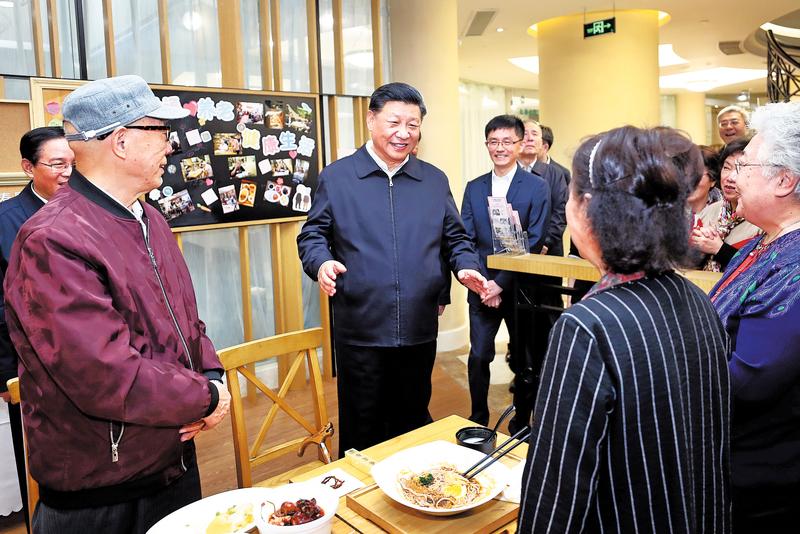 Xi Jinping talks with Shanghai residents at a community center in the city’s Hongqiao sub-district during an inspection tour on Nov 2, 2019. During that trip, Xi explained the essence of socialist and whole-process democracy to the locals. (JU PENG / XINHUA)
Shanghai resident Zhu Guoping remembers Nov 2, 2019, well because that was the day top leader Xi Jinping explained the essence of socialist democracy in China to representatives of her community for the first time.
“We are marching along the road of political development of socialism with Chinese characteristics, and our people’s democracy is a whole-process democracy,” Xi told Chinese and foreign residents participating in a consultation workshop on draft laws during his inspection of a civic center in Hongqiao subdistrict.
Whole-process people’s democracy is a system in which all key legislative decisions are made in accordance with procedures and through deliberations to make sure the decision-making system is sound and democratic, said Xi, general secretary of the Central Committee of the Communist Party of China.
Zhu serves as both a contact member for the civic center and as a local Party chief. That day she happened to shake hands with Xi three times, according to a web report by Xinmin Evening News.
“Once at his entrance, once upon departure, and then during my turn during his talk to the contact members,” she told reporters. “The general secretary is really very friendly.”
For years, the subdistrict’s contact members, including retired teacher Xia Yunlong, have been collecting opinions and ideas on local and national affairs from residents and sending them to State authorities.
Xi told the members that their work is significant as it represents the way the people are masters of the country. Zhu said she thought Xi paved the way for their work, while Xia was reported to say that Xi’s words touched their hearts, according to a People’s Daily web report.
This kind of consultation is part of preparations for the National Congress of the CPC, which convenes once every five years. This year marked the 20th Congress, and a new CPC Central Committee and CPC Central Commission for Discipline Inspection will be elected at the meeting.
Whole-process people’s democracy “is a unique model of governance”, said Mustafa Hyder Sayed, executive director at the Pakistan-China Institute. “When you talk about China, we see that whole-process people’s democracy has delivered.”
Wilson Lee Flores, an economic-political analyst and honorary chairman of the Anvil Business Club in Manila, Philippines, describes China’s progressive governance system as a “people’s democracy with Chinese characteristics” as it is a system that aims to support economic and political policies by placing people at the center.
He said the system “directly consults with and truly represents the needs, voices and aspirations of the people”, and it is “Confucian in moral values”.
Between April 15 and May 16, with the help of media, Chinese internet users had the opportunity to participate in an initiative to solicit public opinions and suggestions ahead of the Party’s 20th National Congress.
More than 8.54 million messages were collected, over 97 percent of which were submitted under real names. The participants came from various sections of society, including personnel from State organs and public institutions, employees of State-owned and private enterprises and self-employed individuals.
They spoke out on a wide range of topics, including full and strict Party governance, high-quality development, comprehensive reform and opening-up, whole-process people’s democracy, law-based State governance, socialist cultural advancement and environmental progress.
By Sept 26, the Organization Department of the CPC Central Committee said in a statement that among the 2,296 delegates, 771 — or 33.6 percent — had been elected at the grassroots level, including 192 workers, 85 farmers and 266 professional and technical personnel.
Every effort has been made to ensure that the delegates elected to attend the CPC’s 20th National Congress are broadly representative, and that the delegates include a proportion of members from the grassroots, it said.
“If we define democracy strictly in terms of decision-making that considers collective society,” said Professor Eduardo Tzili-Apango, a researcher at Mexico’s Autonomous Metropolitan University, “China then is totally a democracy.”
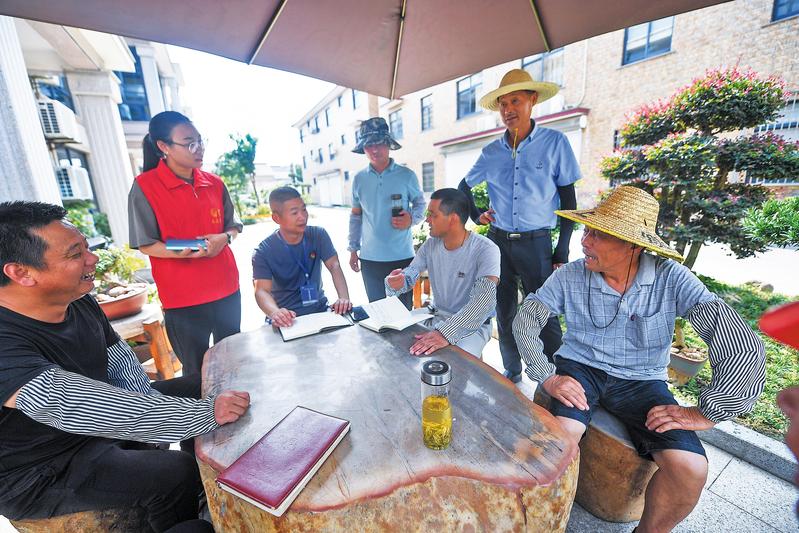 Villagers, Communist Party of China members and cadres discuss village management arrangements in Longxi village, Huzhou, in East China’s Zhejiang
province, on July 21. (XU YU / XINHUA)
Villagers, Communist Party of China members and cadres discuss village management arrangements in Longxi village, Huzhou, in East China’s Zhejiang
province, on July 21. (XU YU / XINHUA)
Consultative system
Whole-process people’s democracy is a hallmark of socialist democracy that distinguishes it from capitalist democratic systems, according to Wang Chen, vice-chairman of the Standing Committee of the National People’s Congress.
Unlike the multiparty electoral politics in many Western countries, where parties focus primarily on wooing voters with promises and defeating rivals, China’s socialist democracy runs through all processes, including elections, decision-making, management and supervision, he said.
William Jones, Washington bureau chief of US publication Executive Intelligence Review, has remarked that China has “a very dynamic democracy” which is “more open, more inclusive” than the democracy in the US.
James Chin, professor of Asian Studies at the University of Tasmania in Australia, told China Daily that the concept or version of democracy is not a question of who is right and who is wrong, but “a question of political culture or which culture you come from”.
Chin said there is “no single mode of democracy”.
“Every country has its own political culture,” he said. “If you think that you are correct, you want other people to follow you. So, the Americans like to push other people to adopt American liberal democracy because they think they are correct.”
Glenn Wijaya, an adviser to the Center for Indonesia-China Studies, said rather than passing judgment on what democracy should look like, the world ought to let China prosper under its own model at this time.
In delivering a joint statement to the 49th session of the United Nations Human Rights Council, Chen Xu, China’s permanent representative to the UN Office in Geneva, said, “The key to democracy in a country lies in whether its people are truly masters of their country and whether problems that its people face are solved.”
He noted that democracy and human rights are a common pursuit of humanity, and diversity is a fundamental feature of human society, so countries with different histories, cultures and national conditions may choose different forms of democracy.
China’s democracy has two key components: “whole process”, and “people’s democracy”.
“Whole process” means that all elements forming a democracy function and produce actual effects at all stages, according to Zhang Shuhua, director of the Socialist Democracy Research Center at the Chinese Academy of Social Sciences.
Thus, all major decisions are made through the collection of public opinion, democratic consultation at all levels, scientific and collective efforts, and proper supervision of the process.
“People’s democracy” is the life of socialism, integrating electoral democracy and consultative democracy. The first refers to the exercise of the people’s rights through elections and voting, while the latter means obtaining full consultation and seeking the greatest common ground among the people before key decisions are made and during reviews of the results.
“What stands out to me most is the fact that despite being a developing country, China successfully eradicated (extreme) poverty by … 2021,” Sayed, at the Pakistan-China Institute, said, adding that this is something “many developed countries have not been able to achieve”.
In February last year, China secured a complete victory in its fight against extreme poverty.
Over the past eight years, the final 98.99 million impoverished rural residents living under the poverty line have all been lifted out of poverty.
All 832 impoverished counties and 128,000 villages have also been removed from the poverty list, and China has met the poverty eradication goals set out in the UN’s 2030 Agenda for Sustainable Development 10 years ahead of schedule.
A World Bank report that came out in April showed that China has contributed close to three-fourths of the global reduction in the number of people living in extreme poverty.
Over the past four decades, the number of people in China with incomes below $1.90 per day — the International Poverty Line as defined by the World Bank to track global extreme poverty — has fallen by close to 800 million, the World Bank has said in a news release.
“Democracy is not truly practiced if the people’s wishes and aspirations are only properly communicated on election day and nothing else,” Wijaya, at the Center for Indonesia-China Studies, said.
“I believe that as long as the economy is booming, ethnic groups are fairly represented, people from all walks of life can express their opinions, and the ruling party is not only vying for support because it wants to win elections but also because it genuinely wants to serve the people, that is enough,” he added.
Xi has also said that whole-process people’s democracy integrates process-oriented democracy with results-oriented democracy, procedural democracy with substantive democracy, direct democracy with indirect democracy, and people’s democracy with the will of the state.
The CPC, from its birth, has been promoting democracy through generations of leadership. Both in the 2017 report to the 19th CPC National Congress and in the new report to the 20th CPC Congress, Xi noted that China’s socialist democracy is “the broadest, most genuine and most effective” of its kind.
In his address to a ceremony marking the CPC’s centenary in 2021, Xi declared, “We will develop whole-process people’s democracy.”
In the eyes of Xi and many others, if the people are awakened only for voting but are not afterward, if they are given a song and dance during campaigning but have no say after the election, or if they are favored during canvassing but are left out in the cold after the election, such a democracy “is not a true democracy”.
Paul Tembe, a South African expert on China, emphasized that “whole-process people’ democracy is a putting-people-first type of development”.
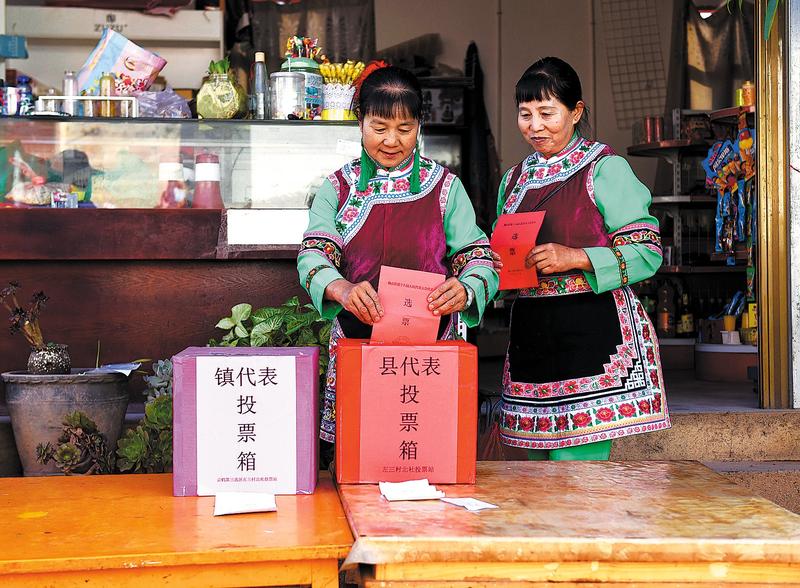 People of the Yi ethnic group in Zuosan village, Dali Bai autonomous prefecture, Yunnan province, vote to elect new deputies to the people’s congress at county and town levels in December.
(ZHANG SHULU / FOR CHINA DAILY)
People of the Yi ethnic group in Zuosan village, Dali Bai autonomous prefecture, Yunnan province, vote to elect new deputies to the people’s congress at county and town levels in December.
(ZHANG SHULU / FOR CHINA DAILY)
Grassroots involvement
China’s National People’s Congress and the Chinese People’s Political Consultative Conference National Committee also offer outsiders a great opportunity to see how whole-process people’s democracy operates.
Both the NPC and the CPPCC will begin new terms in March. During the current round of term changes, more than 2.6 million new deputies have been elected to people’s congresses in townships and county-level regions in China, following the conclusion of elections that began in the first half of last year. Nearly 150,000 more deputies were elected this time than in previous elections.
The base numbers of deputies to people’s congresses at township and county levels have both been increased to boost participation in politics.
According to statistics, 921 million voters, accounting for 86.49 percent of registered voters, cast their votes in the election of county-level people’s congress deputies.
Meanwhile, 623 million voters, accounting for 85.63 percent of registered voters, voted in the election of deputies to township-level people’s congresses.
Above all this, the congresses have built a multilayered system to connect with citizens at the grassroots level. As of last month, the Legislative Affairs Commission of the Standing Committee of the NPC had set up 32 neighborhood contact points, covering all provinces and cities nationwide. Cities and districts also set up over 5,500 contact points.
In Shanghai’s Hongqiao, where Xi first explained China’s whole-process people’s democracy, about 1,300 opinions and suggestions related to 67 laws have been collected and reported since the contact point was established seven years ago. Among these, 101 suggestions have been adopted by the NPC.
In Hunan province last year, the voting system for deputies on livelihoods achieved full coverage of 1,524 townships and was piloted in 26 county-level people’s congresses.
In Longshan county, a special industrial road 10 kilometers long was built after it was voted for by deputies.
Wijaya said one aspect that sticks out in the consultation process is how active the CPC is in obtaining public opinion.
“As a lawyer, I believe this is crucial since the rule of law only functions effectively when it accurately reflects the desires of the rational population. One illustration is the fact that whenever China intends to enact a new law or regulation, there are several drafts that are released to the public in waves,” said Wijaya, who is also an associate at Christian Teo & Partners, a corporate and commercial law firm in Jakarta, Indonesia.
“Despite the volume of public feedback obtained, the CPC moves quickly to transform it into practice and generate the law or regulation. I commend the CPC for its efficacy and efficiency in putting whole-process democracy into practice,” he said.
For Sayed, this integrated democratic process not only benefits the electoral process but society as a whole.
He said what stands out is “the ability of the largest political party in the world, the CPC” to have a “very cohesive disciplined and merit-based system of delivery” — from the prefecture level to the township level, from the city to the province, and to Beijing — as well as a coordinated response mechanism.
“And you can see that when the earthquake in Sichuan province happened (in 2010), you can see how the CPC was mobilized and the rescue efforts and rehabilitation efforts were done promptly and with high effectiveness,” Sayed said.
“So we can see … the Party system delivered very effectively, and the people of China have been given a better life.”
Now, the CPC and China as a whole have come to another crucial moment for national rejuvenation. The 20th CPC National Congress “is historic and very important to renew the vigor of China’s leadership and to strengthen the pace of reforms in a very unstable and problematic world environment,” Flores, at Anvil Business Club, said.
He added that the weak global economy “now needs a strong, courageously reformist and dynamic China” as a catalyst for world economic recovery and also as an anchor for stability.
Sayed said, “When we talk about governance or when we talk about democracy … when we talk about different models of governance, the end game of all models of governance and the purpose is to deliver to the people to make sure that the people of that nation-state or of that country are taken care of and their lives are made better.
“That is the end game, the purpose or the objective of every governance model.”
Xinhua contributed to this story.
Contact the writers at jan@chinadailyapac.com
